↙ Metals
Found to the left and towards the bottom of the periodic table. This includes Groups 1 and 2, the transition metals in the middle block, and heavy elements like lead at the bottom.
Sign up to access the complete lesson and track your progress!
Unlock This CourseYou probably already think of metals as hard, shiny things like spoons and coins. That is a good start, but chemists use a sharper test. It is all about the ions an element makes when it reacts.
Remember, an ion is an atom that has lost or gained electrons, so it has a charge. Losing electrons gives a positive ion. Gaining electrons gives a negative ion.
Key terms:
So calcium is a metal because it reacts to form Ca2+ ions. Sulfur is a non-metal because it never forms positive ions. When it reacts with a metal it forms S2- ions instead.
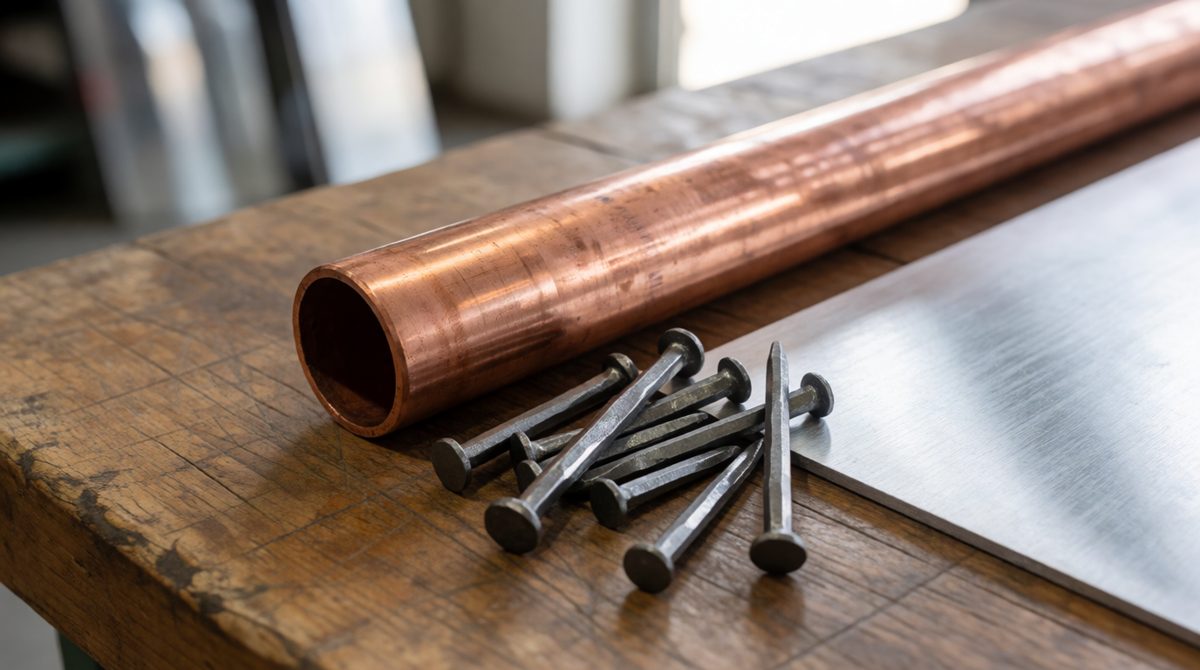
Most elements are metals, like the copper, iron and aluminium here - they sit on the left and bottom of the periodic table
The majority of elements are metals. If you shade every metal on a periodic table, most of the table is covered.
Found to the left and towards the bottom of the periodic table. This includes Groups 1 and 2, the transition metals in the middle block, and heavy elements like lead at the bottom.
Found towards the right and top of the periodic table. This includes elements like carbon, nitrogen, oxygen, the Group 7 elements and the Group 0 elements.
Many printed periodic tables show a zig-zag "staircase" line running from boron down towards the bottom right. Metals are to the left of the line and non-metals are to the right.
Remember, the group number tells you the number of outer electrons, and atoms react to get a full outer shell. Now put those two ideas together.
Most metals have 1, 2 or 3 outer electrons. It takes much less energy to lose a few electrons than to gain five or more. So these atoms lose their outer electrons and become positive ions. The shell underneath is already full.
Most non-metals have 4 to 7 outer electrons. Losing all of them would be far too hard. Instead they gain electrons from metals to form negative ions, or share electrons with other non-metals. Group 0 already has full shells, so its elements hardly react at all.
Here are two examples:
A few heavy metals near the bottom, such as lead, have 4 outer electrons but still lose electrons to form positive ions. This is why the metal area reaches further right lower down the table.
Both calcium and sulfur ions end up with a full outer shell. The difference is the direction the electrons move. You will see how metal and non-metal ions join together in Ionic Bonding.
The spec wants you to explain how the reactions of an element depend on its electrons, and so on its atomic number. The chain of reasoning is always the same:
Element with atomic number 3. It has 3 electrons, so the structure is 2,1. One outer electron, so it is in Group 1 on the far left. It loses that electron to form a 1+ ion. It is a metal (lithium).
Element with atomic number 7. It has 7 electrons, so the structure is 2,5. Five outer electrons, so it is in Group 5 on the right. It needs 3 more for a full shell, so with a metal it gains 3 electrons to form a 3- ion. It is a non-metal (nitrogen).
Element with atomic number 17. Structure 2,8,7. Seven outer electrons, so it gains 1 electron to form a 1- ion. It is a non-metal (chlorine).
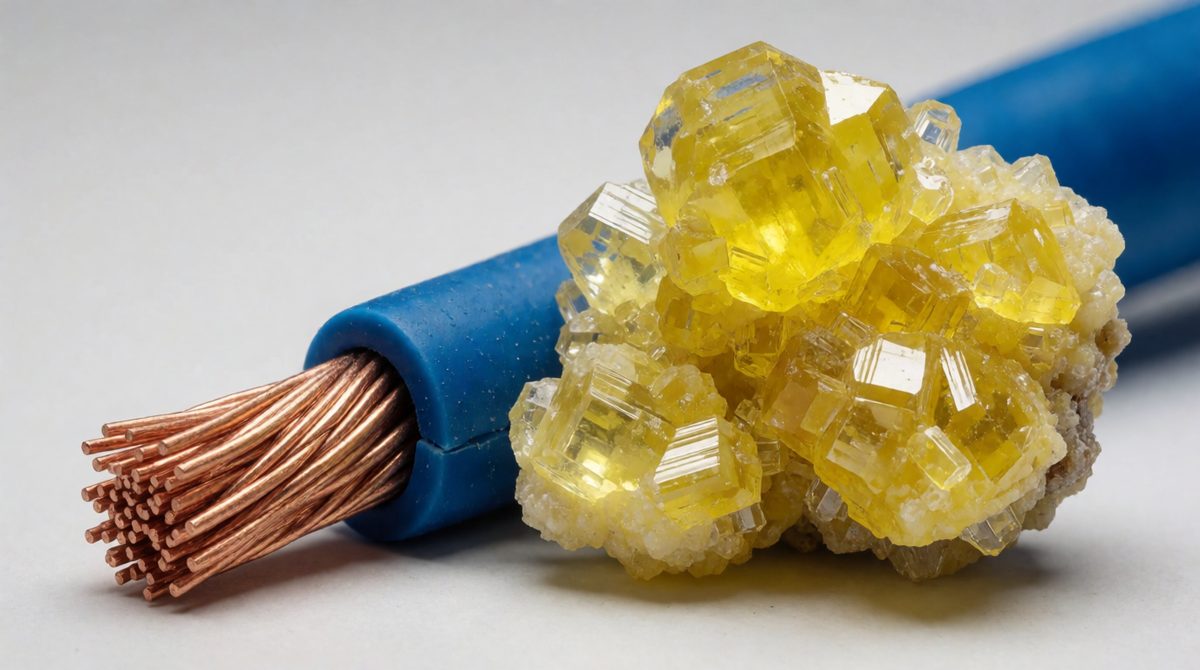
Shiny and great at conducting electricity - that's why copper is the metal inside nearly every wire, while non-metals like sulfur are dull and brittle
Physical properties are things you can observe or measure without changing the substance. Typical differences are:
Everyday examples: copper is used for electrical wires because it conducts well and can be drawn into wires. Sulfur is a yellow, brittle solid that does not conduct.
These are typical properties and there are exceptions. Mercury is a metal but a liquid at room temperature. Bromine is a non-metal that is also a liquid. Carbon as graphite conducts electricity, and carbon as diamond has a very high melting point. Why metals have their properties is explained in Metallic Bonding and Properties of Metals and Alloys.
Chemical properties describe how an element reacts. This is where the definition really shows.
Metals form positive ions. Non-metals form negative ions when they react with metals, or share electrons when they react with other non-metals.
Metal oxides are bases: they react with acids, and those that dissolve in water make alkaline solutions. Non-metal oxides, like sulfur dioxide, dissolve in water to make acidic solutions.
A metal reacting with a non-metal makes an ionic compound. Two non-metals reacting make a compound of molecules held by shared electrons.
Physical properties have exceptions, so the chemical test is more reliable. Graphite conducts, but carbon never forms positive ions, so it is still a non-metal.
"Metals gain electrons to become positive." No. Electrons are negative, so losing them leaves a positive ion.
"It conducts electricity, so it must be a metal." Not always. Graphite conducts and is a non-metal. Use the ion test.
Mixing up left and right. Metals are on the left and bottom. Non-metals are on the right and top.
Element A has the electronic structure 2,8,3. Element B has the electronic structure 2,8,7.
(a) Which element is a metal? Explain your answer in terms of electrons. [3 marks]
(b) Give two physical properties you would expect element B to have. [2 marks]
(a) Element A is the metal (1). It has 3 outer electrons, which it loses when it reacts (1), so it forms positive ions, 3+ ions (1).
(b) Any two from: low melting and boiling point (or a gas at room temperature); poor conductor of electricity; poor conductor of heat; dull; brittle if solid (1 mark each).
When asked to explain metal or non-metal "in terms of electrons", always say three things: how many outer electrons, whether they are lost or gained, and the charge of the ion formed.