Glass
Most of the glass we use is soda-lime glass. It is made by heating a mixture of sand, sodium carbonate and limestone. You find it in windows and bottles.
Borosilicate glass is made from sand and boron trioxide. It melts at a higher temperature than soda-lime glass. That makes it a good choice for things that get very hot, such as oven dishes and laboratory glassware.
Key terms:
- Soda-lime glass: the common glass made from sand, sodium carbonate and limestone.
- Borosilicate glass: glass made from sand and boron trioxide, which melts at a higher temperature.
Clay ceramics

Clay is shaped wet then heated in a kiln, making pottery that is hard but brittle
Clay ceramics include pottery and bricks. They are made by shaping wet clay and then heating it in a furnace. After heating, the clay is hard and keeps its shape.
Ceramics are usually hard, but they are brittle. They snap or smash instead of bending. That is why a dropped mug shatters.
Polymers: the same monomer, different properties
The properties of a polymer depend on two things: which monomers it is made from, and the conditions it is made under. (How polymers are made is in Addition Polymerisation.)
Ethene can make two different kinds of poly(ethene). The difference comes from the conditions.
🛍 Low density (LD) poly(ethene)
Made at a high temperature and a very high pressure. The chains have side branches, so they cannot pack closely. The forces between chains are weaker. It is soft, flexible and has a lower melting point. Used for carrier bags and squeezy bottles.
⚙ High density (HD) poly(ethene)
Made at a lower temperature and pressure, using a catalyst. The chains have very few branches, so they pack closely together. The forces between chains are stronger. It is stiffer, stronger and has a higher melting point. Used for milk crates and buckets.
Both are made from ethene. Only the conditions change, and so the structure of the chains changes.
Key terms:
- LD poly(ethene): poly(ethene) with branched chains. It has a low density.
- HD poly(ethene): poly(ethene) with mostly straight chains. It has a high density.
Thermosoftening and thermosetting polymers
Polymers also behave differently when heated.
🔥 Thermosoftening
These polymers melt when they are heated. They are made of separate chains held together by weak intermolecular forces. Heat breaks these forces, so the chains slide past each other. When cooled, the polymer sets again. Poly(ethene) is an example.
🔒 Thermosetting
These polymers do not melt when they are heated. Their chains are joined to each other by strong covalent bonds, called cross-links. These make one big linked structure. The bonds stay in place when heated. Bakelite is an example.
Common mistakes
Do not say a thermosetting polymer has "stronger intermolecular forces". Its chains are joined by covalent bonds (cross-links). Do not say a thermosoftening polymer has no strong bonds. The atoms inside each chain are covalently bonded, but only weak forces hold one chain to the next.
Composites
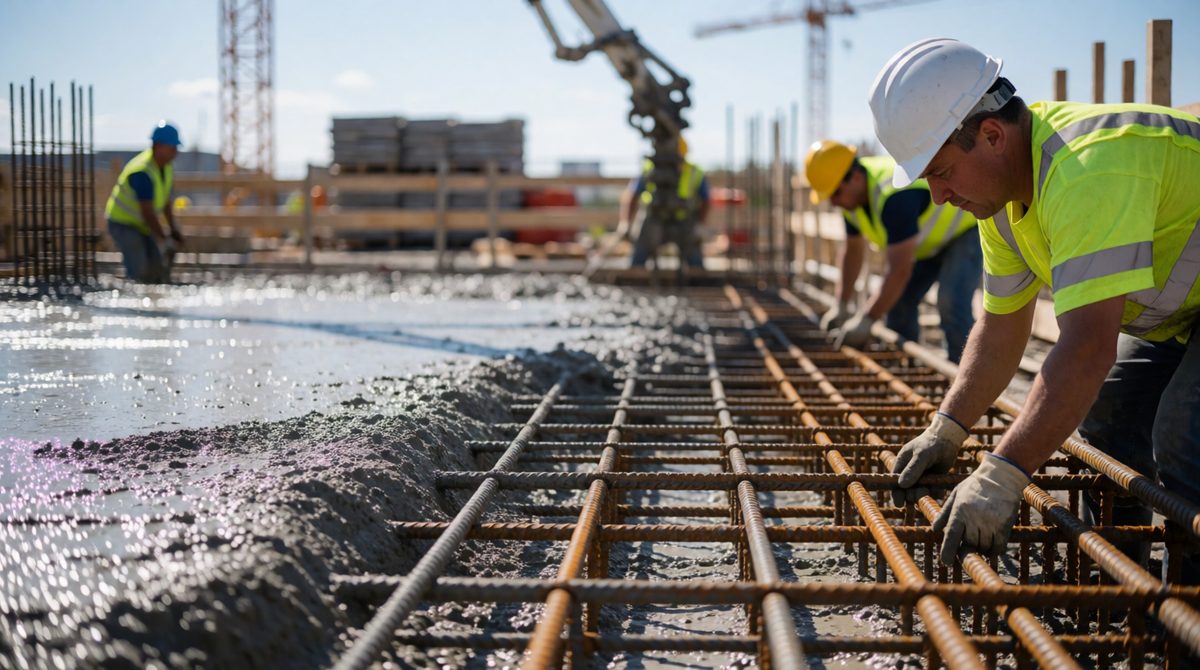
Concrete is a composite: cement binds the gravel, and the steel rebar here adds even more strength
Most composites are made of two materials. One material is the matrix (or binder). It surrounds and binds together fibres or fragments of the other material. The other material is called the reinforcement.
Key terms:
- Composite: a material made of a matrix with a reinforcement in it.
- Matrix (binder): the material that surrounds and holds the reinforcement.
- Reinforcement: the fibres or fragments held in the matrix.
Examples you should recall:
- Fibreglass: glass fibres in a plastic matrix. Light and strong, used in boat hulls.
- Carbon fibre: carbon fibres in a plastic matrix. Very strong and light, used in bike frames.
- Concrete: sand and gravel (fragments) in a cement matrix. Used in buildings and roads.
A composite combines the best properties of both materials. The fibres are strong but can snap on their own. The matrix holds them in place and shares out the force.
Comparing materials and choosing one
You may be given a table of data and asked to compare materials. Look at the numbers, use the units, and link each property to the use.
| Material | Density (g/cm3) | Melting point (°C) | Conducts electricity? |
|---|
| W | 2.5 | about 1,000 | No |
| X | 8.9 | 1,085 | Yes |
| Y | 0.95 | 130 | No |
| Z | 1.6 | does not melt | No |
Worked example
Which material is a metal? X. It conducts electricity and has a high melting point. Which is a thermosetting polymer? Z, because it does not melt. Which is a thermosoftening polymer? Y, because it has a low melting point. How many times denser is X than Y? 8.9 ÷ 0.95 = about 9.4 times.
Some general patterns help when choosing:
- Metals: strong, conduct electricity, can be bent and shaped.
- Glass and ceramics: hard, high melting points, brittle, do not conduct electricity.
- Polymers: low density, easy to shape, do not conduct electricity.
- Composites: can be made light and strong together.
For example, a saucepan handle needs a material that does not melt and does not conduct electricity or heat well. A thermosetting polymer is a good choice. A bike frame needs to be strong and light, so carbon fibre is a good choice.
Exam-style question
A company makes a kettle handle. Explain why a thermosetting polymer is better than poly(ethene) for the handle. Poly(ethene) is a thermosoftening polymer. (3 marks)
Model answer
A thermosetting polymer does not melt when heated, because its chains are joined by strong covalent cross-links. Poly(ethene) has weak forces between its chains, so it would soften and melt when heated. A kettle handle gets warm, so it must not melt.
Exam tip
When asked to explain a difference in melting, always talk about the structure: separate chains with weak forces, or chains joined by cross-links.