The Haber Process and Fertilisers » NPK Fertilisers
What you'll learn this session
Study time: 30 minutes
AQA spec: 4.10.4.2
- Why crops need nitrogen, phosphorus and potassium, and what NPK fertilisers are
- How ammonia is used to make ammonium salts and nitric acid
- How phosphate rock is turned into a useful fertiliser, and the salts made
- How making a fertiliser in industry compares with making it in the lab
🔒 Unlock Full Course Content
Sign up to access the complete lesson and track your progress!
Unlock This CourseWhy plants need fertilisers

Each harvest takes nitrogen, phosphorus and potassium out of the soil, so farmers put them back with fertiliser
Crops take nitrogen, phosphorus and potassium out of the soil as they grow. When the crop is harvested and taken away, those elements go with it. If nothing is put back, the soil runs short and the next crop does badly.
Farmers add fertilisers to put the elements back. This improves agricultural productivity, which means more food from the same field. Plants can only take these elements in from the soil when they are in soluble compounds, because they absorb them dissolved in water.
Key terms:
- Fertiliser: a compound added to soil to replace the elements that crops have used up.
- NPK fertiliser: a fertiliser that contains compounds of all three elements: nitrogen (N), phosphorus (P) and potassium (K).
What is an NPK fertiliser?
The letters come from the chemical symbols: N for nitrogen, P for phosphorus and K for potassium. An NPK fertiliser is a mixture of several different salts, blended so that it contains the right percentages of the three elements. You can see these numbers on a bag of plant food.
Industrial production of NPK fertilisers uses a variety of raw materials in several linked (integrated) processes. Each element comes from its own source.
🌿 Nitrogen
Made from ammonia, which is made in the Haber process. Ammonia is turned into ammonium salts and nitric acid.
⛯ Phosphorus
Comes from phosphate rock, which is mined. The rock is treated with acid to make soluble salts.
⚒ Potassium
Potassium chloride and potassium sulfate are obtained by mining.
Using ammonia to make nitrogen compounds
Ammonia is the starting point for the nitrogen in fertilisers. It can be used to make ammonium salts and nitric acid.
Ammonia is a base, so it reacts with acids in a neutralisation reaction to make ammonium salts:
- ammonia + nitric acid → ammonium nitrate
- ammonia + sulfuric acid → ammonium sulfate
- ammonia + phosphoric acid → ammonium phosphate
In symbols: NH3 + HNO3 → NH4NO3
Ammonium salts are soluble, so plants can take up the nitrogen from them. Ammonia is also used to make nitric acid, which is needed for making nitrate fertilisers and for treating phosphate rock (see below).
Key terms:
- Ammonium salt: a salt that contains the ammonium ion, NH4+, made when ammonia reacts with an acid.
Phosphate rock cannot be used directly
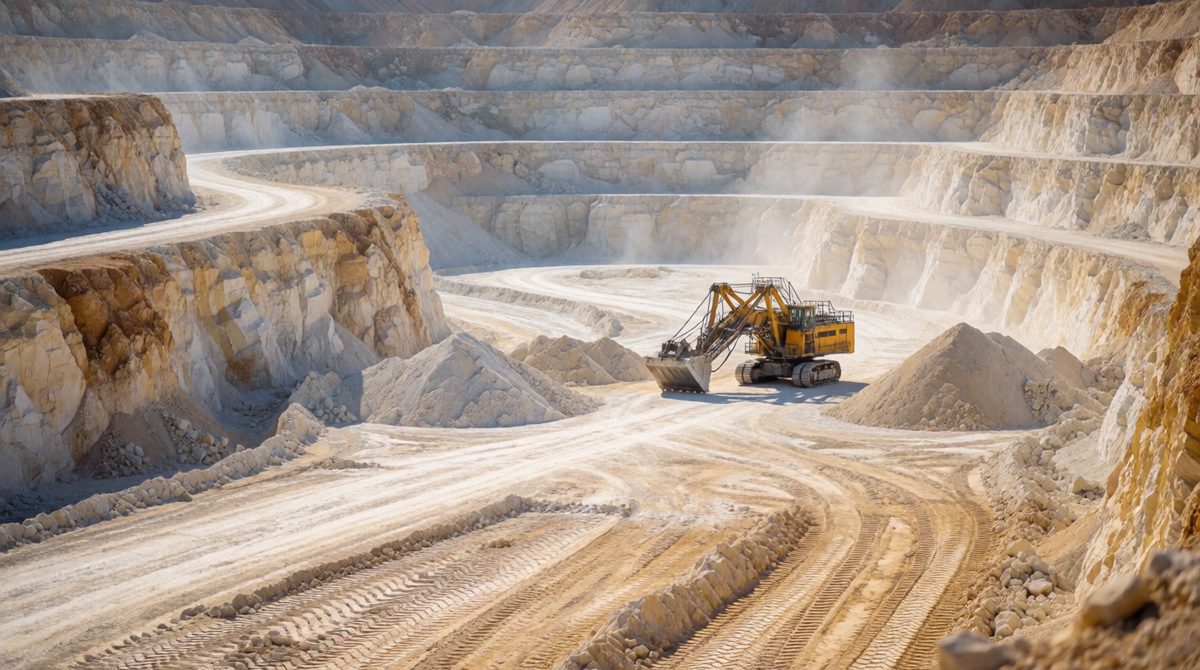
Phosphate rock won't dissolve, so it's treated with acid to make salts plant roots can take in
Phosphate rock is mined. It contains phosphate compounds, but they do not dissolve in water. Plant roots cannot absorb a solid that will not dissolve, so phosphate rock cannot be used directly as a fertiliser.
To fix this, the rock is treated with acid. This makes salts that are soluble. The spec uses three acids, and you need to recall the salts produced from each:
⚗ Nitric acid
Phosphate rock + nitric acid makes phosphoric acid and calcium nitrate.
⚗ Sulfuric acid
Phosphate rock + sulfuric acid makes calcium sulfate and calcium phosphate.
⚗ Phosphoric acid
Phosphate rock + phosphoric acid makes calcium phosphate.
The soluble products can then be used in fertilisers. The phosphoric acid made from nitric acid can also be reacted with ammonia to make ammonium phosphate, which gives both nitrogen and phosphorus in one salt.
Common mistakes
Writing that phosphate rock can be spread straight onto fields. It cannot, because it is not soluble. Another slip is mixing up which acid makes which salt. Nitric acid always gives a nitrate, and sulfuric acid always gives a sulfate. The name of the acid tells you the name of the salt.
Putting an NPK fertiliser together
Think of an NPK fertiliser as a recipe. A factory can blend, for example, ammonium nitrate or ammonium sulfate (for nitrogen), a soluble phosphate salt (for phosphorus) and potassium chloride or potassium sulfate (for potassium). By changing the amounts, the factory makes a formulation with the percentages a crop needs.
Industrial and laboratory production compared
Ammonium sulfate is a good example, because it can be made both ways. The chemistry is the same: ammonia reacts with sulfuric acid.
2NH3 + H2SO4 → (NH4)2SO4
In the laboratory (the required practical to prepare an ammonium salt):
- Measure a fixed volume of ammonia solution into a flask and add a few drops of indicator.
- Add dilute sulfuric acid from a burette until the indicator changes colour. This finds the volumes that react exactly.
- Repeat with no indicator, so the salt is not contaminated.
- Heat gently to evaporate some of the water, then leave the solution to cool so crystals form.
- Filter off the crystals and dry them.
In industry the same reaction is done on a very large scale. Raw materials arrive in bulk, the reaction runs in large vessels as part of a linked series of processes, and the process runs continuously to make tonnes of fertiliser.
| Feature | Laboratory | Industry |
|---|---|---|
| Scale | Small, a few grams | Very large, tonnes |
| How it runs | One batch at a time | Continuous, in linked processes |
| Equipment | Glassware: burette, flask, filter funnel | Large reaction vessels and plant |
| Purpose | Show the method and make a pure sample | Make a product to sell at low cost |
| Raw materials | Small amounts of ammonia solution and dilute sulfuric acid | Bulk ammonia (from the Haber process), acids, mined rock and potassium salts |
The exam may give you information about both methods and ask you to compare them. Look for differences in scale, raw materials, equipment and how the process runs.
Worked example
A student makes ammonium sulfate in the lab and gets crystals. A company makes the same compound in a factory. Give two differences.
Answer: the student makes a small amount in one batch, using glassware, while the factory makes tonnes continuously in large vessels. Both make the same compound, because the reaction is the same.
Exam-style question
Phosphate rock is mined. Explain why it cannot be used directly as a fertiliser, and name the salts produced when it is treated with sulfuric acid. (3 marks)
Model answer
(1) It is not soluble in water. (2) So plants cannot take it up through their roots. (3) Treating it with sulfuric acid makes calcium sulfate and calcium phosphate.
Exam tip
Learn the three acids as a set: nitric acid gives phosphoric acid and calcium nitrate, sulfuric acid gives calcium sulfate and calcium phosphate, and phosphoric acid gives calcium phosphate.