Scientific Thinking » How Science Works
What you'll learn this session
Study time: 30 minutes
AQA spec: WS 1.1 to WS 1.6
- How scientific ideas change when new evidence turns up
- How scientists use models, and what models cannot show
- What science can and cannot answer, including ethical questions
- How to weigh up risks and benefits, and why peer review matters
🔒 Unlock Full Course Content
Sign up to access the complete lesson and track your progress!
Unlock This CourseHow scientific ideas change
Science is not a list of facts that never change. Scientists use evidence to build explanations. When new evidence does not fit an explanation, the explanation has to change. This is how scientific methods and theories develop over time.
A good example is burning. In the 1700s many scientists believed in the phlogiston theory. It said that burning released a substance called phlogiston into the air. Careful experiments showed that metals get heavier when they burn in air. That was hard for the phlogiston theory to explain. Antoine Lavoisier explained the results by saying the metal was combining with part of the air, which we now call oxygen. His idea explained the mass gain and other results better, so it replaced the old theory.
The same thing happens today. A theory is accepted for as long as it explains all the evidence we have. If new data does not support it, scientists change it or replace it. (The story of how the model of the atom changed is in the lesson Developing the Model of the Atom.)
Key terms:
- Evidence: data from experiments or observations that is used to support or reject an idea.
Does the data support the theory?
You may be asked to decide if some data supports a theory. Ask two questions. Does the data match what the theory predicts? Does any of it disagree? A theory that predicts metals lose mass when they burn is not supported by data showing they gain mass.
Using models
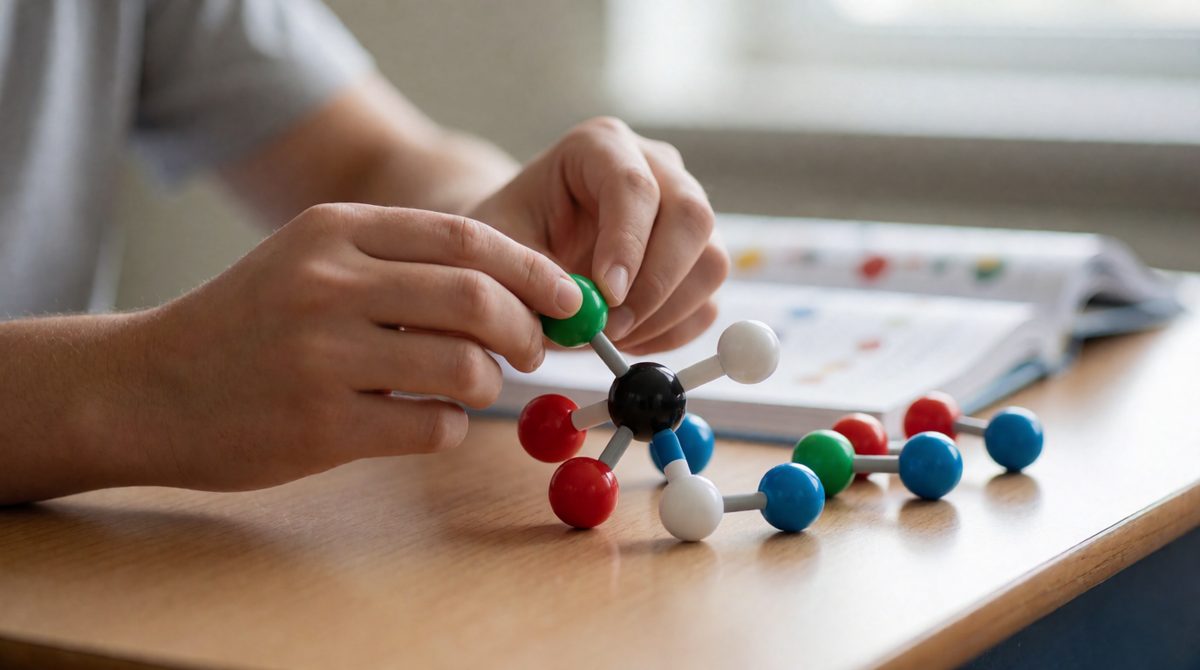
A ball-and-stick model makes tiny molecules big enough to hold - useful, but real atoms aren't coloured balls
A model is a simplified way of showing or explaining something that is too big, too small or too complicated to see directly. Scientists use several types:
✎ Representational and spatial
Diagrams, drawings and 3D models, such as a molecular model kit built from balls and sticks.
✉ Descriptive
An explanation in words or an analogy, such as comparing a reaction to people colliding in a crowd.
⚙ Computational and mathematical
Computer software and equations that make predictions, such as a weather forecast or an equation linking mass and moles.
Models are used to solve problems, make predictions and explain facts, both familiar and unfamiliar. In an exam you may be asked to:
- recognise, draw or interpret a diagram;
- turn data into a representation, such as a table into a graph;
- use a model to explain something, or match features of the model to experimental results;
- use a model to make a prediction or calculate a quantity, or show where the model fails.
Every model has limitations. A model kit does not show that atoms are constantly moving. A computer model only gives good predictions if the data fed into it is good. A model can be tested by observation or experiment: scientists use it to make a prediction, do the experiment and see if the result matches. If it does not, the model must be improved.
The power and limits of science
Science can answer questions that can be tested with data, such as "How much of this pollutant is in the river?" It has led to medicines, new materials and cleaner fuels.
Science needs data to answer a question. But science cannot always give an answer, because data may be:
- uncertain: measurements are never perfect;
- incomplete: nobody has collected enough yet;
- not available: it may be impossible or too expensive to collect.
Science also cannot decide what is right or wrong. New technologies raise ethical issues. For example, a company may be able to make a useful chemical cheaply, but the process might harm a local river. Science can show the harm. People must decide whether the benefit is worth it.
A simple ethical argument
State the technology, give one reason for it and one reason against it, then say whose rights or welfare are affected. For example: "A new pesticide protects crops and keeps food cheap, but it may harm wild bees. Farmers and shoppers gain, but wildlife and future generations could lose."
Everyday and technological applications
Science is used in everyday life and in technology. When a new application appears, we should evaluate its personal, social, economic and environmental effects, then make a decision using the evidence and the arguments.
Worked example: leaded petrol
Compounds of lead were once added to petrol so engines ran more smoothly. In the UK the sale of leaded petrol was banned from the year 2000.
Personal: lead is poisonous and harms health, especially in children.
Social: cleaner air in towns and cities benefits everyone.
Economic: oil companies and car makers had to change their products, which cost money.
Environmental: lead from exhausts spread into air, soil and water.
The harm to health and the environment outweighed the extra cost, so leaded petrol was phased out.
The spec also asks you to describe and evaluate, using data, methods to tackle problems caused by human impacts on the environment. A good example is the ozone layer. Data from Antarctica in the 1980s showed the ozone layer was thinning, and chemicals called CFCs were linked to the loss. Countries agreed in 1987 to phase them out (the Montreal Protocol). Later measurements showed that CFC use fell after the agreement and that the Antarctic ozone hole has started to shrink, so the method is working. To evaluate a method, ask: what does the data show, what does it cost, and what are the side effects?
Evaluating risk
A hazard is something that could cause harm. A risk is the chance that the hazard actually causes harm. New technologies have hazards, and these must be weighed against the benefits. Risk matters in the lab too, as you saw in the practical lessons, and in the wider world.
People often see risk very differently from the measured risk. Reasons include:
- Voluntary or imposed: people accept risks they choose (such as taking up a dangerous sport) more easily than risks forced on them (such as a factory built nearby).
- Familiar or unfamiliar: everyday risks, such as travelling by car, feel smaller than new ones, even if the car is more dangerous.
- Visible or invisible: a hazard you can see feels worse than one you cannot see or smell.
Peer review and communicating results

Sharing results lets peers check the work - peer review helps catch false claims
When scientists finish an investigation, they report it so that other experts (their peers) can check it. This is called peer review. It helps to detect false claims and to build agreement (a consensus) about which claims should be accepted as valid.
Scientists share results with different audiences: other scientists, the public, and decision makers. Reports in newspapers, on social media or on TV are not peer reviewed. They may be oversimplified, inaccurate or biased, so be careful what you trust.
Common mistakes
Saying a model is "wrong" because it has limits (every model has limits; a good model is useful for its purpose). Saying science can prove what is morally right (science gives evidence, people make the ethical decision). Treating a news story as reliable because it mentions a "study".
Exam-style question
A newspaper reports that a new nanoparticle spray can clean polluted ponds. Give two reasons why you should not accept the claim straight away, and describe how scientists could check it.
Model answer
The article is not peer reviewed, so it may be oversimplified, inaccurate or biased (1). The data may be incomplete or uncertain, so it may not show the spray is safe or that it works (1). Scientists could publish the results so other experts can review them (1) and repeat the experiments to see if they get the same results (1).
Exam tip
When asked to evaluate, give a point for AND a point against, then finish with a decision backed by evidence.