✎ Independent
The variable the investigator changes or selects. Only change one.
Sign up to access the complete lesson and track your progress!
Unlock This CourseScience often starts with an observation. A hypothesis is a possible explanation for it, and it must be something you can test with an experiment. In the exam you may be given some observations or data and asked to suggest a hypothesis. You use what you already know about chemistry (a scientific theory) to explain what you see.
Example: a student notices that bikes left by the sea rust faster than bikes kept inland. A good hypothesis is: "Salt in sea air makes iron rust faster." It gives a reason, and we can test it by comparing iron nails in salty water and in pure water.
A hypothesis is not just a guess. It uses a theory or earlier evidence, and it makes a prediction that an experiment can support or disprove.
Key terms:
You may plan an experiment to make observations, to make or identify a substance, to test a hypothesis, to check data or to explore something new. Whatever the purpose, a good plan describes a procedure that someone else could follow. It says what to measure, which apparatus to use, how many readings to take and how to stay safe.
A good plan manipulates one thing and controls the rest. That is why we need three kinds of variable.
The variable the investigator changes or selects. Only change one.
The variable that is measured for each change in the independent variable.
Variables kept the same, so they cannot affect the result.
We keep control variables the same so that any change in the dependent variable must be caused by the independent variable. If two things change at once, you cannot tell which one caused the effect.
Hypothesis: sugar dissolves faster in hotter water.
Independent variable: the temperature of the water (for example 20, 40, 60 and 80 °C).
Dependent variable: the time taken for the sugar to dissolve.
Control variables: the mass of sugar, the volume of water, the way and speed of stirring, and the type of sugar (caster or lumps).
If one test used lumps and another used caster sugar, the comparison would not be fair.
Examiners also ask you to explain why a procedure is well designed. Link each feature to its job. For example: "The same volume of water is used each time so that it does not affect how fast the sugar dissolves."
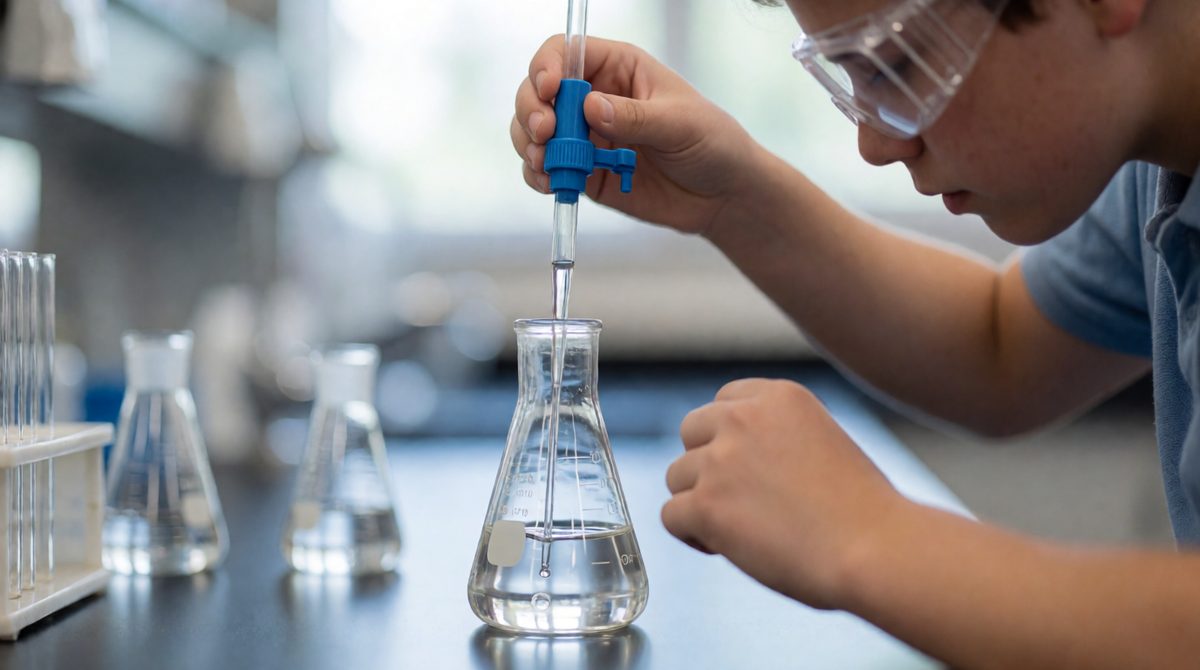
A pipette delivers one exact volume, much more accurate than a measuring cylinder
Pick the apparatus that does the job well, and say why. The best choice depends on how accurately you need to measure.
A measuring cylinder is fine for rough volumes. A pipette gives one exact volume (such as 25.0 cm3). A burette measures a changing volume very precisely. A beaker is only for holding liquids, as its markings are not accurate.
Mass: a balance. Temperature: a thermometer or temperature probe. Time: a stopwatch. Gas volume: a gas syringe or a measuring cylinder over water. Heating gently: a water bath.
A good answer to "select the apparatus and explain why" names the item and gives a reason, such as "a stopwatch, because the dissolving time needs to be measured in seconds".
Before you start, identify the main hazards in the practical. Then suggest ways to reduce the risk of harm. Match each method to its hazard.
Handling apparatus correctly also matters. Read volumes at eye level, zero the balance before weighing, and hold a test tube at an angle with the open end pointing away from people.
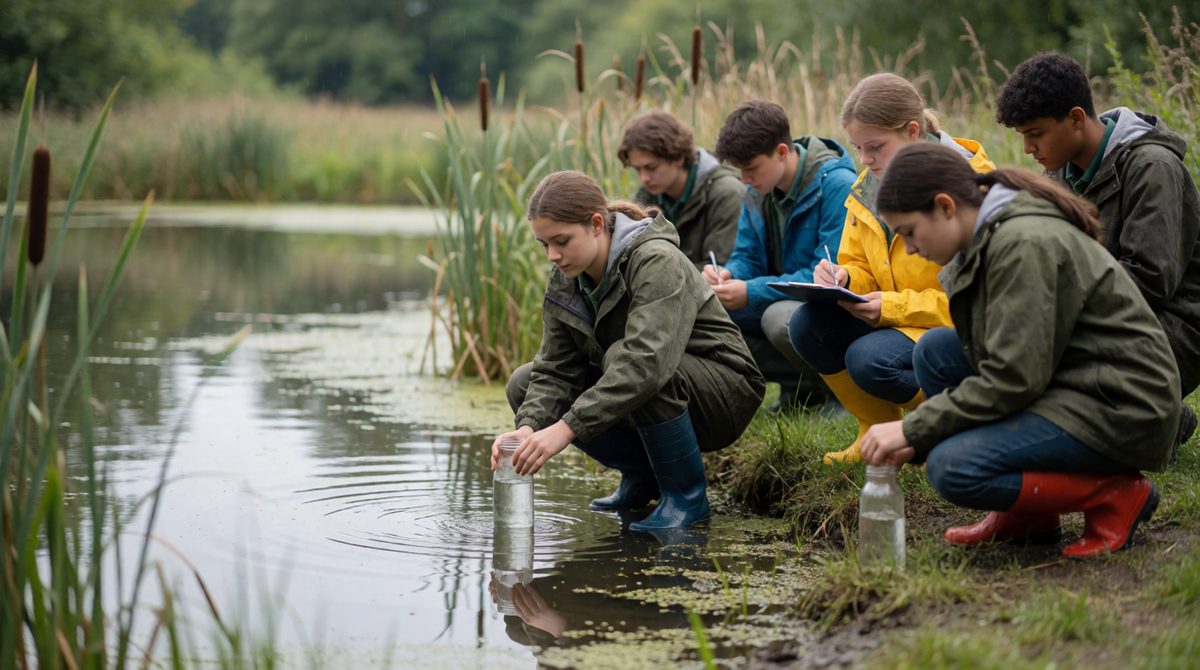
Sampling a pond from several spots gives a representative sample, not just one cup from the edge
Sometimes you cannot test everything, so you take a sample. A sample is representative if it reflects the whole thing. A poor sample gives misleading results.
Example: to test the water in a large pond, one cup from the edge is not enough. A better technique is to collect water from several places and depths, then test each one (or mix them). For a solid such as soil or a powder, take small amounts from different places, then mix them together before testing. Choosing the spots at random avoids picking only the places that give the answer you hope for.
Look at the context in the question. Say where you sample, how many samples you take and why.
Look carefully at the scale. Work out what each small division is worth before you read it. Record the value to the same number of decimal places as the scale allows, and always include the unit. Write results in a table as you go, with the units in the column headings, not in every box.
Observations count too. Record what you see, such as colour changes, bubbles or a solid forming, using clear words.
1. Changing more than one variable at once.
2. Saying "keep everything the same" instead of naming the control variables.
3. Mixing up the dependent variable with the independent variable.
4. Saying "wear safety equipment" without saying which equipment and why.
5. Taking a sample from just one place and calling it representative.
After an experiment, judge how good it was. You should be able to assess whether the measurements were sufficient and precise, and whether the method is valid.
Key terms:
To improve a method, you might:
You can also suggest a further investigation. If sugar dissolves faster in hot water, you could ask whether stirring changes the time, or whether salt behaves the same way.
A student investigates how the temperature of water affects the time for a fizzy vitamin tablet to stop fizzing. She drops one tablet into 100 cm3 of water at 10 °C and times it. She repeats this with a smaller tablet at 30 °C and then a crushed tablet at 60 °C. She uses a beaker to measure the water.
(a) Name the independent variable and the dependent variable. (2 marks)
(b) Give two problems with her method, apart from how she measures the water. (2 marks)
(c) Suggest one safety precaution and one way to improve the accuracy of the volume. (2 marks)
(a) Independent variable: the temperature of the water. Dependent variable: the time taken for the tablet to stop fizzing.
(b) She changed the size and form of the tablet as well as the temperature, so the test is not fair (not valid). She only took one reading at each temperature, so the results are not repeated or precise.
(c) Wear eye protection in case the tablet splashes. Use a measuring cylinder instead of a beaker to measure the water.
For "explain" questions, give a reason after each point. Use words such as "so", "because" and "therefore" to link your answer to the aim of the experiment.