⚖ Mass
Found with a balance. Units: kg, g or mg.
Sign up to access the complete lesson and track your progress!
Unlock This CourseChemistry has its own vocabulary. Words like reactant, product, mixture and compound have exact meanings. In an exam, a loose answer such as "the chemical goes away" loses marks, but "the reactant is used up" earns them. Use the correct term every time, and use the definitions you have met in this course. This applies to every topic, including the required practicals.
Chemists also name substances in a standard way. The international system is called IUPAC nomenclature. It means a chemist in any country uses the same name for the same substance. For example, we write sodium chloride, not "salt", and ethanol, not "alcohol" or "spirits". Note the spelling of sulfur: sulfuric acid and copper sulfate use an f. Only use a common name when the question uses it first.
Key terms:
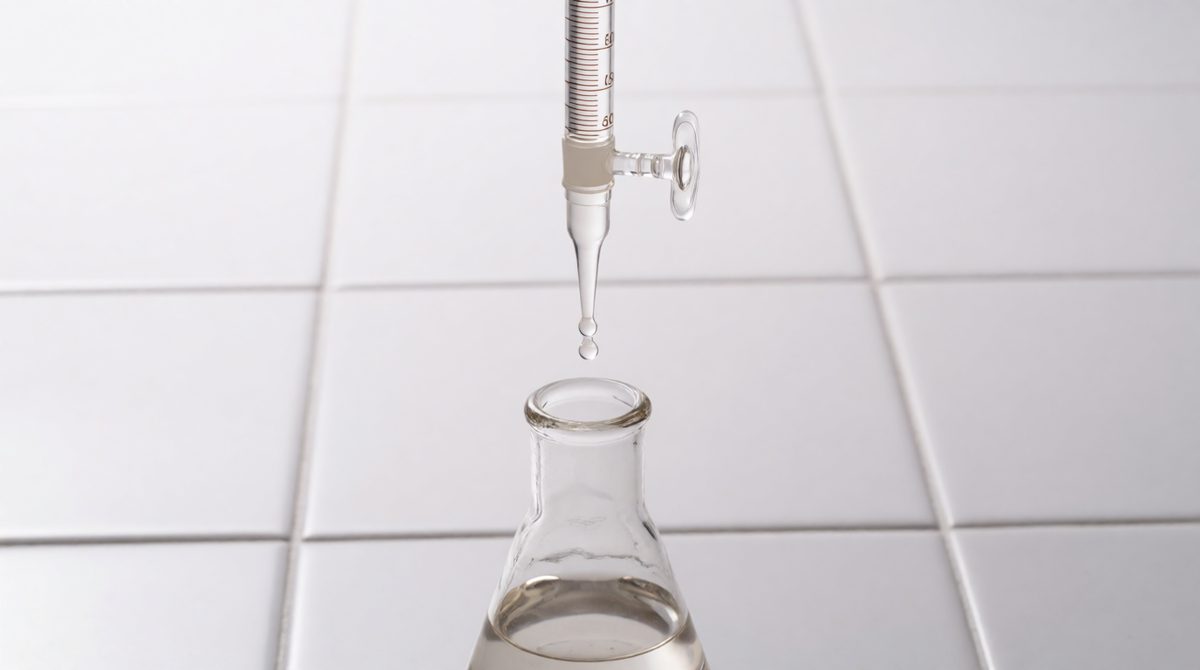
"A lot of acid" is useless, but a burette reading like 25.0 cm³ can be repeated by anyone
A scientific quantity is something we can measure with a number and a unit. It is important because numbers let us compare results, spot patterns and check predictions. "A lot of acid" is useless, but "25.0 cm3 of acid" can be repeated by anyone.
Each quantity is found with a suitable piece of equipment:
Found with a balance. Units: kg, g or mg.
Found with a measuring cylinder, pipette or burette. Units: cm3 or dm3.
Found with a thermometer. Unit: degrees Celsius (°C).
Found with a stopwatch. Unit: seconds (s).
Some quantities are worked out from others. For example, a rate of reaction comes from an amount of product divided by the time taken. Energy is measured in joules (J) or kilojoules (kJ).
Scientists use SI units. The ones you meet most in chemistry are the kilogram (kg), gram (g) and milligram (mg) for mass; the kilometre (km), metre (m) and millimetre (mm) for length; and the joule (J) and kilojoule (kJ) for energy. Use them unless the question clearly needs something else.
Look at the names. Kilo, milli and so on are prefixes. A prefix tells you how many times bigger or smaller a unit is than the basic unit. You need to know these:
tera (T) = 1012 (a million million)
giga (G) = 109 (a thousand million)
mega (M) = 106 (a million)
kilo (k) = 103 (a thousand)
centi (c) = 10-2 (one hundredth)
milli (m) = 10-3 (one thousandth)
micro (µ) = 10-6 (one millionth)
nano (n) = 10-9 (one billionth, or one thousand millionth)
So 1 kg is 1000 g, 1 km is 1000 m, and 1 kJ is 1000 J. In the other direction, 1 mm is one thousandth of a metre, so 1 m is 1000 mm. A nanometre (nm) is one thousand millionth of a metre. Nanoparticles are between 1 and 100 nanometres across.
These powers of ten link to orders of magnitude: a kilometre is three orders of magnitude bigger than a metre.
To interconvert units, remember one rule:
Change 2.5 kg into g. A kilogram is bigger than a gram, so multiply by 1000: 2.5 × 1000 = 2500 g.
Change 45 mg into g. A milligram is smaller than a gram, so divide by 1000: 45 ÷ 1000 = 0.045 g.
Change 12.5 kJ into J: 12.5 × 1000 = 12 500 J.
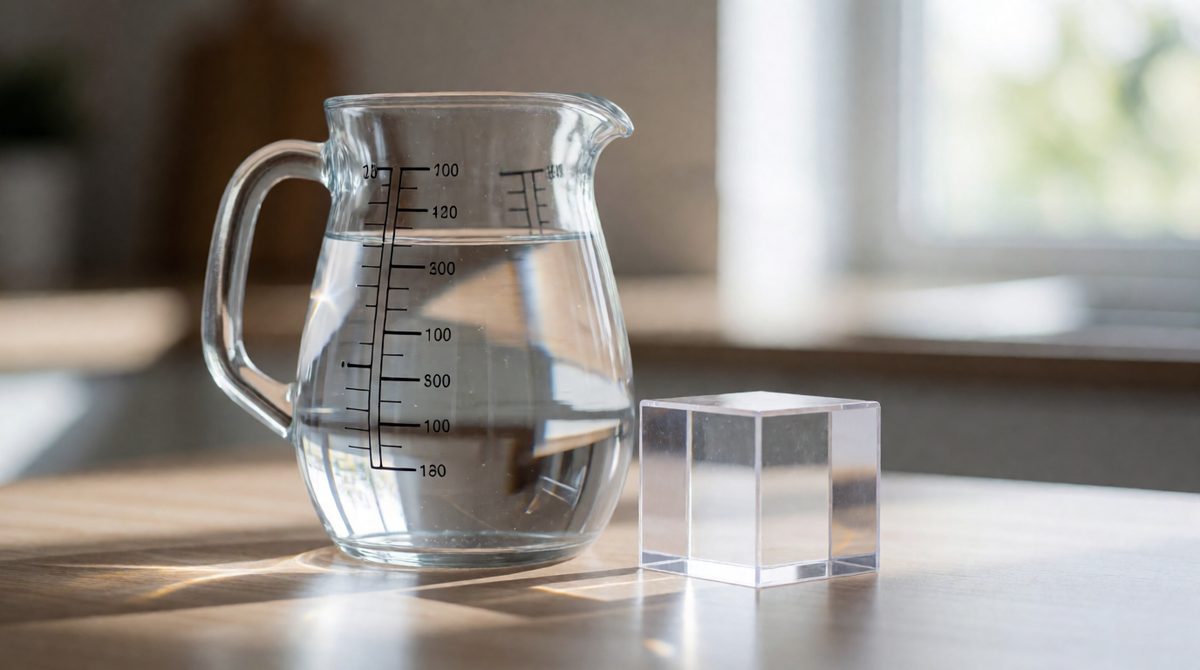
This 1 litre bottle holds exactly 1 dm³, which is 1000 cm³ - a 10 cm cube of water
Volumes in chemistry are usually measured in cm3 (cubic centimetres). Many calculations need dm3 (cubic decimetres). A dm3 is a cube measuring 10 cm × 10 cm × 10 cm, so:
1 dm3 = 1000 cm3
Change 75 cm3 into dm3. A dm3 is bigger, so divide by 1000: 75 ÷ 1000 = 0.075 dm3.
Change 0.5 dm3 into cm3. A cm3 is smaller, so multiply by 1000: 0.5 × 1000 = 500 cm3.
Change 25.0 cm3 into dm3: 25.0 ÷ 1000 = 0.0250 dm3.
Converting with powers of ten works too. Centi is 10-2, so 5 cm = 5 × 10⁻² m = 0.05 m. Micro is 10-6, so 20 µm = 20 × 10-6 m = 2.0 × 10⁻⁵ m. Nano is 10-9, so 3.2 nm = 3.2 × 10⁻⁹ m.
The rule for calculations is simple: give your answer to the same number of significant figures as the least precise number you used. An answer cannot be more precise than the measurements it came from.
Count significant figures from the first digit that is not zero. Zeros at the start do not count, but zeros after other digits in a measurement do. So 0.00406 has 3 significant figures and 25.0 also has 3.
A calculator shows 21.39 for 6.2 × 3.45. The number 6.2 has 2 significant figures and 3.45 has 3, so the answer has 2 significant figures: 21.
A calculator shows 3 for 12.6 ÷ 4.2. The least precise number has 2 significant figures, so give 2 significant figures: 3.0. Keep the zero, because it shows the precision.
Round 0.0023456 to 3 significant figures. The first significant figure is the 2. Keep 2, 3, 4. The next digit is 5, so round up: 0.00235.
1. Multiplying when you should divide. Check: going to a smaller unit gives a bigger number.
2. Writing 1 dm3 = 100 cm3. It is 1000, because a volume has three dimensions.
3. Rounding too early. Keep the full calculator value until the end, then round once.
4. Dropping the final zero, such as writing 3 instead of 3.0, which changes the precision.
5. Leaving off the unit, or using "salt" or "alcohol" when the question needs an IUPAC name.
A student measures 35.0 cm3 of acid and 0.0250 dm3 of alkali.
(a) Write 35.0 cm3 in dm3. (b) Write 0.0250 dm3 in cm3. (c) The student works out 4.2 ÷ 0.0250 and the calculator shows 168. Give the answer to a suitable number of significant figures.
(a) 35.0 ÷ 1000 = 0.0350 dm3.
(b) 0.0250 × 1000 = 25.0 cm3.
(c) 4.2 has 2 significant figures and 0.0250 has 3, so use the least precise: 2 significant figures = 1.7 × 10².
Before you start any calculation, check every volume is in dm3 and every mass is in g. Then round only the final answer.