⚛ More shells
Going down the group, each atom has one more shell of electrons. So the outer electron is further from the nucleus.
Sign up to access the complete lesson and track your progress!
Unlock This CourseLook at the far left column of the periodic table. This is Group 1. Going down, the elements are lithium, sodium, potassium, rubidium, caesium and francium. Together they are called the alkali metals.
They are not like the metals you see every day. They are so soft you can cut them with a knife. A freshly cut surface is shiny, but it goes dull within seconds as it reacts with the air. Lithium, sodium and potassium are also less dense than water, so they float on it.
All the alkali metals react in very similar ways. The reason is their electrons. Every Group 1 atom has a single electron in its outer shell.
| Element | Atomic number | Electronic structure |
|---|---|---|
| Lithium | 3 | 2,1 |
| Sodium | 11 | 2,8,1 |
| Potassium | 19 | 2,8,8,1 |
When an alkali metal reacts, each atom loses that one outer electron. It becomes an ion with a 1+ charge, such as Li+, Na+ or K+. Because they all do the same thing with their outer electron, they all make the same kinds of compounds.
Key terms:
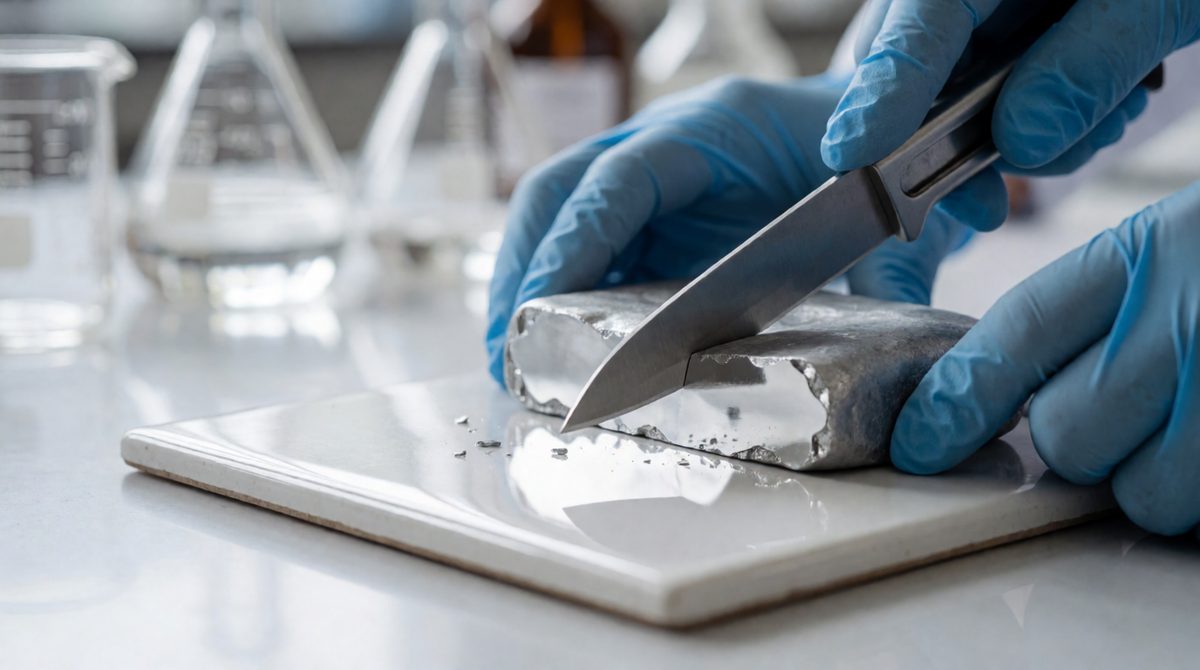
Freshly cut sodium is shiny for seconds, then tarnishes as it reacts with oxygen - that's why it's stored under oil
The alkali metals react with oxygen to form metal oxides. This happens so readily that they tarnish in air. That is why they are stored under oil, which keeps out oxygen and water.
Lithium tarnishes slowly, sodium more quickly and potassium fastest of all. If you heat them, they burn in oxygen. Each oxide has the formula M2O, because two 1+ ions balance one oxide ion.
These oxides dissolve in water to make alkaline solutions.
Heat an alkali metal and lower it into a jar of chlorine gas and it burns vigorously. The product is a metal chloride, a white solid. Again, potassium reacts more vigorously than sodium, and sodium more vigorously than lithium.
Notice the pattern. Every chloride has the formula MCl, because one 1+ metal ion balances one 1− chloride ion. The metal chlorides dissolve in water to form colourless solutions.
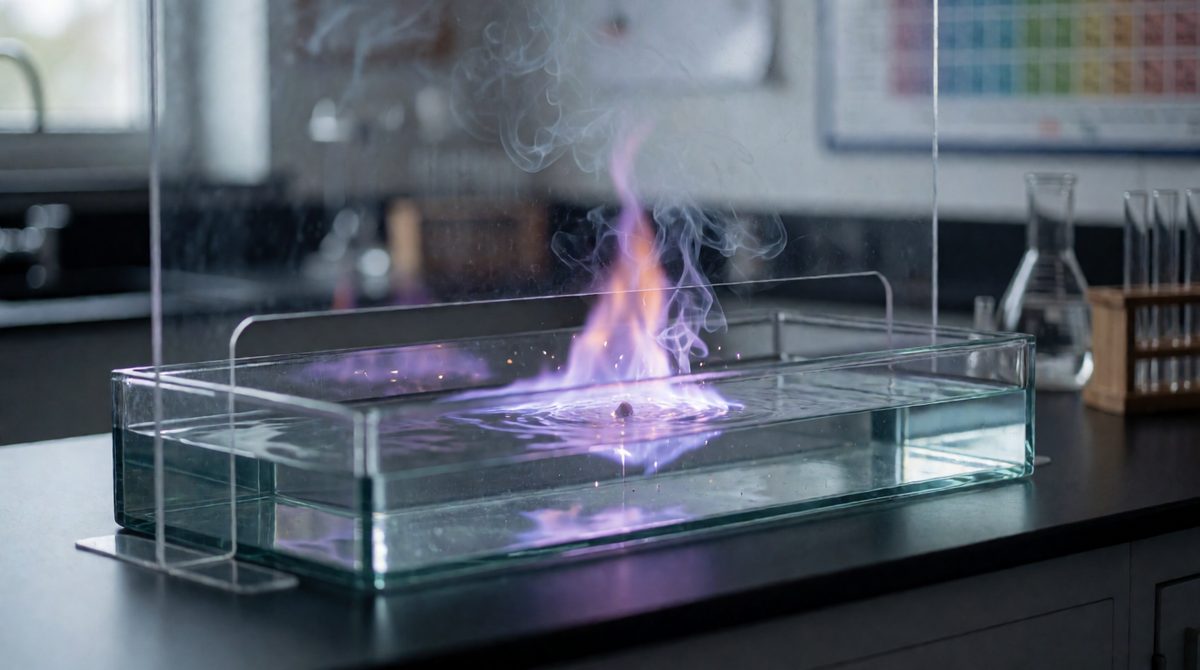
Potassium in water fizzes so hard the hydrogen catches fire with a lilac flame: 2K + 2H₂O → 2KOH + H₂
You need to be able to describe this reaction for lithium, sodium and potassium. When an alkali metal is dropped into water, it reacts to form a metal hydroxide and hydrogen gas.
metal + water → metal hydroxide + hydrogen
2Na + 2H2O → 2NaOH + H2
The metal hydroxide dissolves to give an alkaline solution. Add universal indicator and it turns purple. This is where the name "alkali metals" comes from.
Floats. Fizzes steadily as hydrogen is given off. Slowly gets smaller until it is gone. Does not melt.
Floats. Fizzes quickly. The heat from the reaction melts it into a shiny silver ball that whizzes around on the surface. Disappears faster than lithium.
Floats, melts and whizzes around even faster. So much heat is released that the hydrogen catches fire with a lilac flame. It may spit and crackle, then it is gone.
The equations follow the same pattern for each metal: 2Li + 2H2O → 2LiOH + H2 and 2K + 2H2O → 2KOH + H2.
You have now seen the same story three times. Lithium is the least reactive, then sodium, then potassium. In Group 1, the reactivity of the elements increases going down the group. To explain this, think about the single outer electron.
Going down the group, each atom has one more shell of electrons. So the outer electron is further from the nucleus.
The positive nucleus attracts the negative outer electron. The further away the electron is, the weaker this attraction. The inner shells of electrons also shield the outer electron from the nucleus.
So, going down Group 1, the outer electron is lost more easily. Alkali metals react by losing that electron, so the easier it is to lose, the more reactive the metal.
Put the chain together when you explain it in an exam:
The spec says you must be able to predict properties from given trends. Rubidium and caesium are too dangerous to use in school, but you can predict how they behave from the pattern.
| Element | Melting point (°C) | Reaction with water |
|---|---|---|
| Lithium | 181 | Fizzes steadily |
| Sodium | 98 | Melts, fizzes quickly |
| Potassium | 63 | Melts, hydrogen catches fire |
| Rubidium | ? | ? |
Predict the melting point of rubidium.
Step 1: Spot the trend. Melting point decreases going down the group.
Step 2: Rubidium is below potassium, so its melting point should be lower than 63 °C.
Step 3: The drops are getting smaller (83 °C, then 35 °C), so a sensible estimate is around 35 to 45 °C.
Answer: below 63 °C, about 40 °C. The real value is 39 °C.
Predict how caesium reacts with water. Write a word equation.
Prediction: caesium is near the bottom of Group 1, so it is even more reactive than potassium. It reacts violently, even explosively, with water.
Products: it follows the same pattern as the other alkali metals.
caesium + water → caesium hydroxide + hydrogen
The solution formed is alkaline, and the formula of caesium hydroxide is CsOH.
The same thinking works for any property. Caesium will tarnish even faster than potassium, and its chloride will be CsCl, a white solid.
Saying the outer electron is "gained". Alkali metals lose their outer electron. Only use "gain" for non-metals.
Saying "the nucleus has more protons, so it holds on more tightly". The extra shells and the greater distance matter more. Always say the attraction to the outer electron gets weaker.
Forgetting the second product. With water you get a metal hydroxide and hydrogen, not an oxide.
Mixing up the trends. Reactivity goes up going down Group 1, but melting point goes down.
A teacher adds small pieces of lithium and potassium to two troughs of water containing universal indicator.
(a) Describe two differences you would see between the two reactions. [2 marks]
(b) Explain why potassium is more reactive than lithium. Use ideas about electrons. [3 marks]
(a) Potassium melts into a ball but lithium does not. The hydrogen from potassium catches fire with a lilac flame, but lithium only fizzes steadily. (Also accept: potassium moves around faster, or potassium disappears faster.)
(b) A potassium atom has more shells than a lithium atom, so its outer electron is further from the nucleus (1). The attraction between the nucleus and the outer electron is weaker (1). So the outer electron is lost more easily, and potassium is more reactive (1).
Questions about Group 1 trends always come back to the single outer electron. Write "further from the nucleus", "weaker attraction" and "lost more easily" in that order and you will pick up the marks.