Meet the halogens
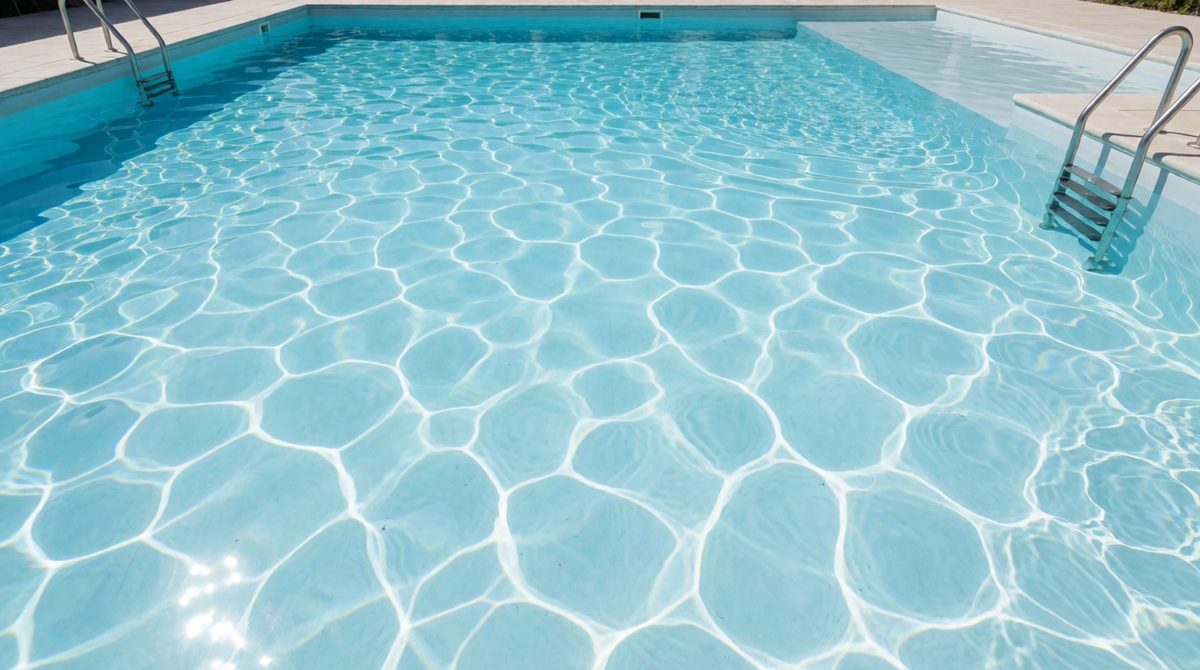
Chlorine kills germs in pool water - it's a halogen with 7 outer electrons, hungry to gain one more
Group 7 is the second column from the right of the periodic table. Going down, the elements are fluorine, chlorine, bromine, iodine and astatine. Together they are called the halogens.
The halogens are non-metals. They have similar reactions because every halogen atom has seven electrons in its outer shell.
| Element | Atomic number | Electronic structure |
|---|
| Fluorine | 9 | 2,7 |
| Chlorine | 17 | 2,8,7 |
| Bromine | 35 | (outer shell of 7) |
| Iodine | 53 | (outer shell of 7) |
A halogen atom is just one electron short of a full outer shell. So when halogens react, each atom tries to gain one electron (or share electrons) to get a full outer shell.
As elements, the halogens exist as molecules made of pairs of atoms, not as single atoms. Two atoms join together to make each molecule, so chlorine is Cl2, bromine is Br2 and iodine is I2. Always write the 2 in equations.
Key terms:
- Halogens: the elements in Group 7 of the periodic table. They all have seven electrons in their outer shell.
- Diatomic molecule: a molecule made of a pair of atoms, such as Cl2.
- Halide ion: the ion a halogen forms when it gains one electron, with a 1- charge, such as Cl-.
- Displacement reaction: a reaction where a more reactive element takes the place of a less reactive element in a compound.
What compounds do halogens make?
You need to describe the compounds formed when chlorine, bromine and iodine react with metals and with non-metals. The type of compound depends on what the halogen reacts with.
⚙ With metals: ionic compounds
A metal atom loses electrons and the halogen atom gains one electron. The halogen becomes a halide ion with a 1- charge: chloride Cl-, bromide Br-, iodide I-. The product is an ionic compound called a metal halide. These are solids at room temperature.
Example: iron + chlorine → iron chloride
2Fe + 3Cl2 → 2FeCl3
⚛ With non-metals: covalent molecules
A non-metal does not give away electrons, so the atoms share electrons instead. The product is made of small covalent molecules.
Example: hydrogen + chlorine → hydrogen chloride
H2 + Cl2 → 2HCl
Hydrogen chloride is a gas. It dissolves in water to make hydrochloric acid.
Names change when a halogen is in a compound: chlorine becomes chloride, bromine becomes bromide and iodine becomes iodide. So magnesium and bromine make magnesium bromide, MgBr2, and hydrogen and iodine make hydrogen iodide, HI. You will learn more about how ions and shared pairs form in Ionic Bonding and Covalent Bonding.
Trends in physical properties
Going down Group 7, the molecules get bigger and heavier. The relative molecular mass increases, and so do the melting point and boiling point. The colour also gets darker.
| Halogen | Relative molecular mass | Melting point (°C) | Boiling point (°C) | At room temperature |
|---|
| Fluorine, F2 | 38 | -220 | -188 | pale yellow gas |
| Chlorine, Cl2 | 71 | -101 | -34 | green gas |
| Bromine, Br2 | 160 | -7 | 59 | red-brown liquid |
| Iodine, I2 | 254 | 114 | 184 | grey-black solid |
Room temperature is about 20 °C. Chlorine boils far below that, so it is a gas. Bromine melts below 20 °C but boils above it, so it is a liquid. Iodine does not melt until 114 °C, so it is a solid. Bigger molecules need more energy to separate them, which is why the melting and boiling points go up. The forces involved are explained in Properties of Ionic Compounds and Small Molecules.
Reactivity decreases down the group
Fluorine is the most reactive halogen. Chlorine is less reactive, then bromine, then iodine. This is the opposite of Group 1, and the reason is the outer shell of electrons.
↓ More shells
Going down the group, each atom has one more shell of electrons, so the outer shell is further from the nucleus.
− Weaker pull
The positive nucleus attracts an incoming electron less strongly when the outer shell is further away.
✓ Less reactive
So it is harder for the atom to gain the one electron it needs. The halogen reacts less readily.
Halogens react by gaining an electron, while alkali metals react by losing one. That is why the two groups have opposite reactivity trends.
Displacement reactions
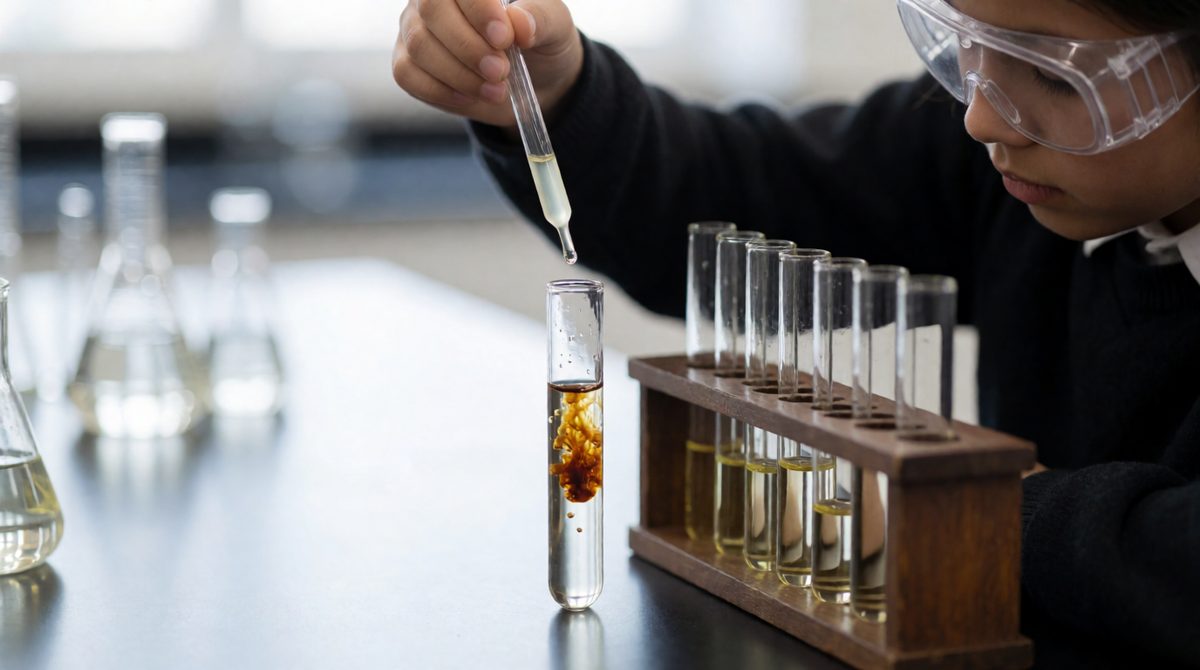
The colour change says it all: chlorine pushes iodine out of potassium iodide, turning the solution brown
A more reactive halogen can displace a less reactive halogen from an aqueous solution of its salt. The more reactive halogen takes the halide ion's place in the compound and pushes the less reactive halogen out as the element.
Example: chlorine water is added to potassium bromide solution. Chlorine is more reactive than bromine, so it displaces it. The colourless solution turns orange because bromine forms.
chlorine + potassium bromide → potassium chloride + bromine
Cl2 + 2KBr → 2KCl + Br2
If iodine is made, the solution turns brown. If the added halogen is less reactive than the one in the salt, there is no reaction.
| Halogen added | Potassium chloride | Potassium bromide | Potassium iodide |
|---|
| Chlorine water | - | turns orange (bromine made) | turns brown (iodine made) |
| Bromine water | no reaction | - | turns brown (iodine made) |
| Iodine solution | no reaction | no reaction | - |
The pattern of results shows the order of reactivity: chlorine > bromine > iodine. In the lab these reactions are done in small amounts, and chlorine is used in a fume cupboard because it is toxic.
Worked example
Will bromine react with sodium iodide solution? Write the equation.
Step 1: Bromine is above iodine in Group 7, so bromine is more reactive.
Step 2: So bromine displaces iodine. The solution turns brown.
Step 3: bromine + sodium iodide → sodium bromide + iodine
Br2 + 2NaI → 2NaBr + I2
Predicting properties from trends
You can use the trends to predict an element you have not studied. Astatine is below iodine.
- It will have a higher melting point and boiling point than iodine, so it will be a solid at room temperature.
- It will be less reactive than iodine, so it will not displace iodine from potassium iodide.
Going the other way, fluorine is at the top, so it is the most reactive halogen. It would displace chlorine from a chloride.
Common mistakes
Saying halogens get more reactive down the group. That is Group 1. Group 7 gets less reactive.
Saying the outer electron is "lost" more easily. Halogens gain an electron, and this gets harder down the group.
Mixing up the element and the ion: chlorine is Cl2, chloride is Cl-. A salt contains chloride, not chlorine.
Thinking iodine can displace chlorine. A halogen only displaces one that is below it.
Exam-style question
A student adds bromine water to potassium chloride solution and to potassium iodide solution.
(a) Describe what the student would see in each test. [2 marks]
(b) Explain why bromine is less reactive than chlorine. [3 marks]
Model answer
(a) Potassium chloride: no change / no reaction (1). Potassium iodide: the solution turns brown because iodine is made (1).
(b) A bromine atom has more shells than a chlorine atom, so its outer shell is further from the nucleus (1). The attraction between the nucleus and an incoming electron is weaker (1). So it is harder for a bromine atom to gain an electron (1).
Exam tip
For reactivity questions, always use the chain: further from the nucleus, weaker attraction, harder to gain an electron. Using the word "gain" is where many marks are won or lost.