🏭 Iron
Iron is the catalyst in the Haber process, which makes ammonia for fertilisers. You will meet this in The Haber Process.
Sign up to access the complete lesson and track your progress!
Unlock This CourseThe transition metals (also called the transition elements) sit in the wide central block of the periodic table, between Group 2 and Group 3. They are all metals.
AQA wants you to know six of them by name. They are all in Period 4, side by side (atomic numbers 24 to 29):
| Element | Symbol | Atomic number |
|---|---|---|
| Chromium | Cr | 24 |
| Manganese | Mn | 25 |
| Iron | Fe | 26 |
| Cobalt | Co | 27 |
| Nickel | Ni | 28 |
| Copper | Cu | 29 |
The transition metals have similar properties to each other. But those properties are very different from the Group 1 alkali metals. That contrast is a favourite exam question.
Key terms:
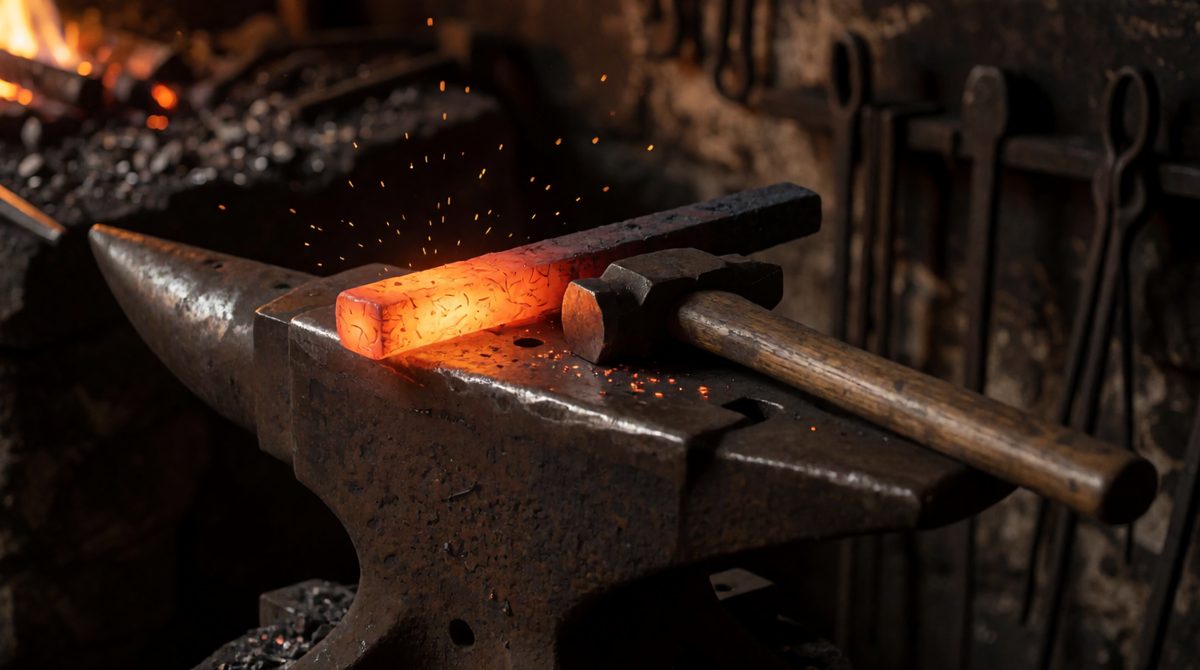
Heavy, hard and strong - iron is a transition metal with a far higher melting point and density than soft Group 1 metals like sodium
Think of a lump of iron and a lump of sodium. Iron is heavy, hard and strong. Sodium is light and soft enough to cut with a knife. Here is how the two families compare.
| Property | Transition metals | Group 1 metals |
|---|---|---|
| Melting point | High (iron melts at about 1,540 °C) | Low (sodium melts at about 98 °C) |
| Density | High (iron is about 7.9 g/cm3) | Low (sodium is about 0.97 g/cm3, so it floats on water) |
| Strength | Strong | Weak |
| Hardness | Hard | Soft |
| Reactivity | Much less reactive | Very reactive |
All six named transition metals follow the same pattern. Chromium, manganese, cobalt, nickel and copper all melt above 1,000 °C and all have densities above 7 g/cm3. Lithium, sodium and potassium all melt below 200 °C and are all less dense than water.
The strength and hardness are why iron (as steel) is used to build bridges. Nobody could build a bridge out of sodium.
Remember that Group 1 metals react quickly with oxygen, water and halogens. Transition metals react with the same things, but much more slowly, and some hardly react at all.
Group 1 metals tarnish within seconds of being cut. Iron and copper react with oxygen only slowly at room temperature. Copper needs strong heating to form black copper oxide quickly.
Group 1 metals fizz in cold water, giving off hydrogen. Copper does not react with water at all. Iron reacts with cold water only very slowly (with oxygen too, it rusts over days, not seconds).
Group 1 metals react vigorously with chlorine. Transition metals such as iron and copper react with chlorine much less vigorously, and usually need to be heated first.
This low reactivity is useful. Copper pipes can carry water for decades without reacting with it.
A Group 1 metal always forms an ion with a 1+ charge, such as Na+. Many transition metals are different: they can form ions with different charges.
Because one metal can make more than one ion, we put the charge in Roman numerals in the name. Iron(II) chloride contains Fe2+ ions, so its formula is FeCl2. Iron(III) chloride contains Fe3+ ions, so its formula is FeCl3. These are two different compounds with different properties.
Write the formula of copper(II) oxide.
Step 1: The (II) tells you the copper ion is Cu2+.
Step 2: The oxide ion is O2-.
Step 3: One 2+ charge balances one 2- charge, so you need one of each.
Answer: CuO.
Now try copper(I) oxide: Cu+ and O2-. You need two Cu+ to balance one O2-, so the formula is Cu2O.
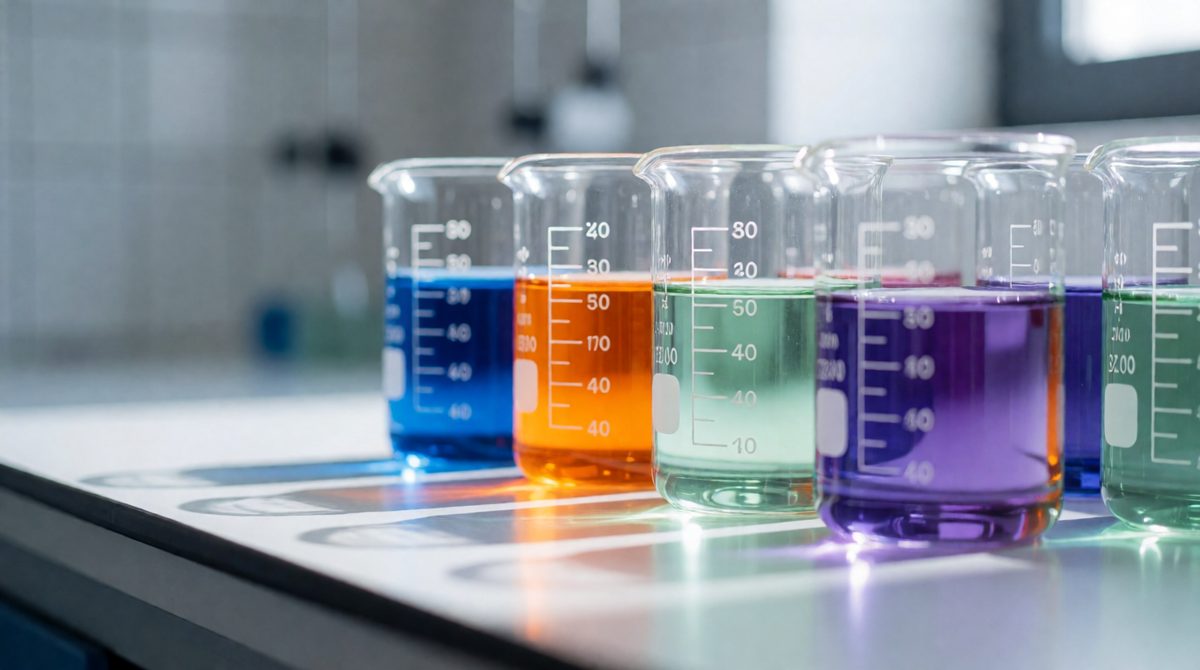
Blue copper sulfate, orange potassium dichromate - those bright colours are a giveaway that a transition metal is in the compound
Compounds of Group 1 metals are usually white solids that dissolve to give colourless solutions, unless the compound also contains a transition metal. Table salt is a good example. Many transition metal compounds are brightly coloured.
| Metal | Example compound | Colour |
|---|---|---|
| Chromium | potassium dichromate | orange |
| Manganese | potassium manganate(VII) | purple |
| Iron | iron(II) sulfate | pale green |
| Cobalt | cobalt chloride (hydrated) | pink |
| Nickel | nickel(II) sulfate | green |
| Copper | copper(II) sulfate (hydrated) | blue |
Notice that the potassium in potassium dichromate and potassium manganate(VII) does not cause the colour. Potassium is a Group 1 metal. The colour comes from the chromium or manganese.
Different ions of the same metal can have different colours. Iron(II) compounds are usually pale green, but iron(III) compounds are usually orange-brown. Coloured transition metal compounds are used to colour glass and pottery glazes. For example, cobalt compounds give a deep blue colour to glass.
A catalyst speeds up a reaction without being used up. Many transition metals and their compounds make very good catalysts.
Iron is the catalyst in the Haber process, which makes ammonia for fertilisers. You will meet this in The Haber Process.
Nickel is the catalyst used when hydrogen is added to vegetable oils to harden them, for example to make margarine.
This black powder, a compound of manganese, speeds up the breakdown of hydrogen peroxide into water and oxygen.
Being useful as catalysts is a typical property of transition metals and their compounds. It is not a typical property of the Group 1 metals.
How a catalyst actually speeds up a reaction is explained in Catalysts.
Saying transition metals are "more reactive" because they are "stronger". Strength and hardness are physical properties. Reactivity is a chemical property. Transition metals are stronger but less reactive.
Mixing up the trends. Group 1 has the low melting points and low densities. Transition metals have the high ones.
Saying "they form coloured ions" with no example. AQA wants you to name a compound and its colour, such as copper(II) sulfate is blue.
Forgetting the Roman numeral. "Iron chloride" could mean FeCl2 or FeCl3. Write iron(II) or iron(III).
Nickel is a transition metal. Sodium is a Group 1 metal.
(a) Give two differences in the physical properties of nickel and sodium. [2 marks]
(b) Nickel forms Ni2+ ions. A student says nickel sulfate solution will be colourless, like sodium sulfate solution. Explain why the student is wrong. [2 marks]
(c) Give one other typical property of transition metals. Use a named transition metal or compound as an example. [2 marks]
(a) Nickel has a much higher melting point than sodium (1). Nickel has a much higher density than sodium (1). (Also accept: nickel is harder or stronger than sodium.)
(b) Nickel is a transition metal and transition metal compounds are often coloured (1). Nickel sulfate solution is green, while sodium sulfate is white and its solution is colourless (1).
(c) Transition metals are useful as catalysts (1), for example iron in the Haber process or nickel when hydrogenating vegetable oils (1). (Also accept: ions with different charges, for example Fe2+ and Fe3+.)
When a question says "compare", write a sentence for both metals using a comparative word, such as "higher", "harder" or "less reactive". Just writing "nickel has a high melting point" may not score the mark.