⊕ The metal atom
It loses its outer electrons. It now has more protons than electrons, so it becomes a positively charged ion.
Sign up to access the complete lesson and track your progress!
Unlock This Course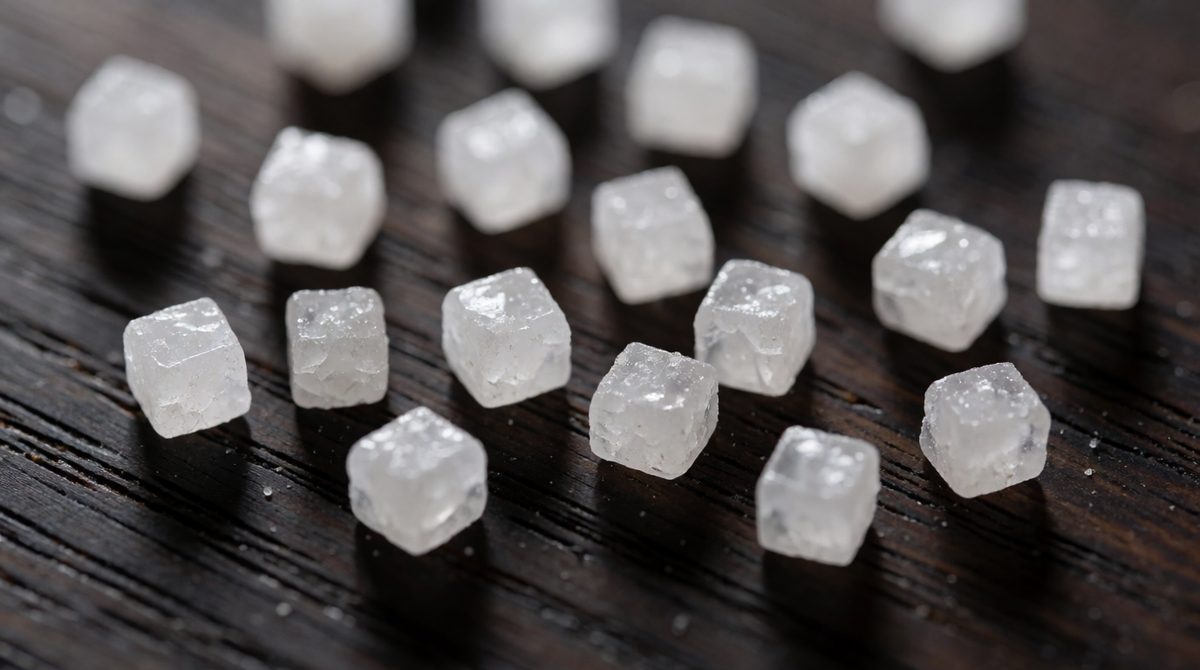
Table salt is held together by ionic bonds - strong attractions between oppositely charged Na⁺ and Cl⁻ ions
Atoms in substances are held together by chemical bonds. There are three types of strong chemical bond: ionic, covalent and metallic. Each one involves different particles.
| Type of bond | The particles | Where it is found |
|---|---|---|
| Ionic | Oppositely charged ions | Compounds formed from metals combined with non-metals |
| Covalent | Atoms which share pairs of electrons | Most non-metallic elements and compounds of non-metals |
| Metallic | Atoms which share delocalised electrons | Metallic elements and alloys |
So you can often tell the type of bonding just by looking at the elements in a substance:
All three bonds come down to two ideas: electrons are either transferred (ionic) or shared (covalent and metallic), and the bond is held by electrostatic forces. You will meet covalent bonding and metallic bonding in their own lessons. This lesson is all about ionic bonding.
Key terms:
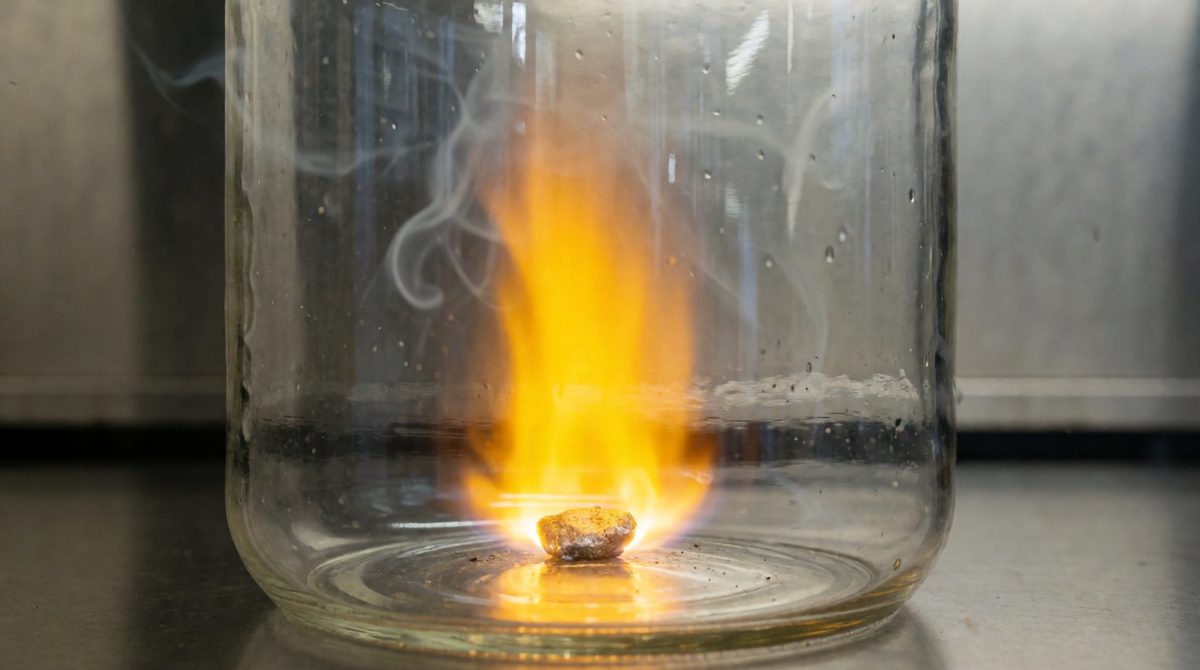
When sodium meets chlorine, each sodium atom hands its one outer electron to a chlorine atom, making Na⁺ and Cl⁻ ions
When a metal atom reacts with a non-metal atom, the electrons in the outer shell of the metal atom are transferred to the non-metal atom.
It loses its outer electrons. It now has more protons than electrons, so it becomes a positively charged ion.
It gains those electrons. It now has more electrons than protons, so it becomes a negatively charged ion.
The ions made by metals in Groups 1 and 2, and by non-metals in Groups 6 and 7, end up with the electronic structure of a noble gas (Group 0). Each ion has a full outer shell.
The positive and negative ions are then strongly attracted to each other by electrostatic forces. That attraction is the ionic bond. How millions of these ions pack together into a structure is covered in Ionic Compounds and Their Structure.
We show electron transfer using a dot and cross diagram. The electrons from one atom are drawn as dots and the electrons from the other atom are drawn as crosses. That way you can see exactly where each electron came from and where it went.
The spec example is sodium chloride:
In exams you can usually show just the outer shell of each atom. Once sodium loses its electron, its outer shell is the full second shell of 8 electrons. Some diagrams draw this full shell for the ion, and some show the ion with no outer electrons. Both are fine as long as the brackets and charges are right.
Magnesium is in Group 2 (2,8,2). Oxygen is in Group 6 (2,6).
Potassium is in Group 1 (2,8,8,1). Sulfur is in Group 6 (2,8,6).
The charge on the ions made by metals in Groups 1 and 2 and non-metals in Groups 6 and 7 relates to the group number. The group number tells you the number of outer electrons, so it tells you how many electrons are lost or gained.
Lose 1 or 2 electrons. Group 1 ions are 1+ (e.g. Li+). Group 2 ions are 2+ (e.g. Ba2+). Charge = group number.
Six outer electrons, so gain 2. Group 6 ions are 2− (e.g. O2−). Charge = 8 minus 6.
Seven outer electrons, so gain 1. Group 7 ions are 1− (e.g. F−). Charge = 8 minus 7.
A quick rule: for metals, the charge is positive and equal to the group number. For non-metals in Groups 6 and 7, the charge is negative and equal to 8 minus the group number.
Magnesium reacts with fluorine to make magnesium fluoride, an ionic compound.
(a) Describe what happens to the electrons when magnesium fluoride forms. [3 marks]
(b) Give the charges on the magnesium ion and the fluoride ion. [2 marks]
(c) Explain why the ions are held together. [2 marks]
(a) Each magnesium atom loses its two outer electrons (1). One electron is transferred to each of two fluorine atoms (1). Each fluorine atom gains one electron, so both ions have the electronic structure of a noble gas, 2,8 (1).
(b) Magnesium ion: 2+ (1). Fluoride ion: 1− (1).
(c) The ions have opposite charges (1), so there is a strong electrostatic force of attraction between them (1).
Before you draw a dot and cross diagram, work out the charges from the group numbers. Then pick how many of each atom you need so the charges cancel out to zero. Only then start drawing.