✖ Dot and cross diagram
Shows each ion in square brackets with its charge outside, and the chloride ion with 8 outer electrons drawn as dots and crosses. Good for showing how the electrons were transferred and the charge on each ion.
Sign up to access the complete lesson and track your progress!
Unlock This Course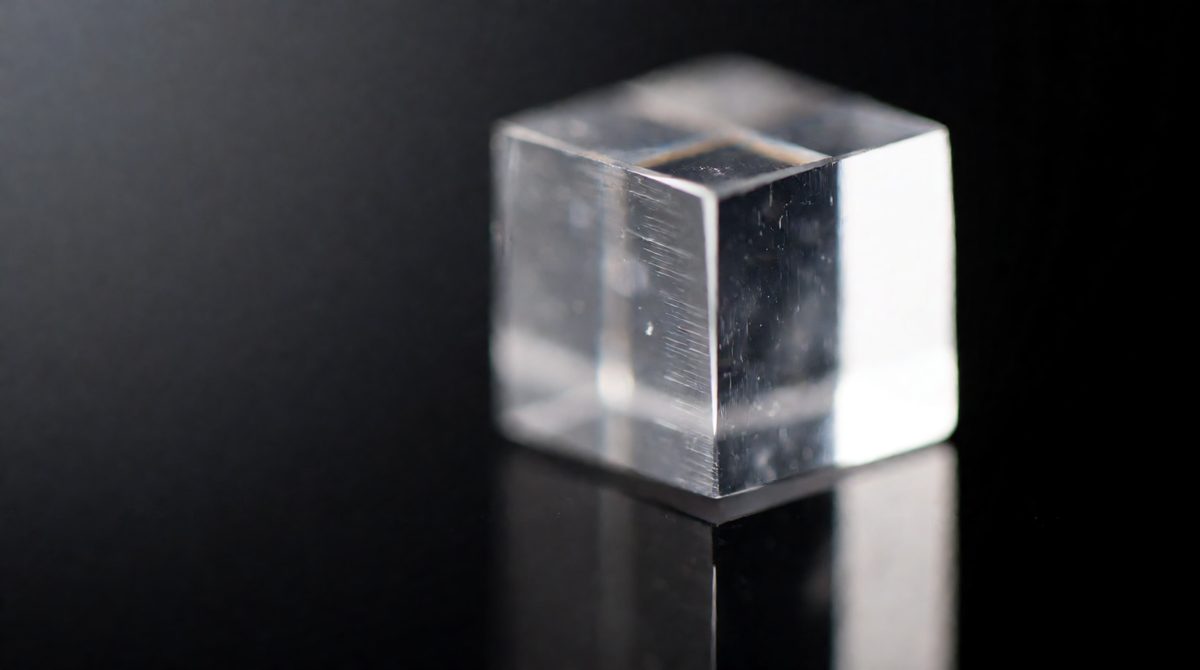
Each tiny cube of salt is a giant lattice of countless Na⁺ and Cl⁻ ions repeating in every direction - that's why the crystals are so square
In the lesson on Ionic Bonding you saw one sodium atom pass an electron to one chlorine atom. But a grain of table salt is not just one pair of ions. It contains a huge number of sodium ions (Na+) and chloride ions (Cl-), all packed together in a regular, repeating pattern.
An ionic compound is a giant structure of ions. The ions are held together by strong electrostatic forces of attraction between oppositely charged ions. Each positive ion attracts every negative ion around it, and each negative ion attracts every positive ion around it.
The important idea is that these forces act in all directions in the lattice. A sodium ion is not bonded to just one chloride ion. It is pulled on by all the chloride ions around it: above, below, in front, behind, left and right. This attraction in all directions is what we call ionic bonding.
In sodium chloride the ions are arranged in a cube pattern. Each Na+ ion is surrounded by 6 Cl- ions, and each Cl- ion is surrounded by 6 Na+ ions. Along any row, the ions alternate: positive, negative, positive, negative. The pattern repeats over and over, many millions of ions in every direction. That is why we call it "giant".
Key terms:
The spec asks you to know four ways of showing the structure of sodium chloride. You learned dot and cross diagrams in Ionic Bonding, so here we look at what each one is good and bad at.
Shows each ion in square brackets with its charge outside, and the chloride ion with 8 outer electrons drawn as dots and crosses. Good for showing how the electrons were transferred and the charge on each ion.
A flat drawing of one layer of ions, with + and - ions alternating in rows. Good for showing the repeating pattern and the ratio of ions in one layer.
Ions are shown as balls joined by sticks, built as a cube. Good for showing the 3D arrangement and that each ion has 6 neighbours of the opposite charge.
Ions are drawn as spheres packed tightly together, often called a space-filling model. Good for showing that the ions touch and that Cl- ions are bigger than Na+ ions.
Every model is a simplification. In the exam you may be asked to describe the limitations of a diagram. A limitation is something the diagram gets wrong or does not show.
| Diagram | Limitations |
|---|---|
| Dot and cross | Does not show how the ions are arranged in space. Shows only one pair of ions, not the giant structure. Does not show the relative sizes of the ions. Uses dots and crosses as if electrons were different, when all electrons are identical. |
| 2D diagram | Shows only one flat layer, so you cannot see the ions above and below. It cannot show that the forces act in all three dimensions. It may not show the relative sizes of the ions. |
| Ball and stick | Shows big gaps between ions, but really the ions are packed closely together. The sticks look like solid bonds between particular pairs of ions, but the forces act in all directions. The balls are often not drawn to scale. |
| 3D (space-filling) | You can only see the outer ions, not the ones in the middle. It does not show the forces between the ions. Like all the others, it shows only a tiny part of a giant lattice. |
One limitation fits every diagram: they show only a small section. A real crystal contains far more ions than any drawing could ever show.
You should be able to look at a diagram of a structure and say that the compound is ionic. Look for these clues:

In this salt the ions pair up 1 Na⁺ to 1 Cl⁻, so the empirical formula is NaCl and the charges add up to zero
To find the empirical formula, count each type of ion and find the simplest whole number ratio. Then check that the charges add up to zero, because an ionic compound has no overall charge.
A 2D diagram shows one layer with 8 Na+ ions and 8 Cl- ions.
Ratio Na+ : Cl- = 8 : 8 = 1 : 1
Charge check: (+1) + (-1) = 0. Empirical formula = NaCl.
A model shows 4 calcium ions (Ca2+) and 8 fluoride ions (F-).
Ratio Ca2+ : F- = 4 : 8. Divide both by 4 to get 1 : 2.
Charge check: (+2) + 2 × (-1) = 0. Empirical formula = CaF2.
A diagram has a key: small grey balls = Al3+, large green balls = F-. You count 3 grey and 9 green.
Ratio Al3+ : F- = 3 : 9. Divide both by 3 to get 1 : 3.
Charge check: (+3) + 3 × (-1) = 0. Empirical formula = AlF3.
The metal ion is written first in the formula, and the number of each ion goes as a small subscript after its symbol. You never write a "1".
Writing the counted numbers as the formula. If a diagram shows 4 Ca2+ and 8 F-, the answer is CaF2, not Ca4F8. Always cancel down to the simplest ratio.
Counting a small cube exactly. A small model is only a piece of the lattice, so the edges can give uneven numbers. A 3 × 3 × 3 cube of sodium chloride has 27 ions: 14 of one kind and 13 of the other. The real ratio is still 1 : 1. Use the charges to check your answer makes sense.
Calling the forces "bonds between pairs". Do not say each sodium ion is bonded to one chloride ion. The attraction acts in all directions throughout the lattice.
Putting the charges in the formula. The formula is NaCl, not Na+Cl-.
A student is shown a diagram of a giant structure. It contains 10 sodium ions, labelled Na+, and 5 sulfide ions, labelled S2-, arranged in a regular repeating pattern.
(a) Give two pieces of evidence from the diagram that the compound is ionic. [2 marks]
(b) Work out the empirical formula of the compound. [1 mark]
(c) The student's teacher shows a ball and stick model of sodium chloride. Give one limitation of the ball and stick model. [1 mark]
(a) The particles have charges, so they are ions (1). Positive and negative ions are arranged in a regular repeating pattern, so it is a giant ionic lattice (1).
(b) Ratio Na+ : S2- = 10 : 5 = 2 : 1, so the empirical formula is Na2S (1).
(c) Any one: the ions are shown far apart, but really they are packed closely together; the sticks suggest bonds between particular ions, but the forces act in all directions; the ions are not shown to scale; it only shows a small part of the giant structure (1).
For a limitation, say what the diagram shows and what is really true. "The ions are shown with gaps between them, but in reality they touch" scores. Just "it's not accurate" does not.