Sharing electrons

Every water droplet is made of H₂O molecules where oxygen shares a pair of electrons with each hydrogen - two covalent bonds
When two non-metal atoms meet, both want to gain electrons, so neither gives any away. Instead, they share.
When atoms share pairs of electrons, they form covalent bonds. Each atom puts one electron into the shared pair, so one covalent bond is one shared pair of electrons. The shared electrons count towards the outer shell of both atoms. This lets each atom reach a full outer shell, like a noble gas.
The shared pair is attracted to the nuclei of both atoms, and this holds the two atoms together. These bonds between atoms are strong. It takes a lot of energy to pull covalently bonded atoms apart.
How many bonds does an atom make? Usually it makes as many as the number of electrons it needs to fill its outer shell:
- Hydrogen (1 outer electron, needs 1 more) makes 1 bond.
- Chlorine (7 outer electrons, needs 1) makes 1 bond.
- Oxygen (6 outer electrons, needs 2) makes 2 bonds.
- Nitrogen (5 outer electrons, needs 3) makes 3 bonds.
- Carbon (4 outer electrons, needs 4) makes 4 bonds.
Hydrogen is a special case. Its first shell is full with just 2 electrons, so one shared pair is enough.
Key terms:
- Covalent bond: a shared pair of electrons between two atoms.
- Molecule: a group of atoms joined together by covalent bonds.
- Single, double and triple bond: one, two or three shared pairs of electrons between the same two atoms.
- Lone pair: a pair of outer electrons that is not shared in a bond.
Three types of covalent substance
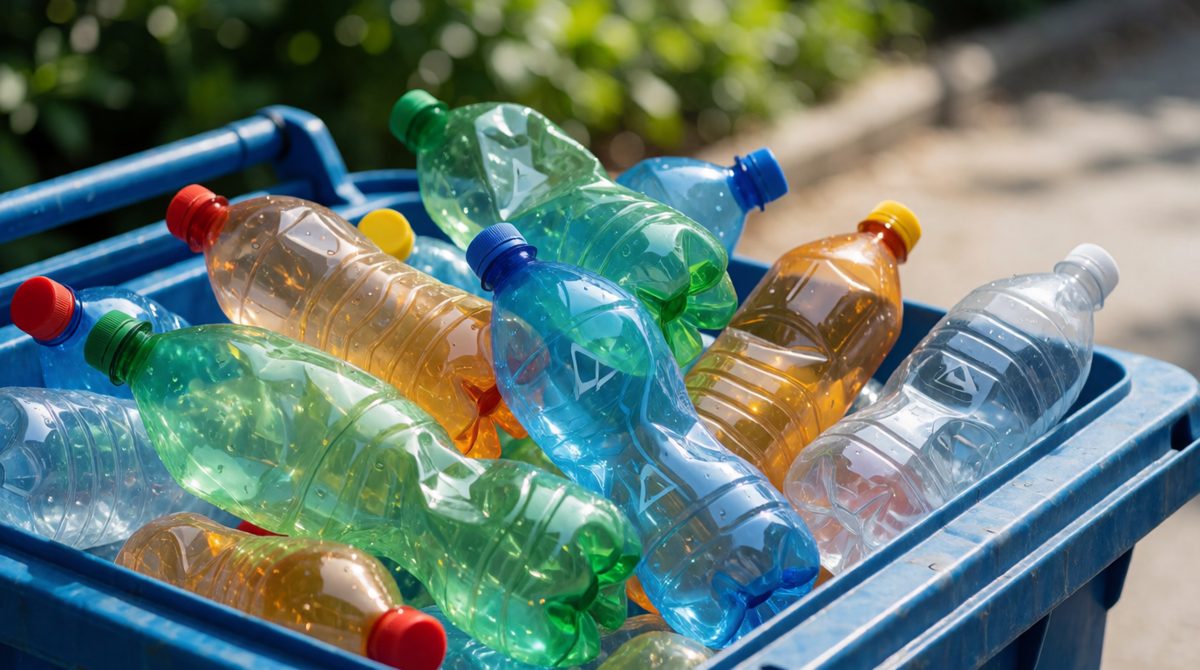
Plastic bottles are polymers - long chains of atoms joined by covalent bonds, just like small molecules but much, much bigger
Covalent bonds are found in three kinds of substance. You need to recognise each one.
⚛ Small molecules
Only a few atoms joined together, such as H2O or CH4. Every molecule of the substance has the same small, fixed number of atoms.
🔗 Polymers
Very large molecules. Thousands of atoms are joined in long chains, like poly(ethene) used to make plastic bags.
💎 Giant covalent structures
A huge network where every atom is covalently bonded to its neighbours, with no separate molecules. Examples: diamond and silicon dioxide.
Spotting a small molecule from its formula. Look for two things. First, it is made only of non-metal elements, so it is usually not ionic (ammonium compounds, such as NH4Cl, are an exception). Second, the formula shows a small number of atoms in one molecule. So H2S, NH3, HCl and Cl2 are all small molecules. NaCl is not, because sodium is a metal, so it is ionic. SiO2 is also made of non-metals, but you need to learn that silicon dioxide is a giant covalent structure, not a small molecule.
Dot and cross diagrams for small molecules
Remember, a dot and cross diagram shows electrons from one atom as dots and from the other atom as crosses. For covalent bonds, the shared pair sits in the overlap where the two outer shells meet. You usually only draw the outer shells. You must be able to draw these eight:
➀ One shared pair
Hydrogen, H2: two circles overlap with one dot and one cross in the middle. Nothing else.
Chlorine, Cl2: one dot and one cross shared in the overlap. Each chlorine also has 3 lone pairs, so each atom has 8 outer electrons around it.
Hydrogen chloride, HCl: one shared pair between H and Cl. Chlorine keeps 3 lone pairs.
➁ More than one shared pair
Oxygen, O2: two shared pairs (four electrons) in the overlap, a double bond. Each oxygen has 2 lone pairs.
Nitrogen, N2: three shared pairs (six electrons) in the overlap, a triple bond. Each nitrogen has 1 lone pair.
💧 Water, H2O
Oxygen in the middle with 2 overlapping hydrogens. 2 shared pairs, and oxygen keeps 2 lone pairs.
⚗ Ammonia, NH3
Nitrogen in the middle with 3 hydrogens. 3 shared pairs, and nitrogen keeps 1 lone pair.
🔥 Methane, CH4
Carbon in the middle with 4 hydrogens. 4 shared pairs and no lone pairs.
Worked example: drawing ammonia
1. Nitrogen is 2,5, so it has 5 outer electrons (draw as dots). Each hydrogen has 1 (draw as crosses).
2. Nitrogen needs 3 more, so it shares with 3 hydrogen atoms.
3. Put one dot and one cross in each of the 3 overlaps.
4. That uses 3 of nitrogen's dots. The other 2 dots go together as a lone pair.
5. Check: nitrogen now has 8 outer electrons (6 shared + 2 lone). Each hydrogen has 2. Done.
Showing bonds as lines
A quicker way to show a covalent bond is a line between the two atoms. A single line is a single bond, two lines a double bond and three lines a triple bond. This is sometimes called a stick diagram or displayed formula.
- H2 is H-H, Cl2 is Cl-Cl and HCl is H-Cl.
- O2 is O=O and N2 is N≡N.
- Water is H-O-H. Ammonia is N with three lines to H atoms. Methane is C with four lines to H atoms.
Polymers are too big to draw in full. Instead you draw one repeating unit inside brackets, with a small n after the brackets, where n is a large number. The bonds at each end of the unit go out through the brackets, to show that the chain carries on. For poly(ethene), the repeating unit is two carbons joined by a single line, each with two hydrogens, so its formula can be written (C2H4)n. You will draw these properly in the lesson on Addition Polymerisation.
Giant covalent structures are also too big to draw, so you draw part of one, using lines for the bonds. For silicon dioxide, each silicon is joined by lines to 4 oxygen atoms, and each oxygen to 2 silicon atoms.
Limitations of each diagram
No diagram shows everything. Know what each one misses.
- Dot and cross: shows where each bonding electron came from and the lone pairs, but does not show the shape of the molecule or the size of the atoms. In real molecules all electrons are identical, so dots and crosses are only a way of showing which atom each electron came from.
- Lines (2D stick diagram): shows which atoms are bonded and single, double or triple bonds clearly, but does not show the electrons, the lone pairs, or the real 3D shape. Methane drawn flat looks square, but it is really 3D.
- Ball and stick: shows the 3D shape and bond angles, but the atoms are shown much further apart than they really are, bonds are not really sticks, the atoms are not shown at their real relative sizes, and the electrons are not shown.
- 3D space-filling: shows the shape and roughly how big the atoms are, but you cannot see the bonds clearly or tell single from double bonds.
- Giant structures and polymers: any diagram only shows a tiny part. The real structure is far bigger and continues in every direction (or along the chain).
Working out a molecular formula
The molecular formula tells you the actual number of each type of atom in one molecule. To deduce it from any diagram or model, just count each type of atom and write the numbers as subscripts.
Worked example 1
A stick diagram shows 2 carbon atoms joined by a single line. Each carbon is also joined to 3 hydrogen atoms.
Carbon: 2. Hydrogen: 3 + 3 = 6.
Molecular formula: C2H6 (ethane). Check the bonds: each carbon has 4 lines and each hydrogen has 1. Correct.
Worked example 2
A ball and stick model has 1 black ball (carbon) with 2 yellow balls (sulfur) joined to it, one each side, by double sticks.
Carbon: 1. Sulfur: 2.
Molecular formula: CS2 (carbon disulfide). You do not write the 1.
Common mistakes
1. Forgetting lone pairs on O, N and Cl in dot and cross diagrams. Count: each atom except hydrogen should end up with 8 outer electrons.
2. Drawing the shared pair outside the overlap. Shared electrons must sit where the shells meet.
3. Drawing only one shared pair in O2 or N2. Oxygen needs 2 shared pairs and nitrogen needs 3.
4. Calling silicon dioxide a small molecule. It is a giant covalent structure.
5. Writing C2H6 as CH3. The molecular formula is the real count in one molecule.
Exam-style question
(a) Draw a dot and cross diagram for a molecule of water. Show the outer electrons only. [2 marks]
(b) A student draws methane as a flat cross with C in the middle and four lines to H atoms. Give one limitation of this diagram. [1 mark]
(c) A model of a molecule shows 1 nitrogen atom and 3 hydrogen atoms. Give its molecular formula. [1 mark]
Model answer
(a) Oxygen in the middle with a hydrogen on each side, overlapping. Each overlap holds one dot and one cross (1 mark). Oxygen also has 2 lone pairs, so 8 electrons in total around oxygen (1 mark).
(b) It does not show the real 3D shape of the molecule (or: it does not show the electrons).
(c) NH3.
Exam tip
After drawing any dot and cross diagram, count the electrons around each atom. Hydrogen should have 2, and every other atom here should have 8. If not, you have missed a lone pair or a shared pair.