⊕ What is left behind
When an atom's outer electrons become delocalised, it has more protons than electrons. So each metal atom in the structure becomes a positive ion. These positive ions sit in the regular pattern.
Sign up to access the complete lesson and track your progress!
Unlock This Course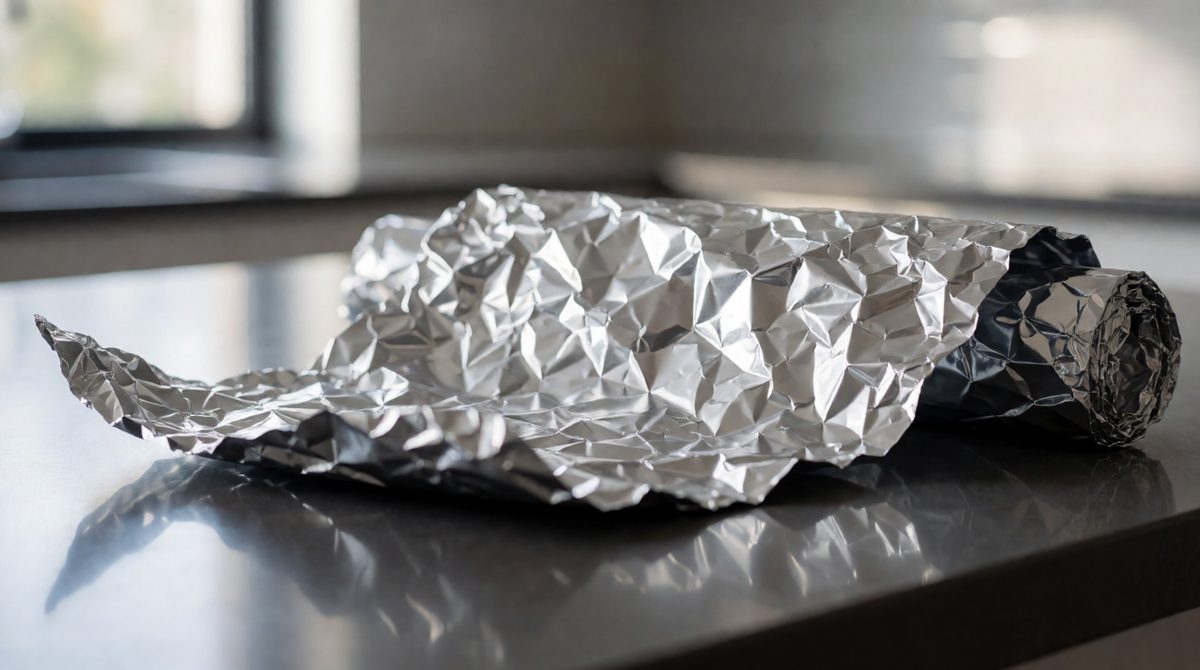
Aluminium foil looks smooth, but inside it's one giant structure of metal atoms packed in a regular pattern
Think of a sheet of aluminium foil. It looks solid and smooth, but inside it is made of a huge number of metal atoms packed tightly together. These atoms are not joined in small groups. They form one enormous structure that carries on in every direction until it reaches the edge of the piece of metal.
The spec says metals consist of giant structures of atoms arranged in a regular pattern. Two ideas are packed into that sentence:
Every atom in a pure metal is the same element, so they are all the same size. That is why they can stack so neatly, a bit like oranges stacked in layers on a market stall.
Key terms:
Metal atoms have only a few electrons in their outer shell. In a metal, these outer shell electrons are delocalised. This means they leave their own atom and are free to move through the whole structure. They are not stuck between two particular atoms, and they do not belong to any one atom any more.
Only the outer shell electrons do this. The electrons in the inner shells stay with their own atom.
When an atom's outer electrons become delocalised, it has more protons than electrons. So each metal atom in the structure becomes a positive ion. These positive ions sit in the regular pattern.
The delocalised electrons move around between the positive ions, spread through the whole metal. You may see this called a 'sea' of delocalised electrons.
The number of delocalised electrons each atom gives depends on how many outer shell electrons it has. Remember, for Groups 1 and 2 the group number tells you the number of outer electrons. Aluminium, in Group 3, has 3.
Overall, a piece of metal has no charge. The total positive charge on the ions is exactly balanced by the total negative charge of the delocalised electrons.
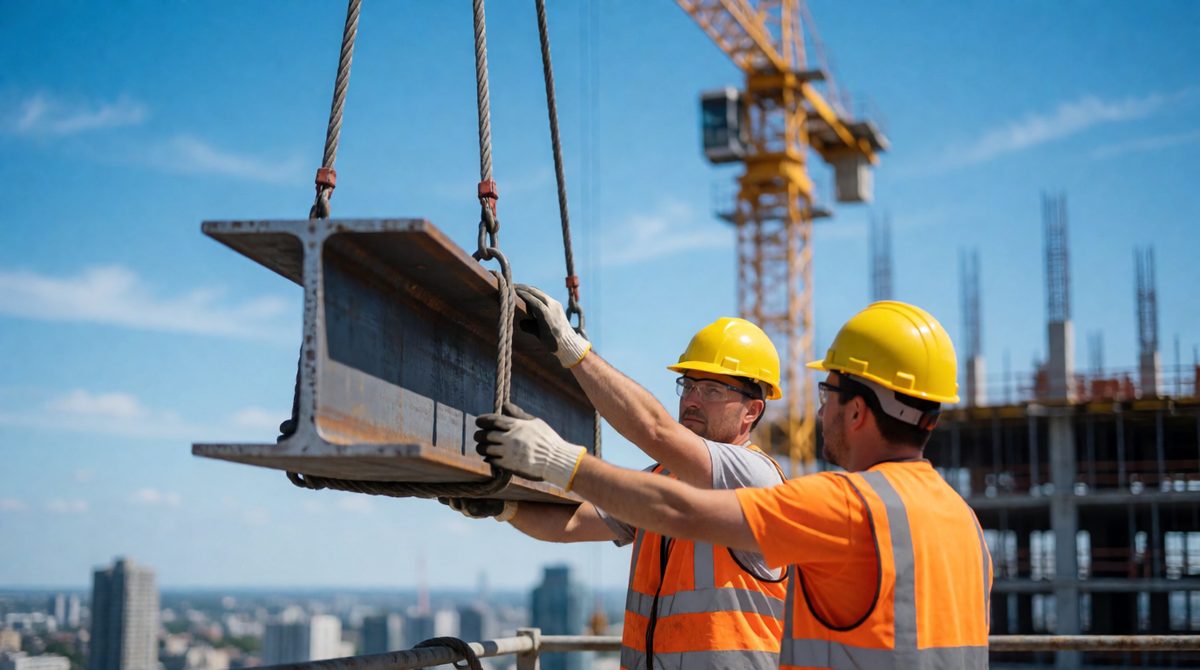
Steel beams this strong owe it to metallic bonding - positive ions pulled hard by a sea of delocalised electrons
The spec says the sharing of delocalised electrons gives rise to strong metallic bonds. Here is why.
The positive metal ions and the negative delocalised electrons attract each other. This is an electrostatic attraction between opposite charges. Each positive ion is attracted to the delocalised electrons all around it, and the electrons are attracted to all the ions around them. The electrons act like a glue that holds the positive ions together in their regular pattern.
Because the electrons are shared by the whole structure, the attraction acts in all directions, and there is a huge number of these attractions in the giant structure. That is what makes metallic bonding a strong bond. Metallic bonding is one of the three types of strong chemical bond, along with ionic and covalent bonding.
How this bonding explains what metals are like, such as melting points, bending and conducting electricity, is covered in the lesson on Properties of Metals and Alloys.
The spec shows metallic bonding with a simple 2D diagram. You should be able to draw one and recognise one.
This is a 2D drawing of a 3D structure. The real metal has layers stacked on top of each other, going back into the page as well. Your drawing shows just one flat slice.
In the exam you may be shown a diagram and asked what type of structure it is. Look for these clues:
All the circles are the same, all are positive, and there are free electrons in the spaces between them.
Two kinds of ion, positive and negative, often different sizes, alternating in the pattern. No free electrons.
Atoms joined by lines (bonds) or overlapping shells. No charged particles: atoms share pairs of electrons.
A diagram shows 12 magnesium ions in a metallic structure. How many delocalised electrons should the diagram show?
Step 1: Magnesium is in Group 2, so each atom has 2 outer electrons.
Step 2: Each atom gives 2 delocalised electrons and becomes Mg2+.
Step 3: 12 ions × 2 electrons = 24 delocalised electrons.
Check: total positive charge = 12 × 2+ = 24+. Total negative charge = 24-. They balance, so the metal has no overall charge.
A diagram of a metal shows 20 positive ions and 20 delocalised electrons. Is the metal sodium or aluminium?
There is 1 delocalised electron for each ion, so each ion has a 1+ charge. Sodium is in Group 1 and gives 1 electron per atom. The metal is sodium. Aluminium would need 3 × 20 = 60 electrons.
Magnesium is a metal. Describe the structure and bonding in magnesium. You may include a labelled diagram in your answer. [4 marks]
Magnesium has a giant structure of atoms arranged in a regular pattern (1). The outer shell electrons of the magnesium atoms are delocalised, so they are free to move through the whole structure (1). This leaves positive magnesium ions, Mg2+, in a regular pattern (1). There is a strong electrostatic attraction between the positive ions and the shared delocalised electrons, which is the metallic bond (1).
Diagram: rows of same-sized circles labelled Mg2+ (or +), with e- spread between them, labelled 'positive ions' and 'delocalised electrons'.
Always use the word delocalised and say what attracts what: positive metal ions attract the delocalised electrons. Naming both particles is often worth a mark on its own.