Solids, liquids and gases

Solid ice, liquid water and gaseous steam all in one shot - same particles, just different arrangements and energy
Everything around you is a solid, a liquid or a gas. These are the three states of matter. A chocolate bar, the juice in a carton and the air you breathe are made of particles, and the state depends on how those particles are arranged and how they move.
Chemists show this with a simple particle model. In this model, each particle is drawn as a small solid sphere (a little ball). The particles could be atoms, ions or molecules, but the model draws them all the same way.
■ Solid
Particles are packed closely in a regular pattern. They vibrate about fixed positions. A solid keeps its own shape and cannot be squashed.
● Liquid
Particles are still close together but arranged randomly. They can move around each other. A liquid flows and takes the shape of its container.
○ Gas
Particles are far apart and arranged randomly. They move quickly in all directions. A gas spreads out to fill its container and can be squashed.
When you draw these in an exam, make the solid a neat grid of touching circles, the liquid a jumbled group of mostly touching circles, and the gas a few circles spread well apart. Keep the circles the same size in all three, because it is the same substance.
Key terms:
- States of matter: the three forms a substance can take: solid, liquid and gas.
- Particle model: a simple model where particles are shown as small solid spheres.
- Melting point: the temperature at which a solid melts and a liquid freezes.
- Boiling point: the temperature at which a liquid boils and a gas condenses.
Changing state
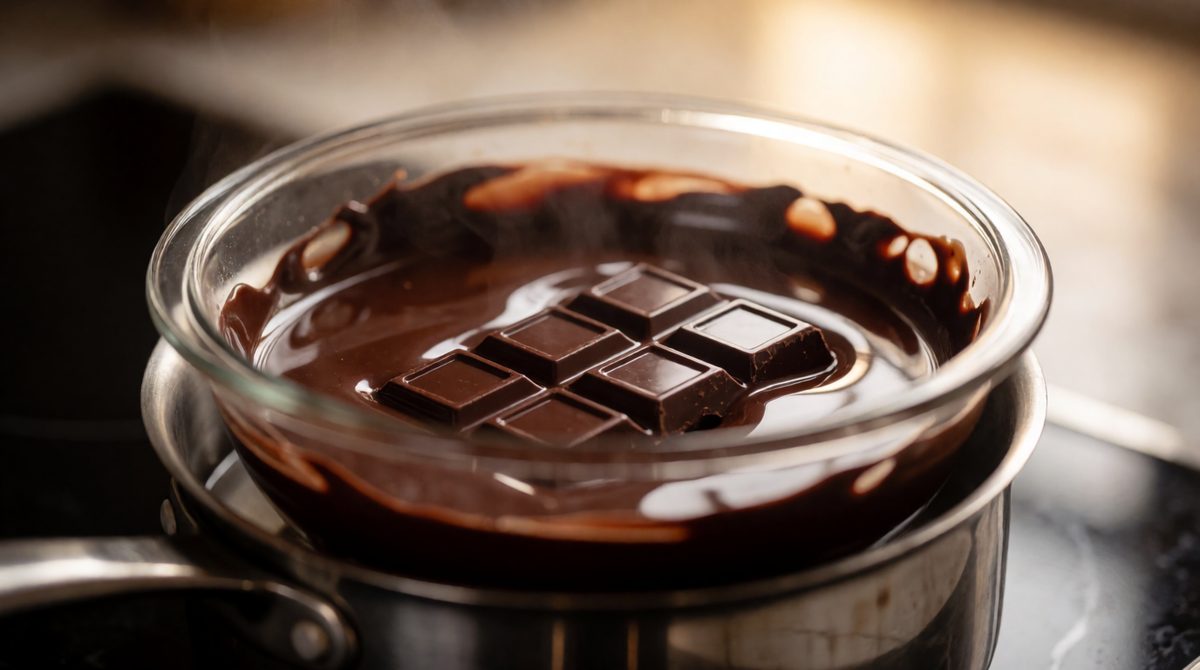
This chocolate is melting at its melting point - the same temperature at which it would freeze again
There are four changes of state you need to know:
- Melting: solid to liquid
- Freezing: liquid to solid
- Boiling: liquid to gas
- Condensing: gas to liquid
Here is the key fact from the spec: melting and freezing take place at the melting point, and boiling and condensing take place at the boiling point. A substance's freezing point is the same temperature as its melting point. Pure water, for example, melts at 0 °C and also freezes at 0 °C.
Changes of state are physical changes. No new substance is made. The particles stay the same, only their arrangement and movement change.
Energy and the forces between particles
Particle theory explains changes of state using energy.
🔥 Melting and boiling
Energy is transferred to the substance, usually by heating. The particles gain energy and this energy is used to overcome the forces holding them together. In melting, enough forces are overcome for the particles to move around each other. In boiling, the forces are overcome so the particles can move far apart.
❄ Freezing and condensing
Energy is transferred from the substance to the surroundings as it cools. The particles lose energy, and the forces between them pull them back closer together. Gas particles condense into a liquid, and liquid particles freeze into a fixed pattern.
The spec says the amount of energy needed to change from solid to liquid and from liquid to gas depends on the strength of the forces between the particles.
- Strong forces need a lot of energy to overcome, so the substance has a high melting point and boiling point.
- Weak forces need little energy to overcome, so the substance has a low melting point and boiling point.
Which forces are involved depends on the type of bonding and the structure of the substance. You met ionic, covalent and metallic bonding in earlier lessons. In giant structures, melting means breaking lots of strong bonds, so melting points are high. Substances made of small molecules have only weak forces between the molecules, so they melt and boil at low temperatures. You will look at each structure in detail in Properties of Ionic Compounds and Small Molecules, Polymers and Giant Covalent Structures, and Properties of Metals and Alloys.
Atoms don't have bulk properties
Properties such as melting point, colour, hardness or being able to conduct electricity are bulk properties. They belong to a large amount of a substance, made of a huge number of particles together.
A single atom does not have these properties. One iron atom does not have a melting point, because melting is about many particles changing how they are arranged. One atom cannot be "solid" or "liquid" on its own. The properties come from how the particles are arranged and how strongly they are held together.
Higher tier only
The simple model is useful, but it has limitations. The spec lists three:
- There are no forces in the model. The spheres are drawn with nothing holding them together. Yet changes of state are all about overcoming forces between particles, so the model cannot show why some substances need more energy to melt or boil than others.
- All particles are shown as spheres. Real particles have different shapes. A water molecule, for example, is not round.
- The spheres are solid. Real atoms are mostly empty space with a tiny nucleus, as you saw in Developing the Model of the Atom.
So when the spec talks about solid inelastic spheres which have no forces between them, the key point is this: a model with no forces cannot explain why energy must be transferred at the melting and boiling points.
Predicting the state from data
You can work out the state of any substance at a given temperature if you know its melting point and boiling point. Use this rule:
- Below the melting point: solid
- Between the melting point and the boiling point: liquid
- Above the boiling point: gas
A number line helps. Mark the melting point and boiling point, then see where your temperature falls.
Worked example
The table shows data for four substances.
- A: melting point −114 °C, boiling point 78 °C
- B: melting point 801 °C, boiling point 1413 °C
- C: melting point −218 °C, boiling point −183 °C
- D: melting point 44 °C, boiling point 280 °C
What state is each at 25 °C?
A: 25 is above −114 but below 78, so liquid.
B: 25 is below 801, so solid.
C: 25 is above −183, so gas.
D: 25 is below 44, so solid.
Which substance has the strongest forces between its particles? B, because it has the highest melting point and boiling point.
What state is D at 100 °C? 100 is between 44 and 280, so liquid.
Common mistakes
- Negative numbers: −183 is higher than −218. Students often get this the wrong way round. Picture a thermometer: the further below zero, the colder.
- Mixing up melting point and boiling point. Melting point is the solid and liquid boundary. Boiling point is the liquid and gas boundary.
- Forgetting energy is released when a substance freezes or condenses. Energy goes in for melting and boiling, and comes out for freezing and condensing.
State symbols
In chemical equations, we show the state of each substance with a state symbol in brackets after its formula.
- (s) solid
- (l) liquid
- (g) gas
- (aq) aqueous, meaning dissolved in water
Some examples:
- Carbon burning: C(s) + O2(g) → CO2(g)
- Heating calcium carbonate: CaCO3(s) → CaO(s) + CO2(g)
- Water boiling: H2O(l) → H2O(g)
- Salt dissolving in water: NaCl(s) → NaCl(aq)
You need to add the right state symbols to equations for the reactions you meet across the course, so look out for them in later lessons.
Key terms:
- State symbol: a letter in brackets in an equation showing whether a substance is solid, liquid, gas or aqueous.
- Aqueous solution: a solution where the solvent is water.
Common mistakes
Water itself is (l), never (aq). Aqueous means dissolved in water, so the water can't be dissolved in itself. Also, check the conditions in the question. Water in a beaker is H2O(l), but steam is H2O(g).
Exam-style question
Substance X has a melting point of −7 °C and a boiling point of 59 °C. Substance Y has a melting point of 1085 °C and a boiling point of 2562 °C.
(a) Give the state of X at 20 °C. [1 mark]
(b) Explain, in terms of forces and energy, why Y has a much higher melting point than X. [3 marks]
Model answer
(a) Liquid (20 °C is between −7 °C and 59 °C).
(b) The forces between the particles in Y are much stronger than in X (1). Melting needs energy to overcome these forces (1). So more energy is needed to melt Y, which means a higher temperature (1).
Exam tip
In "explain" questions about melting or boiling points, always link three things: the strength of the forces, the energy needed to overcome them, and the temperature. Missing out energy loses a mark.