➕ Positive ions
Group 1 (Li, Na, K): +1, e.g. Na+
Group 2 (Mg, Ca): +2, e.g. Mg2+
Aluminium: +3, Al3+
Hydrogen: +1, H+

Every sip of this water is packed with H₂O molecules: two hydrogen atoms bonded to one oxygen atom
A formula tells you which elements are in a substance and how many atoms of each there are. The symbols tell you the elements. The small numbers written low down, called subscripts, tell you how many atoms of the element just before them.
Brackets work like brackets in maths. The number outside multiplies everything inside. In Ca(OH)2 there is 1 calcium atom, 2 oxygen atoms and 2 hydrogen atoms.
Some elements exist as pairs of atoms joined together, so their formula has a 2. You need to know these seven: H2, N2, O2, F2, Cl2, Br2 and I2. Whenever any of these seven appear in an equation as elements, always write them with the 2.
Key terms:
For many compounds you just learn the formula: water H2O, carbon dioxide CO2, ammonia NH3, methane CH4 and hydrogen chloride HCl. For compounds of a metal and a non-metal, you can work the formula out using the charges on their ions. Ions are charged particles. You will learn why they have these charges in Ionic Bonding. For now, use this table as a tool.
Group 1 (Li, Na, K): +1, e.g. Na+
Group 2 (Mg, Ca): +2, e.g. Mg2+
Aluminium: +3, Al3+
Hydrogen: +1, H+
Group 7 (F, Cl, Br, I): -1, e.g. Cl-
Oxide O2- and sulfide S2-: -2
Hydroxide OH- and nitrate NO3-: -1
Sulfate SO42- and carbonate CO32-: -2
The rule is simple: the charges must add up to zero, because a compound has no overall charge. Pick the smallest number of each ion that makes this happen.
Potassium chloride: K+ and Cl-. +1 and -1 already make zero, so the formula is KCl.
Magnesium chloride: Mg2+ and Cl-. You need two Cl- to cancel +2, so the formula is MgCl2.
Aluminium oxide: Al3+ and O2-. The smallest total both can reach is 6. Two Al3+ give +6 and three O2- give -6, so the formula is Al2O3.
If you need more than one of an ion made of several atoms, put it in brackets: calcium hydroxide is Ca(OH)2, not CaOH2.
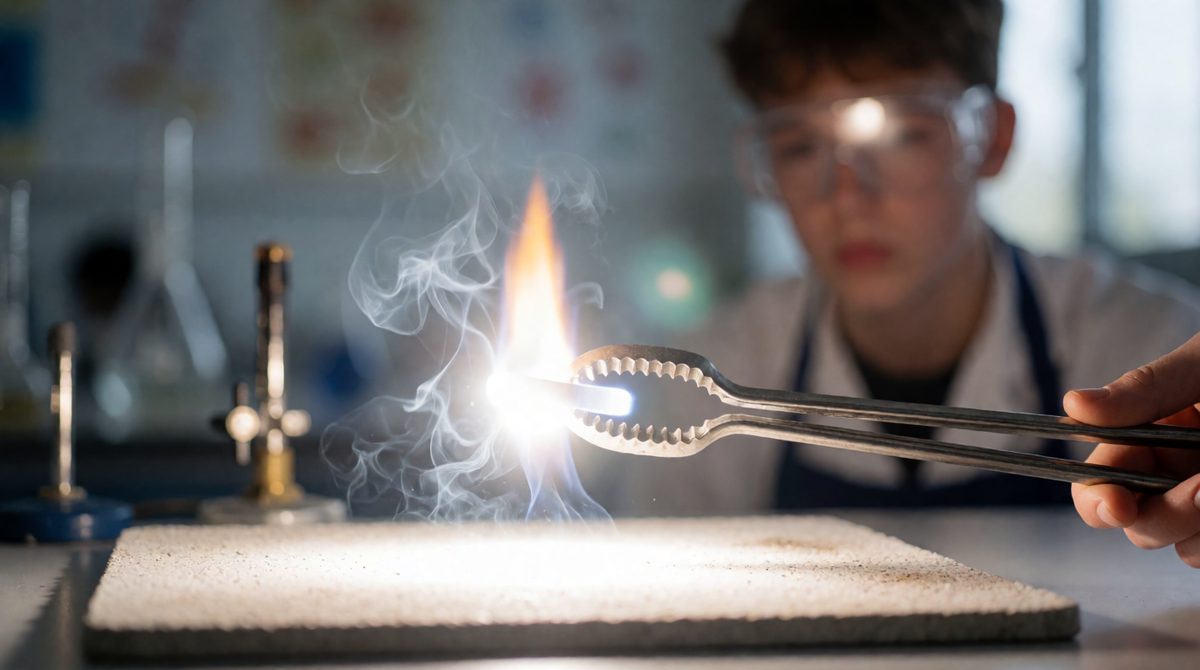
That dazzling white flame is magnesium joining with oxygen: 2Mg + O₂ → 2MgO, same atoms on both sides
A word equation names the reactants and products. A symbol equation shows the same reaction with formulae. A balanced symbol equation has the same number of atoms of each element on both sides of the arrow. You will see why this must be true in Conservation of Mass.
To balance an equation you put big numbers in front of formulae. These are called balancing numbers (or coefficients). A 2 in front of H2O means two whole water molecules: 4 hydrogen atoms and 2 oxygen atoms.
Key terms:
Turn the word equation into formulae. Get every formula right first and never change it later.
Count each element on the left and on the right. Find one that doesn't match.
Put a number in front of a formula to fix it, then count again. Repeat until every element matches.
magnesium + oxygen → magnesium oxide
Formulae: Mg + O2 → MgO
Oxygen: 2 on the left, 1 on the right. Put a 2 in front of MgO: Mg + O2 → 2MgO
Now magnesium is 1 on the left and 2 on the right. Put a 2 in front of Mg:
2Mg + O2 → 2MgO (Mg: 2 and 2. O: 2 and 2. Balanced.)
methane + oxygen → carbon dioxide + water
Formulae: CH4 + O2 → CO2 + H2O
Carbon: 1 and 1, fine. Hydrogen: 4 on the left, 2 on the right, so put a 2 in front of H2O. Now oxygen on the right is 2 (in CO2) + 2 (in 2H2O) = 4. Put a 2 in front of O2:
CH4 + 2O2 → CO2 + 2H2O
Tip: balance the element that appears on its own (here oxygen, as O2) last.
lithium + oxygen → lithium oxide
Formulae: Li + O2 → Li2O (Li+ and O2-)
Oxygen: 2 on the left, 1 on the right, so write 2Li2O. That gives 4 lithium on the right, so write 4Li:
4Li + O2 → 2Li2O
Changing a subscript to balance. Writing H2O2 to get more oxygen turns water into a different substance (hydrogen peroxide). Only ever change the big numbers in front.
Forgetting the 2 on elements that exist as pairs. Oxygen is O2, not O. Hydrogen is H2.
Not multiplying through. 2Ca(OH)2 contains 4 oxygen atoms and 4 hydrogen atoms, not 2.
Leaving numbers that could be smaller. 4Mg + 2O2 → 4MgO is balanced, but you should divide by 2 to give the simplest whole numbers.
An ionic equation shows only the particles (ions, atoms or molecules) that actually take part in a reaction. Ions that are there at the start and still there, unchanged, at the end are called spectator ions and are left out. When any acid reacts with any alkali, the reaction that really happens is:
H+ + OH- → H2O
A half equation shows what happens to just one substance when it loses or gains electrons. Electrons are written as e-. For example, a sodium atom losing one electron:
Na → Na+ + e-
In ionic and half equations the atoms must balance and the total charge must be the same on both sides. In the half equation above, the left has charge 0 and the right has +1 and -1, which also make 0. You will use these much more in Oxidation and Reduction in Terms of Electrons and Half Equations at the Electrodes.
Calcium reacts with water to make calcium hydroxide and hydrogen.
(a) Write the formula of calcium hydroxide. [1 mark]
(b) Write a balanced symbol equation for the reaction. [2 marks]
(a) Ca2+ needs two OH- ions, so the formula is Ca(OH)2.
(b) Ca + H2O → Ca(OH)2 + H2. The right has 4 hydrogen and 2 oxygen atoms, so put a 2 in front of H2O:
Ca + 2H2O → Ca(OH)2 + H2
1 mark for all the correct formulae, 1 mark for correct balancing.
When you finish, tick off every element with a quick count on each side. It takes ten seconds and catches most mistakes.
Access the full course and all the resources like custom timetables and progress tracking.
Join Today