Properties of ionic compounds
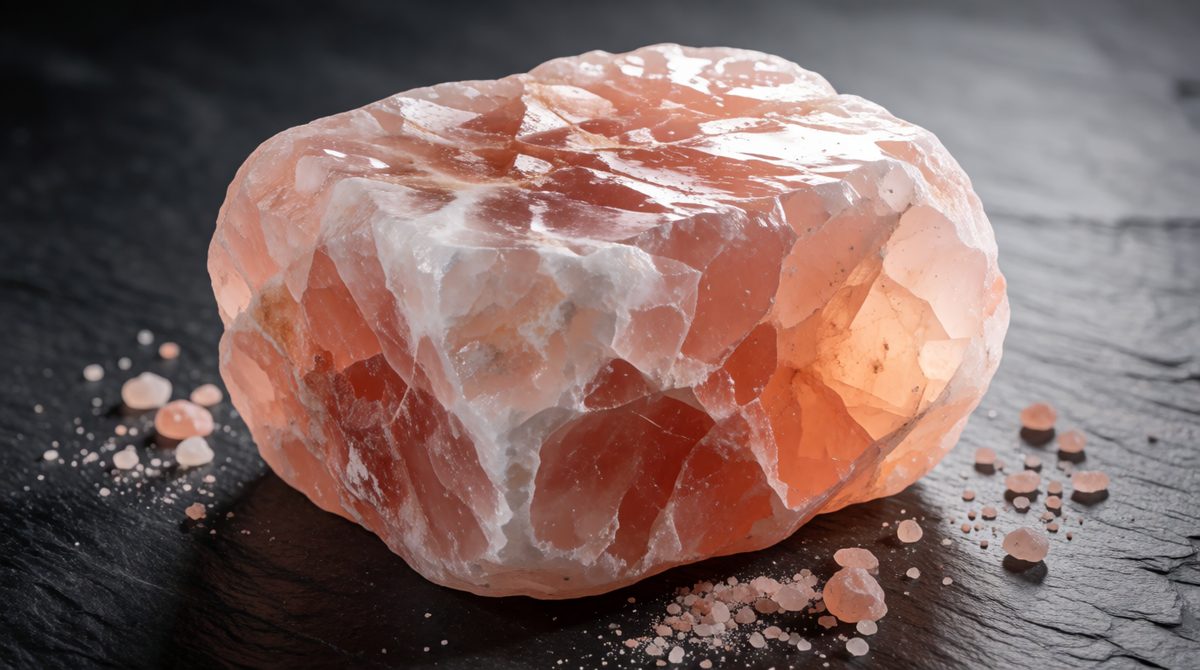
Rock salt needs over 800 °C to melt - those strong ionic bonds in every direction take a lot of energy to break
Remember, an ionic compound is a giant ionic lattice. Oppositely charged ions sit in a regular pattern, and there are strong electrostatic forces of attraction in all directions between them. These forces are the ionic bonds. Every ion is pulled on by the ions around it, and there are a huge number of ions in even a tiny grain.
This structure explains the two big properties of ionic compounds that the exam asks about.
🌡 High melting and boiling points
To melt an ionic compound, the ions must break free from their fixed places. That means overcoming many strong bonds. This takes a large amount of energy, so the temperature must be very high. Sodium chloride (table salt) melts at 801 °C. That is why salt stays solid in a hot frying pan.
⚡ Conducting electricity
For a substance to conduct, charged particles must be free to move so that charge can flow. In an ionic compound, the charged particles are the ions. When the compound is melted or dissolved in water, the ions are free to move, so it conducts.
Solid, molten or dissolved?
Whether an ionic compound conducts depends on whether its ions can move.
■ Solid
The ions are held in fixed positions in the lattice. They can only vibrate. They cannot move from place to place, so a solid ionic compound does not conduct.
🔥 Melted (molten)
The lattice has broken down. The ions can move past each other, so charge can flow. Molten sodium chloride conducts.
💧 Dissolved in water
The ions separate and spread out through the water. They are free to move, so the solution conducts. Salt water conducts electricity.
A useful way to remember it: ionic compound + moving ions = conducts. Solid salt has ions, but they are stuck, so no current flows.
You only need to know the structure of sodium chloride for the exam. For any other ionic compound, use the same ideas: strong forces in all directions, lots of energy to overcome them, and ions that must be free to move to carry charge.
Properties of small molecules

That candle smell is small wax molecules escaping - weak intermolecular forces mean low melting and boiling points
Remember, a small molecule is a few atoms joined by covalent bonds. Substances made of small molecules are usually gases or liquids at room temperature. They have relatively low melting points and boiling points.
To understand why, you need to spot that there are two different kinds of force in a substance made of molecules:
- Covalent bonds hold the atoms together inside each molecule. These are very strong.
- Intermolecular forces act between separate molecules. These are weak.
Key terms:
- Intermolecular forces: the weak forces of attraction between molecules. "Inter" means between.
When a substance made of small molecules melts or boils, it is the weak intermolecular forces that are overcome, not the covalent bonds. The molecules move apart from each other, but every molecule stays whole. For example, when liquid methane boils, the gas is still made of CH4 molecules. Only a small amount of energy is needed to overcome weak forces, so the melting and boiling points are low.
This is how the spec wants you to explain the bulk properties of molecular substances: intermolecular forces are weak compared with covalent bonds.
Bigger molecules, higher boiling points
The intermolecular forces increase with the size of the molecules. Bigger molecules attract each other more strongly, so more energy is needed to pull them apart. This means larger molecules have higher melting and boiling points.
You can see this in a family of molecules made only of carbon and hydrogen atoms (you will meet them again in a later lesson on crude oil):
- Methane, CH4: boiling point -162 °C
- Ethane, C2H6: boiling point -89 °C
- Propane, C3H8: boiling point -42 °C
- Pentane, C5H12: boiling point 36 °C
As the molecules get bigger, the boiling point goes up. Methane, ethane and propane are gases at room temperature, but pentane is a liquid. All of them still have low boiling points compared with sodium chloride.
Worked example
Hexane, C6H14, is the next molecule after pentane in the same family. Predict whether its boiling point is higher or lower than that of pentane, and explain why.
Step 1: Compare sizes. Hexane has more atoms than pentane, so it is a larger molecule.
Step 2: Link size to forces. Larger molecules have stronger intermolecular forces.
Step 3: Link forces to energy. More energy is needed to overcome stronger forces.
Answer: Hexane has a higher boiling point than pentane. (Its real boiling point is 69 °C.)
Why small molecules do not conduct
Substances made of small molecules do not conduct electricity. This is because the molecules do not have an overall electric charge. Even when the substance is a liquid and the molecules can move, there are no charged particles to carry the current.
Compare salt and sugar. Salt solution conducts because it contains ions that can move. Sugar is made of molecules, so sugar solution does not conduct.
Ionic compounds and small molecules side by side
⚛ Ionic compounds
Giant lattice of ions. Many strong ionic bonds to overcome. High melting and boiling points. Solids at room temperature. Conduct only when melted or dissolved.
○ Small molecules
Separate molecules. Weak intermolecular forces to overcome. Low melting and boiling points. Usually gases or liquids. Do not conduct, because the molecules have no overall charge.
Common mistakes
Saying covalent bonds break when a small molecule boils. They do not. Only the weak forces between molecules are overcome. Writing "the covalent bonds are weak" loses marks, because covalent bonds are strong.
Saying ionic compounds have intermolecular forces. Ionic compounds are not made of molecules. Talk about strong electrostatic forces between oppositely charged ions.
Saying electrons carry the charge in molten salt. In ionic compounds it is the ions that move, not electrons.
Saying solid ionic compounds conduct. The ions are there, but they are fixed in place.
Exam-style question
Substance A melts at 801 °C. It conducts electricity when molten but not when solid. Substance B boils at -42 °C and does not conduct electricity.
(a) Explain why substance A has a high melting point. [2 marks]
(b) Explain why substance A conducts when molten but not when solid. [2 marks]
(c) Explain why substance B has a low boiling point. [2 marks]
Model answer
(a) A is ionic, with strong electrostatic forces of attraction between oppositely charged ions (1). A large amount of energy is needed to overcome these many strong bonds (1).
(b) When molten, the ions are free to move so charge can flow (1). In the solid, the ions are held in fixed positions and cannot move (1).
(c) B is made of small molecules with weak intermolecular forces (1). Only a small amount of energy is needed to overcome these forces; the covalent bonds do not break (1).
Exam tip
Always name the particles and the force. Write "strong forces between ions" for ionic compounds and "weak forces between molecules" for small molecules. Then link the force to the amount of energy needed.