▶ Pure metal
All the atoms are the same size. The layers are regular and flat. When a force is applied, the layers slide over each other easily, so the metal is soft.
Sign up to access the complete lesson and track your progress!
Unlock This CourseRemember, a metal is a giant structure of positive ions surrounded by a sea of delocalised electrons. The strong attraction between them is metallic bonding.
The spec puts it simply: metals have giant structures of atoms with strong metallic bonding. This means that most metals have high melting and boiling points.
Here is the chain of reasoning you need:
For example, iron melts at about 1,538 °C and tungsten at about 3,422 °C. That is why tungsten was used for the glowing wire in old-style light bulbs.
Notice the word most. Mercury is a metal, but it is a liquid at room temperature because it melts at about −39 °C. So in an exam, say "most metals", not "all metals".
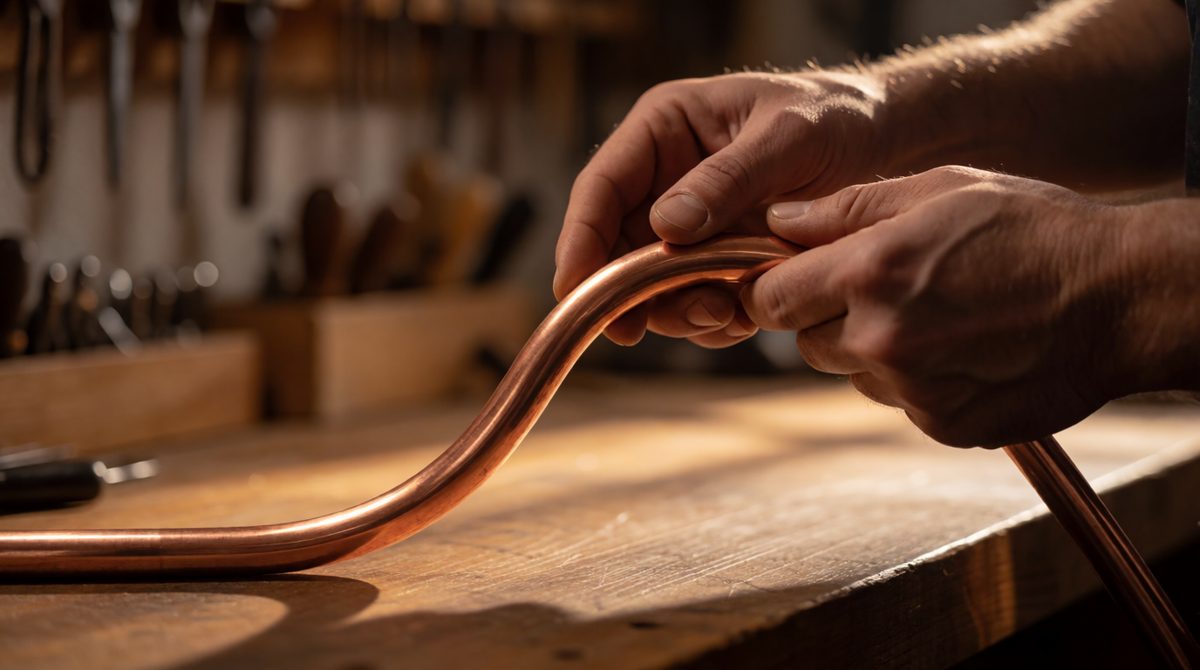
Pure copper bends easily because its layers of same-sized atoms slide over each other
In a pure metal, all the atoms are the same element, so they are all the same size. They pack together neatly in layers.
When you push hard on a pure metal, the layers can slide over each other. The metallic bonding is not broken, because the delocalised electrons can move with the layers and keep holding everything together. So the metal changes shape instead of shattering.
This is why metals can be bent and shaped. Remember, this is what we mean when we say metals are malleable. It lets us hammer metal into sheets, press it into car body panels or bend it into pipes.
Key terms:
But the same feature has a downside. Because the layers slide so easily, pure metals are too soft for many uses. Pure iron, copper and aluminium are all fairly soft. A bridge, a tool or a coin made from a soft pure metal would bend, dent or wear away.
To fix this, pure metals are mixed with other metals to make alloys, which are harder. This is the explanation the spec says you must be able to give.
All the atoms are the same size. The layers are regular and flat. When a force is applied, the layers slide over each other easily, so the metal is soft.
Atoms of a different element are a different size. They distort the layers, so the layers are no longer flat. It is more difficult for the layers to slide over each other, so the alloy is harder.
Think of a pile of paper sheets. A neat stack slides apart easily if you push the top. Now slip a few marbles between the sheets. The sheets are bumpy and jam against each other, so they are much harder to slide. The different-sized atoms in an alloy act like those marbles.
The added atoms can be bigger or smaller than the main metal atoms. Either way, they disrupt the regular layers.
You will meet named alloys and what they are used for in the lesson Alloys as Useful Materials.
Question: A diagram shows two arrangements of atoms. In diagram A, all the circles are the same size and in neat rows. In diagram B, a few larger circles sit among the smaller ones and the rows are bent. Which is the alloy, and which is harder?
Step 1: Look for different-sized atoms. Only B has them, so B is the alloy and A is the pure metal.
Step 2: Link to the layers. In B the larger atoms distort the layers.
Step 3: Link to hardness. Distorted layers cannot slide over each other as easily, so B is harder.
Metals are good conductors of electricity. The reason is the delocalised electrons. They are free to move through the whole structure, so they can carry electrical charge through the metal.
When a metal wire is connected to a cell, the delocalised electrons flow through it. That flow of charge is an electric current. This is why the pins of a plug are made of metal.
Notice it is the electrons that move, not the ions. The positive metal ions stay in their fixed positions in the structure.

The pan heats up fast because delocalised electrons carry thermal energy quickly through the metal
Metals are also good conductors of thermal energy (heat). Again, the delocalised electrons are the key: energy is transferred by the delocalised electrons as they move through the metal.
So when one end of a metal object is heated, energy quickly reaches the other end. This is why saucepans are made of metal: thermal energy passes quickly from the hob to the food. It is also why a metal spoon left in hot soup soon feels hot.
Delocalised electrons carry electrical charge through the metal.
Energy is transferred by the delocalised electrons through the metal.
"Alloys are harder because the bonds are stronger." This does not get the mark. The answer must be about different-sized atoms distorting the layers, so the layers cannot slide easily.
"Metals conduct because ions move." Wrong for solid metals. It is the delocalised electrons that move and carry the charge.
"Free electrons" without saying what they do. Always finish the sentence: they carry charge (electricity) or transfer energy (thermal energy).
"Metals have high melting points because of strong intermolecular forces." Metals do not have molecules. Talk about many strong metallic bonds in a giant structure.
Pure aluminium is too soft for making aircraft parts, so an alloy of aluminium is used instead.
(a) Explain why the alloy is harder than pure aluminium. [3 marks]
(b) Explain why aluminium conducts electricity. [2 marks]
(a) In pure aluminium the atoms are all the same size and are arranged in layers, which can slide over each other (1). In the alloy, atoms of other elements are a different size, which distorts the layers (1). This makes it more difficult for the layers to slide over each other, so the alloy is harder (1).
(b) Aluminium has delocalised electrons (1), which are free to move and carry electrical charge through the metal (1).
For "explain why alloys are harder", use the three key ideas in order: different-sized atoms, layers distorted, layers cannot slide easily. Each one is usually worth a mark.