What is nanoscience?

Nanoparticles are only 1 to 100 nm across, far too small for a normal microscope, so scientists use electron microscopes
Nanoscience is the study of structures that are 1 to 100 nm in size. The unit nm is the nanometre. One nanometre is one billionth of a metre:
1 nm = 1 x 10⁻⁹ m
Structures this small are made of only a few hundred atoms. That is tiny. A human hair is many thousands of nanometres wide, so hundreds of nanoparticles could fit side by side across it.
Remember, an atom has a radius of about 0.1 nm (1 x 10⁻¹⁰ m). Small molecules are only a few atoms across, so they are usually smaller than 1 nm. This means a nanoparticle is bigger than a single atom or small molecule, but far too small to see.
Key terms:
- Nanoscience: the study of structures that are 1 to 100 nm in size, of the order of a few hundred atoms.
- Nanoparticle: a particle 1 to 100 nm in size.
- Bulk material: a material made of normal-sized particles or pieces, not nanoparticles.
- Surface area to volume ratio: the surface area of an object divided by its volume.
Nanoparticles, fine particles and coarse particles
Scientists sort tiny particles into groups by their diameter. You need to know these three groups and their sizes.
⚛ Nanoparticles
1 to 100 nm across. These are the smallest group, and they are smaller than fine particles.
🌫 Fine particles (PM2.5)
Diameters between 100 and 2500 nm. In metres, that is 1 x 10⁻⁷ m to 2.5 x 10⁻⁶ m.
🌪 Coarse particles (PM10)
Diameters between 2.5 x 10⁻⁶ m and 1 x 10⁻⁵ m (2500 to 10 000 nm). Coarse particles are often called dust.
The numbers in the names give a clue. PM2.5 particles are up to 2.5 micrometres across, and PM10 particles are up to 10 micrometres across. One micrometre is 1000 nm, so 2.5 micrometres is 2500 nm.
Worked example: converting sizes
Convert 2.5 x 10⁻⁶ m into nanometres.
Divide by the size of 1 nm: (2.5 x 10⁻⁶) ÷ (1 x 10⁻⁹) = 2.5 x 103 = 2500 nm.
A particle is 4 x 10⁻⁸ m across. Which group is it in?
(4 x 10⁻⁸) ÷ (1 x 10⁻⁹) = 40 nm. This is between 1 and 100 nm, so it is a nanoparticle.
Comparing sizes: orders of magnitude
The spec wants you to compare nano sizes with the sizes of atoms and molecules. A quick way is to use orders of magnitude. Each order of magnitude is a factor of 10.
- An atom has a radius of about 0.1 nm, so its size is of the order of 1 x 10⁻¹⁰ m.
- A 100 nm nanoparticle is 1 x 10⁻⁷ m across.
- 10-7 ÷ 10-10 = 103, so the nanoparticle is three orders of magnitude bigger than an atom. In other words, it is roughly 1000 times bigger.
Worked example: order of magnitude
A coarse particle is 1 x 10⁻⁵ m across. A nanoparticle is 1 x 10⁻⁸ m across. How many times bigger is the coarse particle?
(1 x 10⁻⁵) ÷ (1 x 10⁻⁸) = 1 x 10³
The coarse particle is 1000 times bigger. That is three orders of magnitude. Tip: when dividing powers of ten, subtract the powers: -5 - (-8) = 3.
Surface area to volume ratio
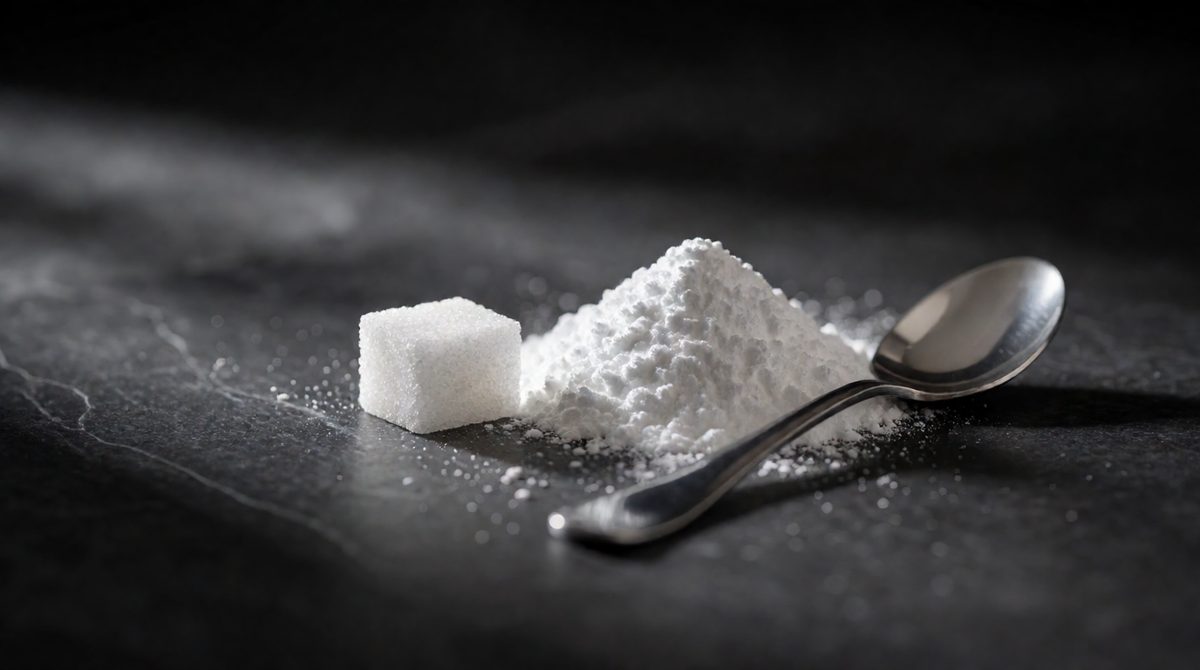
Crushed sugar dissolves faster than a cube, and nanoparticles take that idea to the extreme with a huge surface area to volume ratio
The key to why nanoparticles are special is their surface area to volume ratio. For a cube with sides of length L:
- Each face has an area of L x L. A cube has 6 faces, so surface area = 6 x L2
- Volume = L x L x L = L3
- Surface area to volume ratio = surface area ÷ volume
Worked example: three cubes
Cube A, side 1 cm: surface area = 6 x 1 x 1 = 6 cm2. Volume = 1 x 1 x 1 = 1 cm3. Ratio = 6 ÷ 1 = 6.
Cube B, side 0.1 cm: surface area = 6 x 0.1 x 0.1 = 0.06 cm2. Volume = 0.1 x 0.1 x 0.1 = 0.001 cm3. Ratio = 0.06 ÷ 0.001 = 60.
Cube C, side 0.01 cm: surface area = 6 x 0.01 x 0.01 = 0.0006 cm2. Volume = 0.01 x 0.01 x 0.01 = 0.000001 cm3. Ratio = 0.0006 ÷ 0.000001 = 600.
Each time the side got 10 times smaller, the ratio got 10 times bigger.
This gives the rule from the spec: as the side of a cube decreases by a factor of 10, the surface area to volume ratio increases by a factor of 10.
Why? Surface area depends on L2 but volume depends on L3. When L shrinks, the volume shrinks much faster than the surface area. So for its size, a small cube has far more surface.
Now apply this to nanoparticles. A 10 nm cube has a surface area of 600 nm2 and a volume of 1000 nm3, so its ratio is 600 ÷ 1000 = 0.6 per nm. A 1 mm cube is 1 000 000 nm along each side, so its ratio is only 0.000006 per nm. The side of the nanoparticle cube is 100 000 times smaller, so its ratio is 100 000 times bigger.
Why nanoparticles behave differently
Here is another way to picture it. Imagine a tiny cube built from 10 x 10 x 10 = 1000 atoms. The atoms not on the surface form an inner cube of 8 x 8 x 8 = 512 atoms. So 1000 - 512 = 488 atoms are on the surface. That is about 49% of all the atoms.
Now picture a bigger cube of 100 x 100 x 100 = 1 000 000 atoms. The inner cube is 98 x 98 x 98 = 941 192 atoms, so only 58 808 atoms are on the surface. That is about 6%.
🔬 Different properties
In a nanoparticle, a big share of the atoms are at the surface. Surface atoms are the ones that touch and react with other substances. Because of this high surface area to volume ratio, nanoparticles may have properties different from the same material in bulk.
⚖ Smaller quantities needed
The high surface area to volume ratio also means that smaller quantities may be needed to be effective than for materials with normal particle sizes. More of the material is at the surface doing its job, so less is hidden away inside.
The uses of nanoparticles, and their possible risks, come in the next lesson, Uses and Risks of Nanoparticles.
Common mistakes
Mixing up the ratio direction. Smaller particles have a bigger surface area to volume ratio, not a smaller one. Their actual surface area is smaller, but compared with their volume it is much larger.
Forgetting the 6. A cube has six faces, so surface area is 6 x L2, not L2.
Getting powers of ten wrong. 1 nm is 10-9 m, not 10-6 m. Write out your division step by step.
Mixing up PM2.5 and PM10. PM10 are the bigger, coarse particles (dust). PM2.5 are the smaller, fine particles.
Exam-style question
A cube of a metal has sides of 20 nm.
(a) Calculate the surface area to volume ratio of the cube. [3 marks]
(b) A second cube of the same metal has sides of 2 nm. State how its surface area to volume ratio compares with the first cube. [1 mark]
(c) Explain why nanoparticles of a metal may have different properties from the same metal in bulk. [2 marks]
Model answer
(a) Surface area = 6 x 20 x 20 = 2400 nm2 (1). Volume = 20 x 20 x 20 = 8000 nm3 (1). Ratio = 2400 ÷ 8000 = 0.3 per nm (1).
(b) The side is 10 times smaller, so the ratio is 10 times bigger: 3 per nm (1).
(c) Nanoparticles have a much higher surface area to volume ratio (1), so a much larger share of their atoms are at the surface, where they can react or interact with other substances (1).
Exam tip
If two cube sizes differ by a factor of 10, the ratio changes by a factor of 10 the other way. Use this to check your answer, but always show the full working when the question says "calculate".