✖ Big number in front
A number written in normal script before a formula multiplies everything in that formula. 3H2O means three whole water molecules.
Sign up to access the complete lesson and track your progress!
Unlock This CourseIn a chemical reaction, new substances are made. It can look like something has been created out of nothing, or that something has vanished. But at the level of atoms, nothing is ever created or destroyed.
During a reaction, the atoms in the reactants are simply rearranged. Bonds break, the atoms swap partners, and new bonds form. Every atom you start with is still there at the end. It is just joined to different atoms.
Since the same atoms are there before and after, the total mass cannot change. This is the law of conservation of mass.
Key terms:
Think of it like a set of building bricks. You can pull a model apart and build something completely different, but if you weigh all the bricks before and after, the mass is the same. You have not added or lost any bricks.
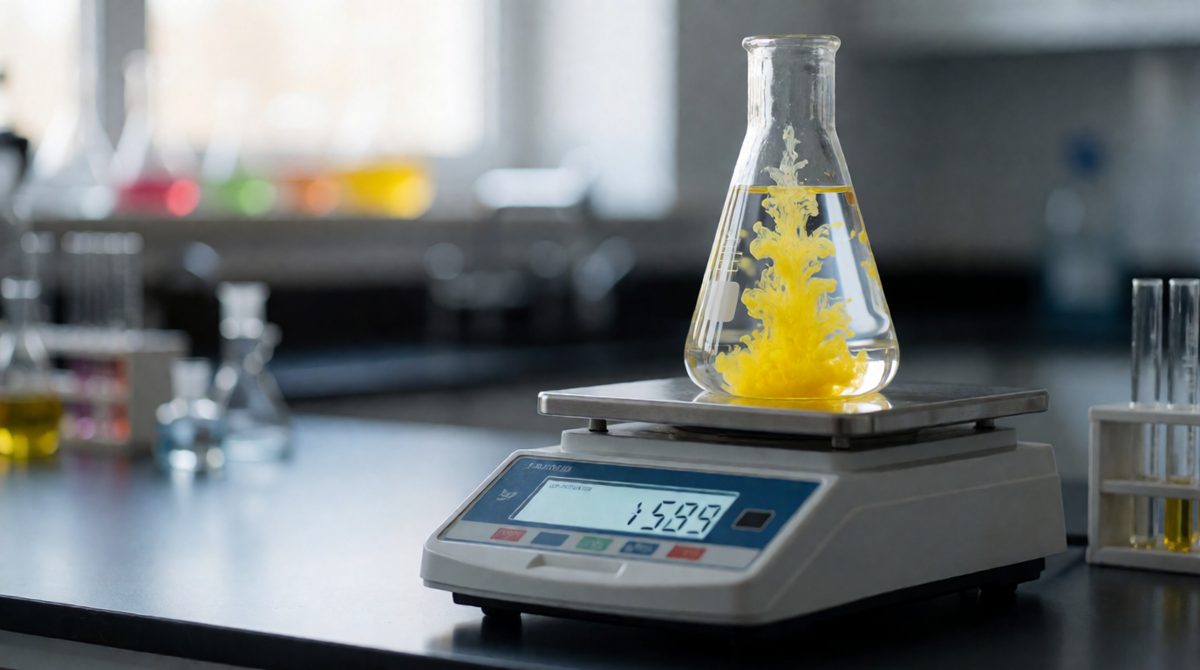
That bright yellow cloud is lead iodide forming, and the balance reading doesn't budge, because no atoms are made or lost
A good way to see the law in action is to mix two solutions that react to make a solid. A solid that forms when two solutions are mixed is called a precipitate.
Lead nitrate solution and potassium iodide solution are both colourless. When they are mixed, a bright yellow solid of lead iodide appears. Something new has clearly been made.
Now imagine doing this on a balance. You put both solutions, in their containers, on the balance. Then you pour one into the other and put both containers back on. The reading on the balance does not change. A new substance has formed, but no atoms have left and none have arrived, so the total mass stays the same.
Here is the balanced symbol equation:
Pb(NO3)2 + 2KI → PbI2 + 2KNO3
Count the atoms on each side and you get exactly the same numbers. That is the law of conservation of mass written as an equation.
A symbol equation is a model of what happens to the atoms in a reaction. If atoms cannot be lost or made, the model must show the same number of atoms of each element on both sides. That is what a balanced equation is.
An unbalanced equation would be saying that atoms have appeared from nowhere or disappeared. That breaks the law of conservation of mass, so it cannot be a true picture of the reaction.
Remember, you balance an equation by changing the balancing numbers in front of formulae, never the formulae themselves. The step by step method is in the lesson Writing Formulae and Balanced Equations. Here we focus on reading the numbers correctly, because that is how you check that atoms are conserved.
A number written in normal script before a formula multiplies everything in that formula. 3H2O means three whole water molecules.
A number written in subscript within a formula multiplies only the atom (or bracket) just before it. In H2O, the 2 belongs to H only.
To count atoms, multiply the subscript by the big number in front. If there is a bracket, multiply by the number outside the bracket too.
3H2SO4
H: 3 × 2 = 6. S: 3 × 1 = 3. O: 3 × 4 = 12. Total = 21 atoms.
2Fe2O3
Fe: 2 × 2 = 4. O: 2 × 3 = 6.
2Al(NO3)3
Al: 2 × 1 = 2. N: 2 × 3 = 6. O: 2 × 3 × 3 = 18.
Fe2O3 + 2Al → Al2O3 + 2Fe
Left: Fe = 2, O = 3, Al = 2
Right: Al = 2, O = 3, Fe = 2
Every element has the same number of atoms on both sides, so the equation is balanced. No atoms are lost or made.
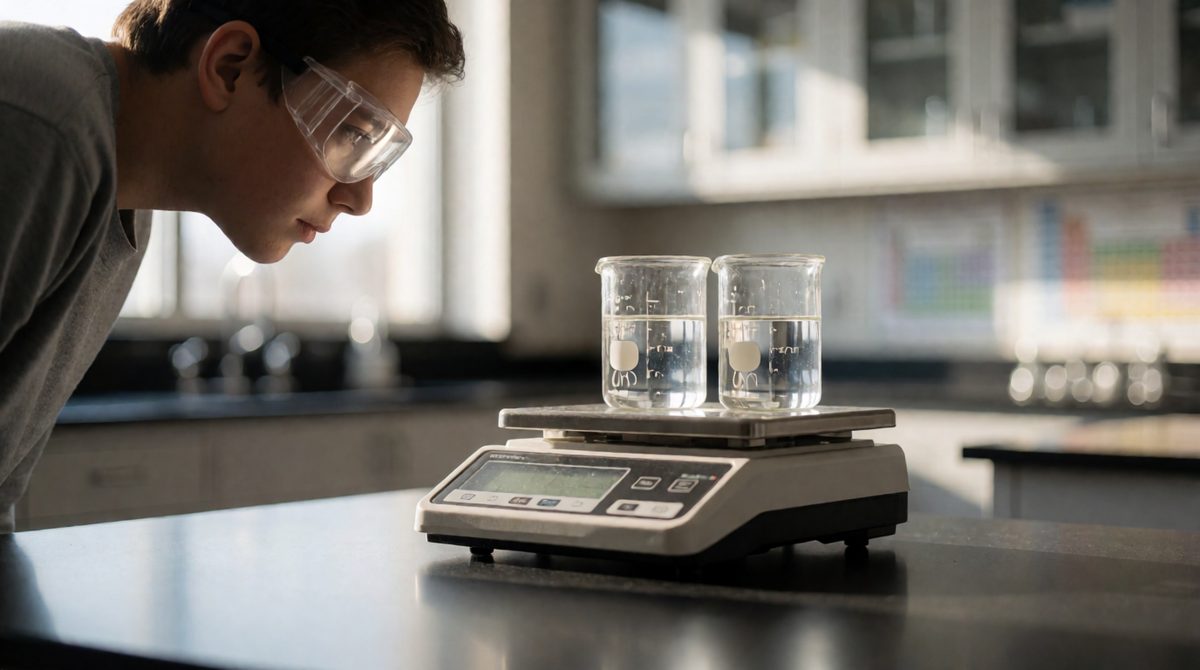
Weigh everything before and after: total mass of reactants always equals total mass of products
Because no atoms are lost or made, you can use one simple rule:
total mass of reactants = total mass of products
If you know all the masses except one, you can work out the missing one by adding or subtracting.
Iron(III) oxide reacts with aluminium: Fe2O3 + 2Al → Al2O3 + 2Fe
160 g of iron(III) oxide reacts completely with 54 g of aluminium. It makes 102 g of aluminium oxide. What mass of iron is made?
Total mass of reactants = 160 + 54 = 214 g
Mass of iron = 214 − 102 = 112 g
When zinc and sulfur are heated together, they react to make zinc sulfide.
zinc + sulfur → zinc sulfide
13.0 g of zinc reacts completely with sulfur to make 19.4 g of zinc sulfide. What mass of sulfur reacted?
Mass of sulfur = 19.4 − 13.0 = 6.4 g
Here you subtract from the product, because the product contains every atom of zinc and every atom of sulfur. If a reaction makes or uses a gas, see the lesson Mass Changes When Gases Are Involved.
A student mixes 40.0 g of one solution with 35.0 g of another solution. A precipitate forms. What is the total mass of the mixture at the end?
Nothing enters or leaves, so the total mass = 40.0 + 35.0 = 75.0 g
The precipitate is part of that 75.0 g. It was made from atoms already in the two solutions.
Only multiplying part of a formula. In 3H2SO4 the 3 multiplies the S and the O as well as the H. Students often write 6 H atoms but forget there are 12 O atoms.
Applying a subscript to the wrong atom. In SO4, the 4 belongs to O, not S.
Forgetting the bracket. In Al(NO3)3 the 3 outside the bracket multiplies both N and O.
Thinking a new substance means new atoms. A colour change or a new solid does not mean atoms were made. They were rearranged.
Adding masses on the wrong side. Add up all the reactants together, or all the products together. Then compare the two totals.
Copper sulfate solution reacts with sodium hydroxide solution. A blue precipitate of copper hydroxide forms.
CuSO4 + 2NaOH → Cu(OH)2 + Na2SO4
(a) How many oxygen atoms are shown on the right-hand side of the equation? (1 mark)
(b) A student mixes 16.0 g of copper sulfate with 8.0 g of sodium hydroxide, both in solution. They react completely to form 9.8 g of copper hydroxide. Calculate the mass of sodium sulfate formed. (2 marks)
(c) Explain, in terms of atoms, why the total mass does not change during this reaction. (2 marks)
(a) Cu(OH)2 has 2 oxygen atoms and Na2SO4 has 4. Total = 6.
(b) Total mass of reactants = 16.0 + 8.0 = 24.0 g. Mass of sodium sulfate = 24.0 − 9.8 = 14.2 g.
(c) No atoms are lost or made during the reaction. The atoms are only rearranged into new substances, so the mass of the products equals the mass of the reactants.
When asked to explain conservation of mass, always use the word atoms. "No atoms are lost or made" is the key phrase examiners look for. Saying "mass is not lost" on its own just repeats the question.