⚗ Magnesium hydroxide, Mg(OH)2
One OH group = 16 + 1 = 17
Two OH groups = 2 × 17 = 34
Magnesium = 24
Mr = 24 + 34 = 58
Sign up to access the complete lesson and track your progress!
Unlock This Course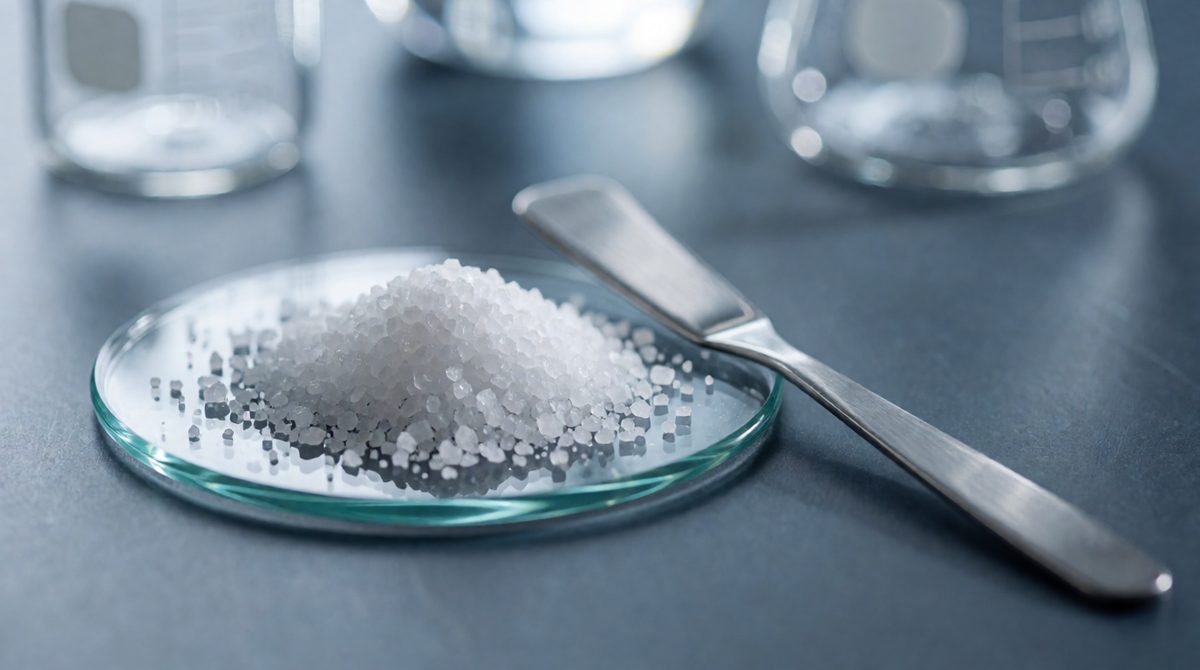
Each white grain here is sodium chloride, and its Mr is just its atoms added up: 23 + 35.5 = 58.5
Remember, the relative atomic mass (Ar) of an element is the number you read from the periodic table. It tells you how heavy an atom of that element is compared with other atoms.
Most substances are not single atoms. They are made of atoms joined together, as shown by their formula. To find how heavy one unit of the substance is, you simply add up the Ar values of all the atoms in the formula. This total is called the relative formula mass, written Mr.
Like Ar, Mr is a relative value, so it has no units. You do not write "g" after it.
Key terms:
Use the same three steps every time:
In this lesson we use these Ar values, which match the periodic table you get in the exam: H = 1, C = 12, N = 14, O = 16, Na = 23, Mg = 24, Al = 27, S = 32, Ca = 40.
2 hydrogen atoms: 2 × 1 = 2
1 oxygen atom: 1 × 16 = 16
Mr = 2 + 16 = 18
2 hydrogen: 2 × 1 = 2
1 sulfur: 1 × 32 = 32
4 oxygen: 4 × 16 = 64
Mr = 2 + 32 + 64 = 98
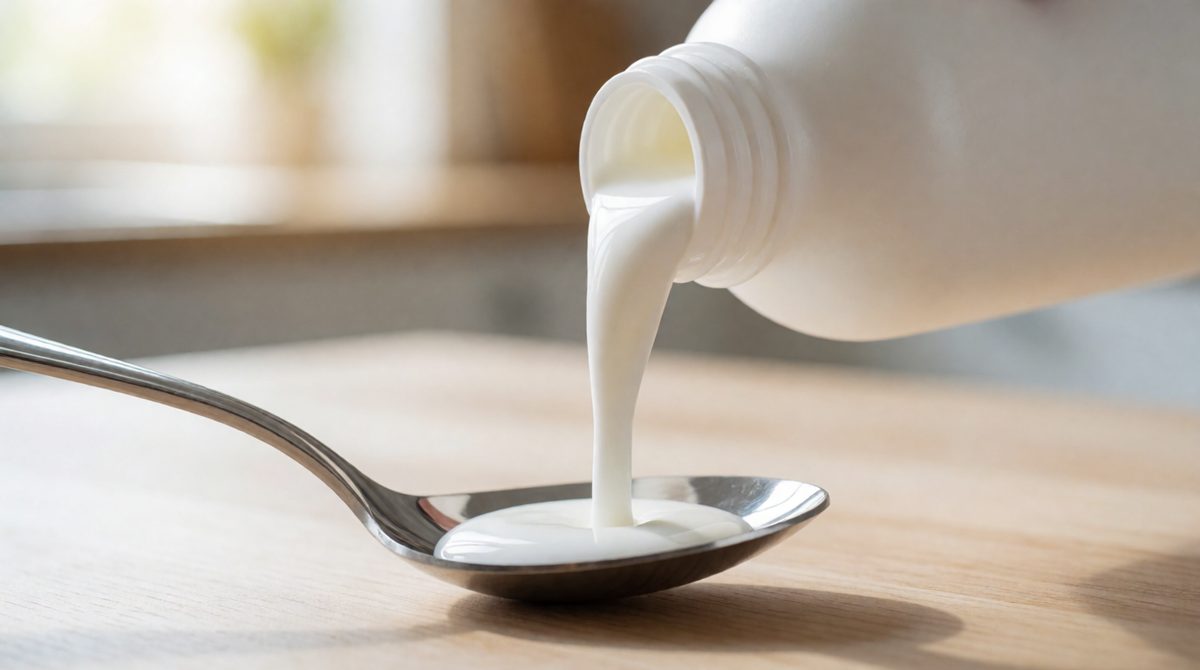
That milky medicine contains magnesium hydroxide, Mg(OH)2, and the bracket doubles the OH: Mr = 24 + 2 × 17 = 58
A small number after a bracket multiplies everything inside the bracket. The easiest way is to work out the mass of the bracket group first, then multiply it.
One OH group = 16 + 1 = 17
Two OH groups = 2 × 17 = 34
Magnesium = 24
Mr = 24 + 34 = 58
One NH4 group = 14 + (4 × 1) = 18
Two NH4 groups = 2 × 18 = 36
SO4 = 32 + (4 × 16) = 96
Mr = 36 + 96 = 132
Here is a harder one. Aluminium sulfate is Al2(SO4)3. Two aluminium atoms give 2 × 27 = 54. One SO4 group is 96, so three of them give 3 × 96 = 288. Mr = 54 + 288 = 342.
You already know that atoms are not made or lost in a reaction. This means that in a balanced equation, the total Mr of the reactants, in the quantities shown, equals the total Mr of the products, in the quantities shown.
"In the quantities shown" is the important part. If there is a big number in front of a formula, you multiply that formula's Mr by it.
N2 + 3H2 → 2NH3
Reactants:
N2: 2 × 14 = 28
3H2: each H2 is 2, so 3 × 2 = 6
Total = 28 + 6 = 34
Products:
NH3: 14 + 3 = 17
2NH3: 2 × 17 = 34
Both sides add up to 34, so the equation checks out.
2NaOH + H2SO4 → Na2SO4 + 2H2O
Reactants:
NaOH = 23 + 16 + 1 = 40, so 2NaOH = 80
H2SO4 = 98 (from worked example 2)
Total = 80 + 98 = 178
Products:
Na2SO4 = (2 × 23) + 32 + (4 × 16) = 46 + 32 + 64 = 142
2H2O = 2 × 18 = 36
Total = 142 + 36 = 178
Both sides are 178. If your two totals do not match, check your arithmetic and that you used the big numbers.
This is a handy way to check your work. If an exam question asks you to show that mass is conserved in an equation, this is exactly what you do.
Once you know the Mr, you can work out how much of a compound's mass comes from one element. Use this formula:
percentage by mass of an element = (Ar × number of atoms of that element) ÷ Mr of the compound × 100
Mr of MgO = 24 + 16 = 40
Mass from magnesium = 24
Percentage = 24 ÷ 40 × 100 = 60%
There are two nitrogen atoms: one in NH4 and one in NO3.
Mr = 14 + (4 × 1) + 14 + (3 × 16) = 14 + 4 + 14 + 48 = 80
Mass from nitrogen = 2 × 14 = 28
Percentage = 28 ÷ 80 × 100 = 35%
Compare this with ammonium sulfate. Its Mr is 132 and it also has two nitrogen atoms, so the percentage of nitrogen is 28 ÷ 132 × 100 = 21.2% (to 3 significant figures). Both compounds are used as fertilisers, and this sort of calculation lets you compare how much nitrogen each one contains per gram.
A quick check: the percentages of all the elements in a compound must add up to 100%. In MgO, magnesium is 60%, so oxygen must be 40%.
Ignoring the bracket. In Mg(OH)2 the 2 applies to both O and H. Writing 24 + 16 + 2 = 42 is wrong. The answer is 58.
Forgetting the big numbers in an equation. In 2NH3 you must double 17 to get 34.
Using the atomic number. Oxygen's atomic number is 8, but its Ar is 16. Always use the larger number, the relative atomic mass.
Counting an element only once. In NH4NO3 nitrogen appears in two places. Count every atom.
Adding units. Mr has no units. "Mr = 18 g" is wrong.
Magnesium carbonate breaks down when heated:
MgCO3 → MgO + CO2
Relative atomic masses (Ar): C = 12, O = 16, Mg = 24
(a) Calculate the relative formula mass (Mr) of magnesium carbonate. [1 mark]
(b) Show that the total Mr of the reactants equals the total Mr of the products. [2 marks]
(c) Calculate the percentage by mass of magnesium in magnesium carbonate. Give your answer to 3 significant figures. [2 marks]
(a) 24 + 12 + (3 × 16) = 24 + 12 + 48 = 84
(b) MgO = 24 + 16 = 40 and CO2 = 12 + (2 × 16) = 44 (1 mark). Products total 40 + 44 = 84, which equals the Mr of the reactant, 84 (1 mark).
(c) 24 ÷ 84 × 100 (1 mark) = 28.571... = 28.6% (1 mark)
Always show your working line by line, one element or group at a time. If you make a slip with the final sum, you can still pick up a method mark for correct working.