▲ Mass goes up
A reactant is a gas from the air. Its particles join onto the solid, so the solid gets heavier. The mass of the gas was never weighed at the start.
Sign up to access the complete lesson and track your progress!
Unlock This CourseRemember, mass is conserved in every reaction. No atoms are lost or made. So why do some reactions show a different reading on the balance at the end?
The answer is nearly always a gas. Gases are made of particles that are spread out and moving quickly in all directions. You cannot see most gases, so it is easy to forget they have mass. But every gas particle has mass, just like the particles in a solid.
Many experiments are done in a container that is open to the air, such as a crucible or an open flask. This is called a non-enclosed system. Gas particles can get in from the air, or get out into the air, without anyone noticing. The balance only weighs what is actually sitting on it.
Key terms:
There are two ways the mass can seem to change:
A reactant is a gas from the air. Its particles join onto the solid, so the solid gets heavier. The mass of the gas was never weighed at the start.
A product is a gas. Its particles escape into the atmosphere, so what is left in the container is lighter. The mass of the gas is not weighed at the end.
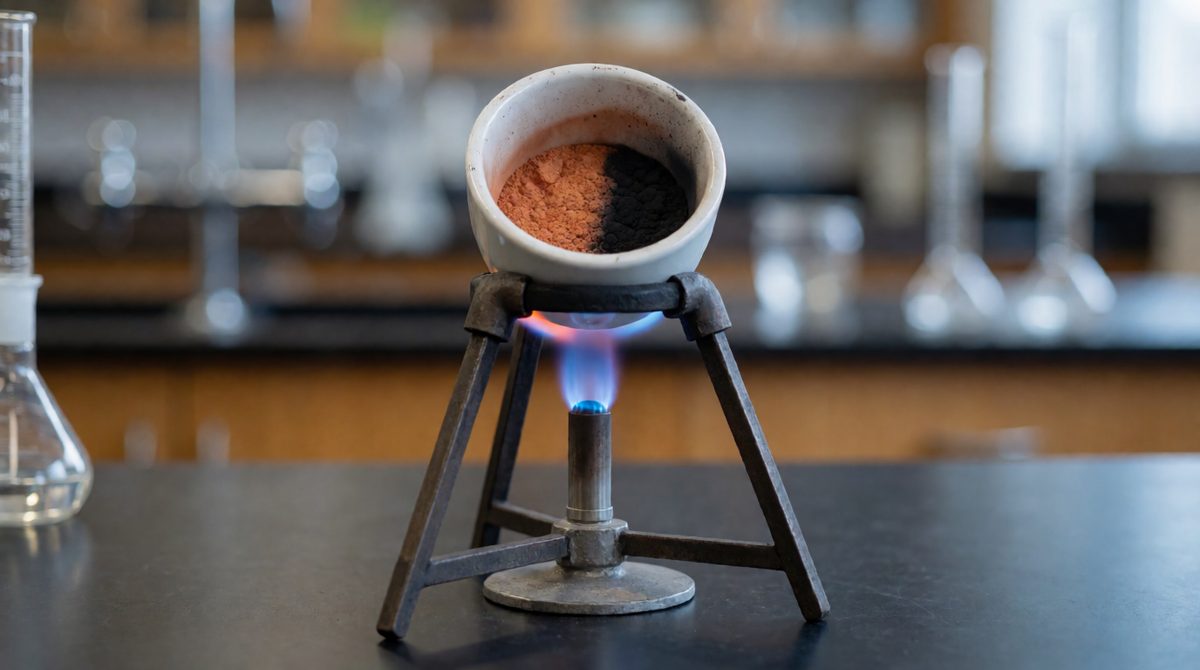
Orange copper turning black as it gains oxygen from the air, so the solid gets heavier: 2Cu + O2 → 2CuO
When copper powder is heated strongly in air, its surface turns from orange-brown to black. The black solid is copper oxide. If you weigh the solid before and after, the copper oxide is heavier than the copper you started with.
Here is the balanced symbol equation:
2Cu(s) + O2(g) → 2CuO(s)
Look at the state symbols. The copper is a solid and so is the product. But the oxygen is a gas, and it comes from the air around the crucible. At the start, you only weighed the copper. The oxygen was in the air, not on the balance.
Explaining it with the particle model:
This is true for any metal reacting with oxygen. The mass of the metal oxide produced is greater than the mass of the metal. You will meet more about metals and oxygen in the lesson Metal Oxides and the Reactivity Series.
A student heats 6.4 g of copper in an open crucible until it has all reacted. The copper oxide has a mass of 8.0 g.
Mass of oxygen that reacted = mass of product − mass of metal
= 8.0 − 6.4 = 1.6 g
The solid gained 1.6 g because 1.6 g of oxygen from the air joined onto it.
Breaking down a substance by heating it is called thermal decomposition. Metal carbonates break down this way to make a metal oxide and carbon dioxide.
Copper carbonate is a green powder. When you heat it, it turns black. The black solid is copper oxide. If you weigh the solid before and after, it is lighter at the end.
CuCO3(s) → CuO(s) + CO2(g)
Again, the state symbols tell the story. One product is a solid, but the other is carbon dioxide gas. In an open test tube or crucible, the carbon dioxide escapes into the atmosphere. That leaves the metal oxide as the only solid product.
Explaining it with the particle model:
A student heats 12.4 g of copper carbonate until it has all decomposed. The copper oxide left has a mass of 8.0 g.
Mass of carbon dioxide given off = mass at start − mass at end
= 12.4 − 8.0 = 4.4 g
The total mass is still conserved: 8.0 g of copper oxide + 4.4 g of carbon dioxide = 12.4 g.

All that fizzing is carbon dioxide escaping the open flask, which is why the balance reading drops
The same idea works for reactions in a flask. If sodium carbonate is added to hydrochloric acid in an open conical flask on a balance, it fizzes. The reading on the balance goes down as the fizzing happens.
Na2CO3(s) + 2HCl(aq) → 2NaCl(aq) + H2O(l) + CO2(g)
The bubbles are carbon dioxide. They rise out of the liquid and leave through the open neck of the flask. The reading stops falling when the reaction stops making gas.
Now imagine doing it in a sealed flask, an enclosed system. The carbon dioxide cannot get out, so the reading on the balance stays the same. This shows the mass was never really lost. It had simply moved somewhere the balance could not weigh it.
When you are given a balanced equation and told the mass went up or down, follow these steps:
1. Look at the state symbols and find the gas, marked (g).
2. Is the gas a reactant or a product?
3. Reactant gas: its particles come from the air and join the solid, so the measured mass increases.
4. Product gas: its particles escape into the air, so the measured mass decreases.
5. Finish by saying that mass is still conserved, because the mass of the gas was not measured.
"Mass was lost because atoms were destroyed." Wrong. Atoms are never destroyed in a reaction. They escaped as a gas.
"Gases have no mass." Wrong. Gas particles are spread out, but each one still has mass.
"The metal got heavier because it got hot." Wrong. Heating does not add mass. The extra mass comes from oxygen atoms joining the metal.
Mixing up the direction. Gas as a reactant means the mass goes up. Gas as a product means the mass goes down. Check which side of the arrow the gas is on.
Forgetting the particles. If the question says "use the particle model", you must talk about particles (atoms or molecules) of gas joining or leaving.
A student heats some zinc carbonate in an open crucible. The equation for the reaction is:
ZnCO3(s) → ZnO(s) + CO2(g)
The mass of the crucible and its contents before heating is 32.50 g. After heating, it is 31.62 g.
(a) Explain why the mass decreased. Use the particle model in your answer. [3 marks]
(b) Calculate the mass of carbon dioxide produced. [1 mark]
(a) One of the products, carbon dioxide, is a gas (1). The carbon dioxide molecules escape from the open crucible into the air (1). So the atoms in the carbon dioxide are no longer weighed, but no atoms are lost overall, so mass is still conserved (1).
(b) 32.50 − 31.62 = 0.88 g (1)
Never write that mass was "lost" or "gained" without saying where it went or came from. Examiners want three ideas: name the gas, say it left or joined, and say mass is still conserved.