⚗ Mixture
Substances are not chemically combined. Each keeps its own properties. The amounts can vary: you can stir a little or a lot of salt into water. It can be separated by physical processes.
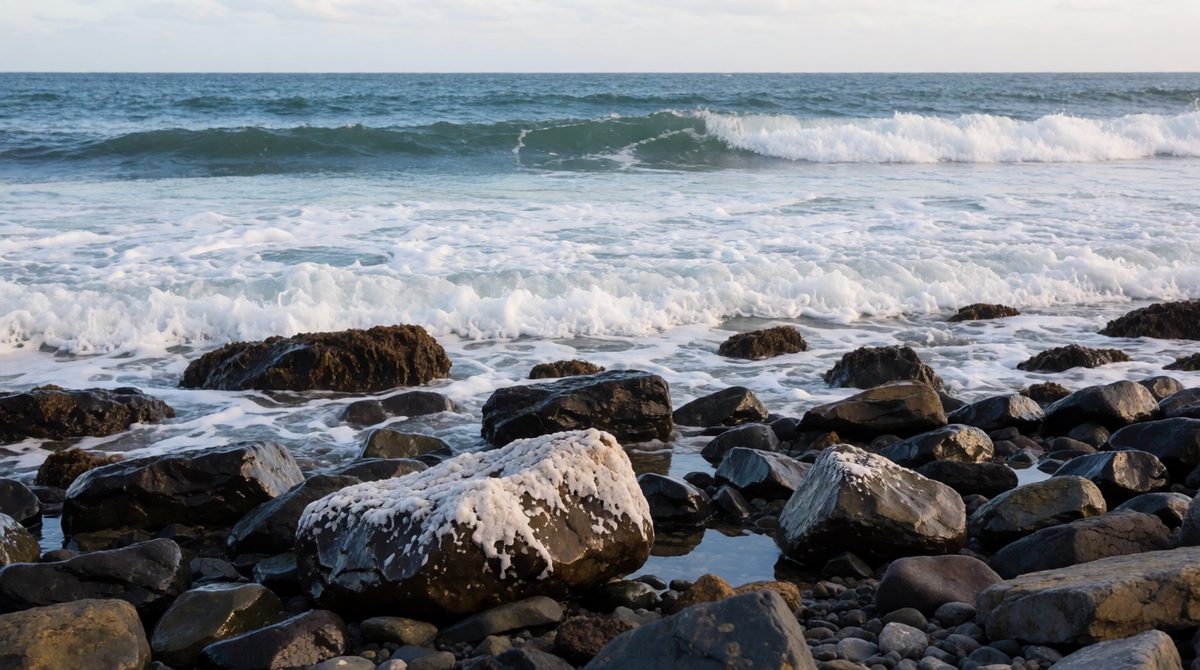
Sea water is a mixture, so when it dries the salt is left behind on the rocks, just as it was
Most of the things around you are not single substances. Air, sea water, orange juice and the soil in a garden are all mixtures.
A mixture is made of two or more elements or compounds that are not chemically combined. The substances are just mixed in together. No bonds form between them.
This has an important result: the chemical properties of each substance in a mixture are unchanged. Air is a mixture of mostly nitrogen and oxygen. The oxygen in air still lets things burn, just as pure oxygen does. Each substance keeps behaving like itself.
Compare this with a compound. Remember, a compound is two or more elements chemically combined in fixed proportions. To split a compound you need a chemical reaction. A mixture is easier to split, because nothing is joined together.
Key terms:
Substances are not chemically combined. Each keeps its own properties. The amounts can vary: you can stir a little or a lot of salt into water. It can be separated by physical processes.
Elements are chemically combined in fixed proportions. The compound has new properties, different from its elements. It can only be split up by a chemical reaction.
Mixtures can be separated by physical processes. The five you need are filtration, crystallisation, simple distillation, fractional distillation and chromatography. These processes do not involve chemical reactions and no new substances are made. You get back the same substances that went into the mixture.
Each technique works because the substances in the mixture have a different physical property, such as whether they dissolve or what temperature they boil at.
Filtration separates an insoluble solid from a liquid. An example is separating sand from water.
You pour the mixture through filter paper in a funnel. The paper has tiny holes. Water molecules and anything dissolved in the water are small enough to pass through. The sand grains are too big, so they stay on the paper as the residue. The liquid collected below is the filtrate.
Filtration only removes solids that have not dissolved. Salt dissolved in water passes straight through the paper.
Crystallisation gets a soluble solid out of a solution. An example is getting copper sulfate crystals from copper sulfate solution.
Why not just boil all the water away? Some solids, like copper sulfate crystals, change if they are heated too strongly. Gentle heating then cooling gives bigger, better crystals.
Simple distillation separates a liquid from a solution. An example is getting pure water from sea water.
You heat the solution in a flask. The water boils and turns to steam, but the salt does not, because its boiling point is far higher. The steam passes into a condenser, a tube cooled by cold water flowing around it. The steam cools and condenses back into liquid water, which drips into a beaker. The salt is left behind in the flask.
So simple distillation uses two changes of state: evaporating then condensing.
Fractional distillation separates a mixture of liquids that have different boiling points. An example is separating ethanol from water. Ethanol boils at 78°C and water at 100°C.
It is like simple distillation, but a fractionating column sits between the flask and the condenser. The column is packed with glass beads or rods and is hotter at the bottom and cooler at the top.
The same idea is used on a huge scale to separate crude oil, which you will meet in Fractional Distillation and Petrochemicals.
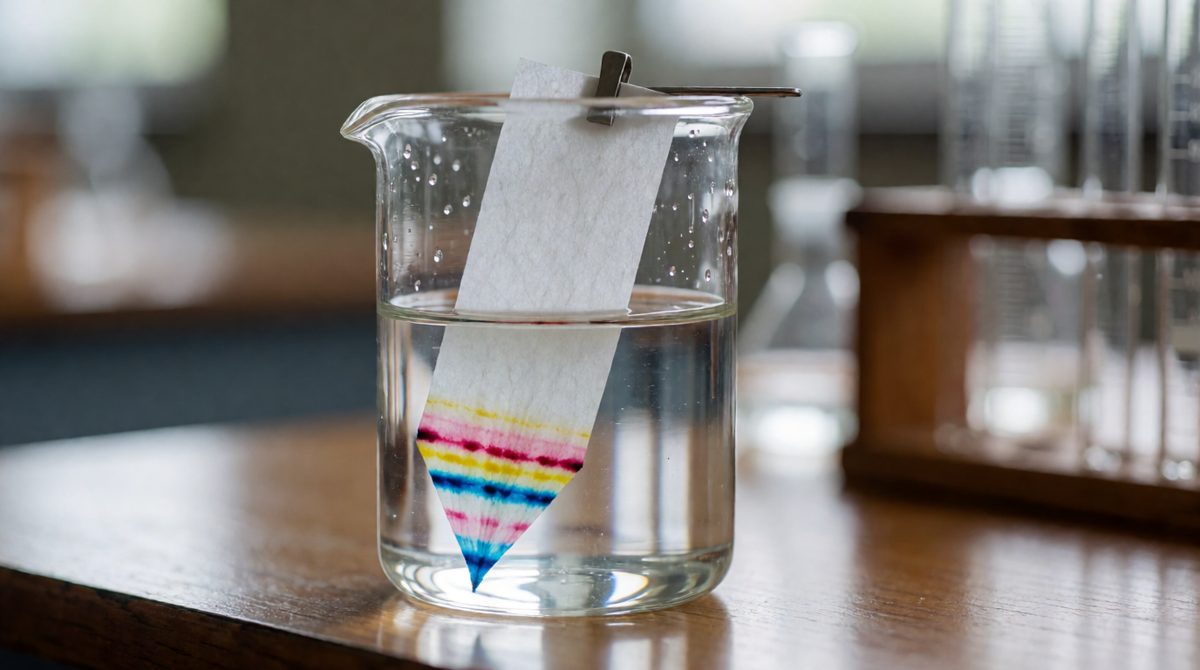
Watch the colours race up the paper! Chromatography splits food colouring into its separate dyes
Chromatography separates substances dissolved in a solvent, such as the different coloured dyes in a food colouring.
A small spot of the mixture is put on a line near the bottom of a piece of paper. The paper is stood in a solvent. The solvent soaks up the paper and carries the dyes with it. Different dyes move up the paper by different amounts, so they spread out into separate spots.
You will learn exactly how it works, and how to measure it, in the Chromatography lesson.
Filtration uses whether a solid dissolves. Crystallisation uses evaporating and cooling. Distillation uses boiling points.
Simple: liquid from a solution. Fractional: liquids with different boiling points.
Separates dissolved substances, such as dyes, that move different distances.
In the exam you may be given information about a mixture and asked to suggest how to separate or purify it. Ask yourself two questions: what state is each substance in, and does the solid dissolve?
Sometimes you need more than one step.
Rock salt is a mixture of salt and sand. How could you get pure, dry salt crystals from it?
Step 1: Add water and stir. The salt dissolves but the sand does not.
Step 2: Filter. The sand stays on the filter paper as the residue. The salt solution passes through as the filtrate.
Step 3: Crystallise. Heat the filtrate to evaporate some water, then leave it to cool so salt crystals form. Filter and dry the crystals.
If you wanted the water back as well, you could use simple distillation instead of step 3.
Using filtration to remove a dissolved solid. Dissolved salt passes through filter paper. You need crystallisation or distillation.
Mixing up simple and fractional distillation. Simple separates a liquid from a solid dissolved in it. Fractional separates liquids from each other.
Saying a new substance is made. Separating is a physical process. The salt you get back is the same salt that went in.
Mixing up filtrate and residue. The filtrate goes through the paper. The residue stays on it.
A student has a mixture of water and propanone. Propanone is a liquid that dissolves in water and boils at 56°C. Water boils at 100°C.
Name the method the student should use to separate the two liquids and explain how it works. (3 marks)
Fractional distillation (1). The liquids have different boiling points (1). When heated, the propanone boils off first because it has the lower boiling point, rises up the fractionating column and is condensed and collected, while the water condenses in the column and stays behind (1).
Always link your method to a property. Say why it works, for example "the liquids have different boiling points" or "sand is insoluble in water". That reason is often where the marks are.
Access the full course and all the resources like custom timetables and progress tracking.
Join Today