⚫ 1 mol of carbon, C
Contains 6.02 × 10²³ carbon atoms.
Everything in this lesson is Higher tier only. If you are sitting Foundation papers, you will not be asked about moles.
Sign up to access the complete lesson and track your progress!
Unlock This Course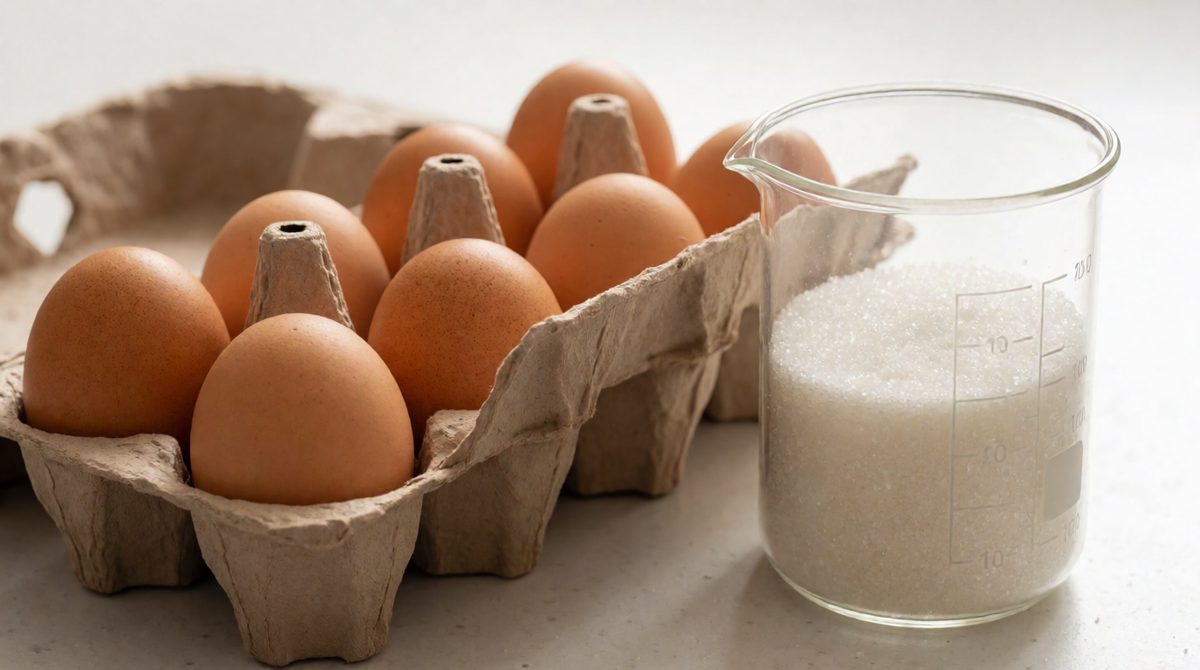
Just like eggs come in dozens, chemists count particles in moles: one mole is 6.02 × 10²³ of them
Atoms are far too small to count one by one. Even a tiny pinch of salt contains more particles than you could ever count. So chemists use a set number of particles as a unit, a bit like the way we buy eggs by the dozen or paper by the ream.
That unit is the mole. Chemical amounts are measured in moles. The symbol for the unit mole is mol. So if you have 2 moles of water, you write 2 mol.
One mole is a fixed, very large number of particles. That number is the Avogadro constant:
6.02 × 10²³ per mole
Written out in full, that is 602,000,000,000,000,000,000,000. This is why we use standard form.
The spec says that one mole of a substance contains the same number of the stated particles, atoms, molecules or ions as one mole of any other substance. A mole of anything always has 6.02 × 10²³ of the particles you name.
Key terms:
A mole can count any kind of particle: atoms, molecules, ions, electrons, formulae and even equations. So you must always be clear about which particle you are counting.
The spec gives this example: in one mole of carbon (C), the number of atoms is the same as the number of molecules in one mole of carbon dioxide (CO2). Both are 6.02 × 10²³.
Contains 6.02 × 10²³ carbon atoms.
Contains 6.02 × 10²³ CO2 molecules. Each molecule has 3 atoms, so there are 3 mol of atoms in total: 1 mol of carbon atoms and 2 mol of oxygen atoms.
The same idea works for ionic compounds. One mole of calcium chloride, CaCl2, contains one mole of formula units. Inside that there is 1 mol of Ca2+ ions and 2 mol of Cl- ions. The small numbers in the formula tell you how many moles of each particle you get.
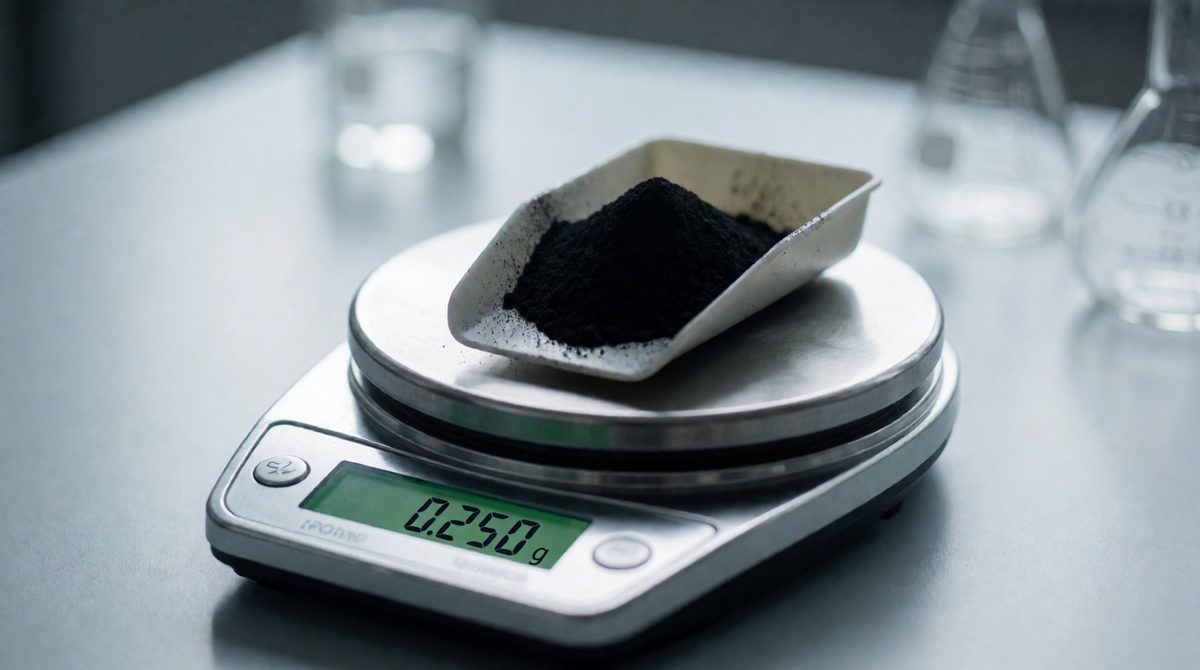
Weigh out 12 g of carbon and you've got one mole of atoms, because the mass of a mole in grams equals the Ar or Mr
Here is the really useful part. The mass of one mole of a substance in grams is numerically equal to its relative formula mass.
Remember, relative formula mass (Mr) is found by adding up the relative atomic masses in the formula. To get the mass of one mole, you just put "grams" after that number.
Ar = 12, so 1 mol has a mass of 12 g
Mr = 12 + (2 × 16) = 44, so 1 mol has a mass of 44 g
Mr = 23 + 16 + 1 = 40, so 1 mol has a mass of 40 g
So 12 g of carbon and 44 g of carbon dioxide have different masses, but they contain the same number of particles. A carbon dioxide molecule is heavier than a carbon atom, so you need more grams to get the same number of them.
The spec says you should be able to use Mr to work out the number of moles in a given mass, and the other way round. You only need one equation:
number of moles = mass (g) ÷ Mr
Rearranged: mass (g) = number of moles × Mr
A handy way to remember it is a triangle with mass on top and moles and Mr side by side underneath. Cover the one you want to find.
How many moles are in 88 g of carbon dioxide, CO2? (Ar: C = 12, O = 16)
Step 1: Mr of CO2 = 12 + (2 × 16) = 44
Step 2: moles = mass ÷ Mr = 88 ÷ 44 = 2.0 mol
What is the mass of 0.25 mol of calcium carbonate, CaCO3? (Ar: Ca = 40, C = 12, O = 16)
Step 1: Mr of CaCO3 = 40 + 12 + (3 × 16) = 100
Step 2: mass = moles × Mr = 0.25 × 100 = 25 g
How many moles are in 5.0 g of sodium hydroxide, NaOH? (Ar: Na = 23, O = 16, H = 1)
Step 1: Mr of NaOH = 40
Step 2: moles = 5.0 ÷ 40 = 0.125 mol, which is 0.13 mol to 2 significant figures
The mass was given to 2 significant figures, so 2 significant figures is a sensible answer.
Because one mole is always 6.02 × 10²³ particles, you can also find how many particles are in a sample:
number of particles = number of moles × 6.02 × 10²³
How many molecules are in 8.00 g of methane, CH4? (Ar: C = 12, H = 1)
Step 1: Mr of CH4 = 12 + (4 × 1) = 16
Step 2: moles = 8.00 ÷ 16 = 0.500 mol
Step 3: molecules = 0.500 × 6.02 × 1023 = 3.01 × 10²³ molecules
Each CH4 molecule has 5 atoms, so this sample holds 5 × 3.01 × 1023 = 1.505 × 1024 atoms, or 1.51 × 1024 to 3 significant figures.
On a calculator, type the Avogadro constant using the ×10x (or EXP) button: 6.02, then ×10x, then 23. This keeps the whole number together, which matters when you divide by it.
A student has 14.9 g of potassium chloride, KCl. (Ar: K = 39, Cl = 35.5; Avogadro constant = 6.02 × 10²³ per mole)
(a) Calculate the number of moles of potassium chloride. [2 marks]
(b) Calculate the number of potassium ions in the sample. Give your answer in standard form to 3 significant figures. [2 marks]
(a) Mr of KCl = 39 + 35.5 = 74.5 (1 mark). Moles = 14.9 ÷ 74.5 = 0.200 mol (1 mark).
(b) Each KCl formula contains one K+ ion, so there are 0.200 mol of K+ ions (1 mark). Number of ions = 0.200 × 6.02 × 1023 = 1.204 × 1023 = 1.20 × 10²³ (1 mark).
Always write the equation, then the numbers, then the answer with its unit. If you make a slip with the calculator, you can still get a mark for showing the right method.