↓ Fewer moles
In worked example 3, you want O2 (1) from H2O2 (2). So 0.20 × 1/2 = 0.10 mol.
Everything in this lesson is Higher tier only. If you are sitting Foundation papers, you will not be asked to do these calculations.
Sign up to access the complete lesson and track your progress!
Unlock This Course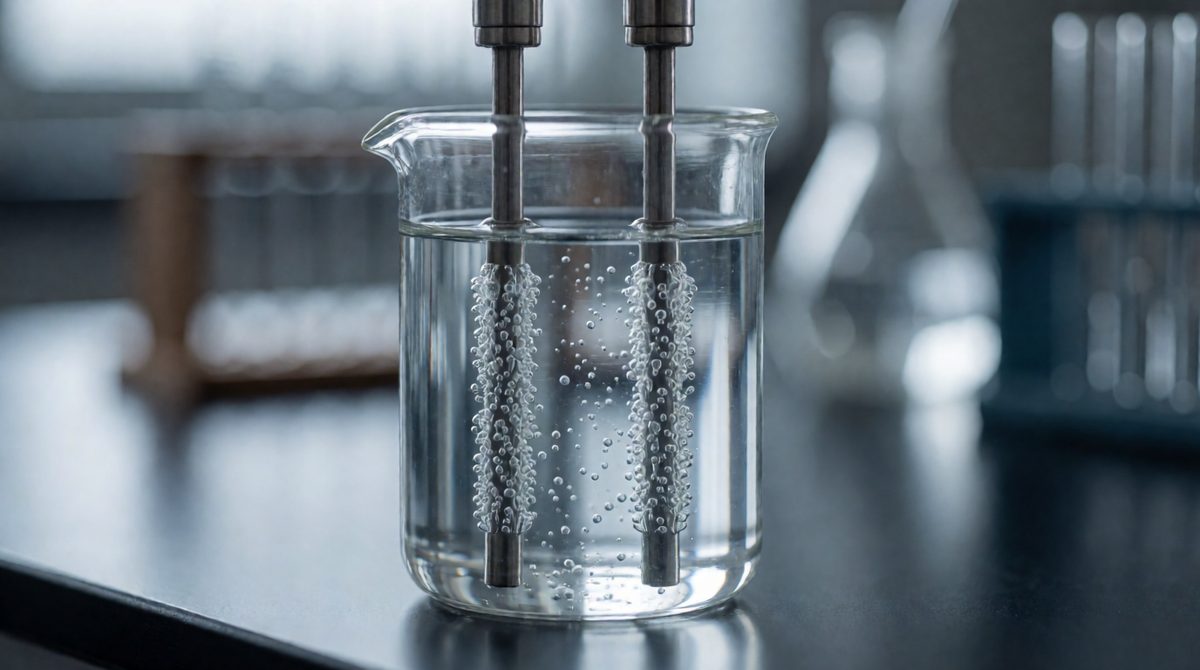
Water splitting into bubbles of gas: 2H2O → 2H2 + O2, so twice as many moles of hydrogen as oxygen
A balanced symbol equation is more than a list of formulae. The spec says that chemical equations can be interpreted in terms of moles. The balancing numbers in front of each formula tell you how many moles of each substance react or are made.
Here is the spec's own example:
Mg + 2HCl → MgCl2 + H2
This shows that one mole of magnesium reacts with two moles of hydrochloric acid to produce one mole of magnesium chloride and one mole of hydrogen gas.
If there is no number in front of a formula, it means 1. So the ratio of moles in this reaction is:
Mg : HCl : MgCl2 : H2 = 1 : 2 : 1 : 1
This ratio is the key to every calculation in this lesson. It tells you that if you use 0.5 mol of magnesium, you need 1 mol of acid, and you make 0.5 mol of magnesium chloride and 0.5 mol of hydrogen. Double one, and you double them all.
Key terms:
The spec says you should be able to calculate the masses of substances shown in a balanced symbol equation. Remember, the mass of one mole in grams is the same number as the Mr. So you multiply each Mr by its balancing number.
Work out the masses shown in Mg + 2HCl → MgCl2 + H2. (Ar: Mg = 24, H = 1, Cl = 35.5)
So 24 g of magnesium reacts with 73 g of hydrochloric acid to make 95 g of magnesium chloride and 2 g of hydrogen.
Check: 24 + 73 = 97 g and 95 + 2 = 97 g. The totals match, as they always should.
These masses always stay in the same ratio. Half the magnesium (12 g) would need half the acid (36.5 g) and make half the products.
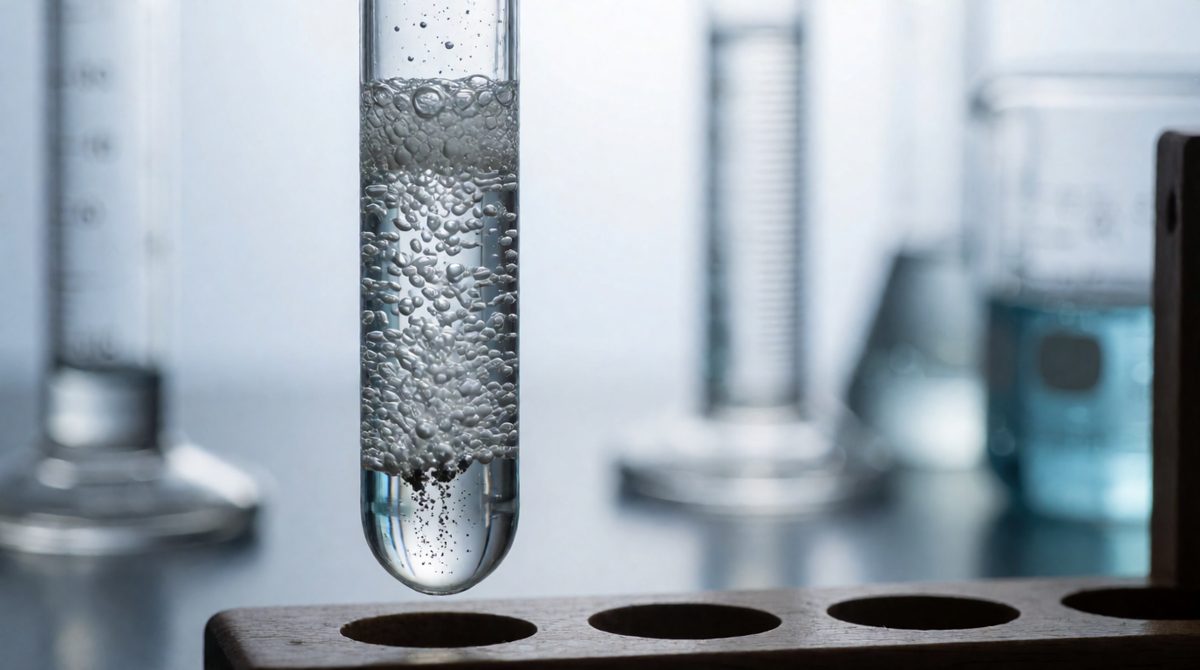
Those bubbles are oxygen from hydrogen peroxide, and the balanced equation lets you predict exactly how much you'll get
In the exam you are usually given the mass of one substance and asked for the mass of another. The spec says you should be able to calculate the masses of reactants and products from the balanced symbol equation and the mass of a given reactant or product.
The same three steps work every time:
Find the moles of the substance you know.
moles = mass ÷ Mr
Use the balancing numbers to find the moles of the substance you want.
Turn those moles back into a mass.
mass = moles × Mr
Notice that step 2 is the only new part. Steps 1 and 3 use the equation from the lesson on the mole and the Avogadro constant.
Calcium burns in oxygen: 2Ca + O2 → 2CaO
What mass of calcium oxide is made from 8.0 g of calcium? (Ar: Ca = 40, O = 16)
Step 1: moles of Ca = 8.0 ÷ 40 = 0.20 mol
Step 2: the ratio Ca : CaO is 2 : 2, which is the same as 1 : 1. So 0.20 mol of CaO is made.
Step 3: Mr of CaO = 40 + 16 = 56. Mass = 0.20 × 56 = 11.2 g
Hydrogen peroxide breaks down: 2H2O2 → 2H2O + O2
What mass of oxygen is made from 6.8 g of hydrogen peroxide? (Ar: H = 1, O = 16)
Step 1: Mr of H2O2 = (2 × 1) + (2 × 16) = 34. Moles = 6.8 ÷ 34 = 0.20 mol
Step 2: the ratio H2O2 : O2 is 2 : 1. So you get half as many moles of oxygen: 0.20 ÷ 2 = 0.10 mol
Step 3: Mr of O2 = 32. Mass = 0.10 × 32 = 3.2 g
Aluminium reacts with oxygen: 4Al + 3O2 → 2Al2O3
What mass of aluminium is needed to make 20.4 g of aluminium oxide? What mass of oxygen reacts? (Ar: Al = 27, O = 16)
Step 1: Mr of Al2O3 = (2 × 27) + (3 × 16) = 102. Moles = 20.4 ÷ 102 = 0.200 mol
Step 2: Al : Al2O3 is 4 : 2, so 0.200 × 2 = 0.400 mol of Al. O2 : Al2O3 is 3 : 2, so 0.200 × 3/2 = 0.300 mol of O2
Step 3: mass of Al = 0.400 × 27 = 10.8 g. Mr of O2 = 32, so mass of O2 = 0.300 × 32 = 9.60 g
Check: 10.8 + 9.60 = 20.4 g. That matches the mass of aluminium oxide made.
Propane is the fuel in many camping gas cylinders. It burns: C3H8 + 5O2 → 3CO2 + 4H2O
What mass of carbon dioxide is made when 22 g of propane burns completely? (Ar: C = 12, H = 1, O = 16)
Step 1: Mr of C3H8 = (3 × 12) + (8 × 1) = 44. Moles = 22 ÷ 44 = 0.50 mol
Step 2: C3H8 : CO2 is 1 : 3. So 0.50 × 3 = 1.5 mol of CO2
Step 3: Mr of CO2 = 44. Mass = 1.5 × 44 = 66 g
The carbon dioxide has more mass than the propane because oxygen from the air has joined on.
To get step 2 right, write the two balancing numbers as a fraction:
moles wanted = moles known × (balancing number of wanted ÷ balancing number of known)
In worked example 3, you want O2 (1) from H2O2 (2). So 0.20 × 1/2 = 0.10 mol.
In worked example 5, you want CO2 (3) from C3H8 (1). So 0.50 × 3/1 = 1.5 mol.
Always ask yourself: should the answer have more moles or fewer? If the wanted substance has the bigger balancing number, the moles go up.
Titanium can be made by reacting titanium chloride with sodium:
TiCl4 + 4Na → Ti + 4NaCl
(Ar: Ti = 48, Cl = 35.5, Na = 23)
(a) Calculate the mass of sodium needed to react with 380 g of titanium chloride. [3 marks]
(b) Calculate the mass of titanium made from 380 g of titanium chloride. [1 mark]
(a) Mr of TiCl4 = 48 + (4 × 35.5) = 190. Moles of TiCl4 = 380 ÷ 190 = 2.0 mol (1 mark).
Ratio TiCl4 : Na is 1 : 4, so moles of Na = 2.0 × 4 = 8.0 mol (1 mark).
Mass of Na = 8.0 × 23 = 184 g (1 mark).
(b) Ratio TiCl4 : Ti is 1 : 1, so 2.0 mol of Ti. Mass = 2.0 × 48 = 96 g (1 mark).
Lay out every calculation as mass, then moles, then ratio, then mass, with a label on each line. If your final number is wrong, the examiner can still give you marks for each correct step.