⚖ Steps 1 and 2
Step 1: work out the Mr of every substance.
Step 2: change each mass into moles using moles = mass ÷ Mr.
Everything in this lesson is Higher tier only. If you are sitting Foundation papers, you will not be asked to balance equations from masses.
Sign up to access the complete lesson and track your progress!
Unlock This Course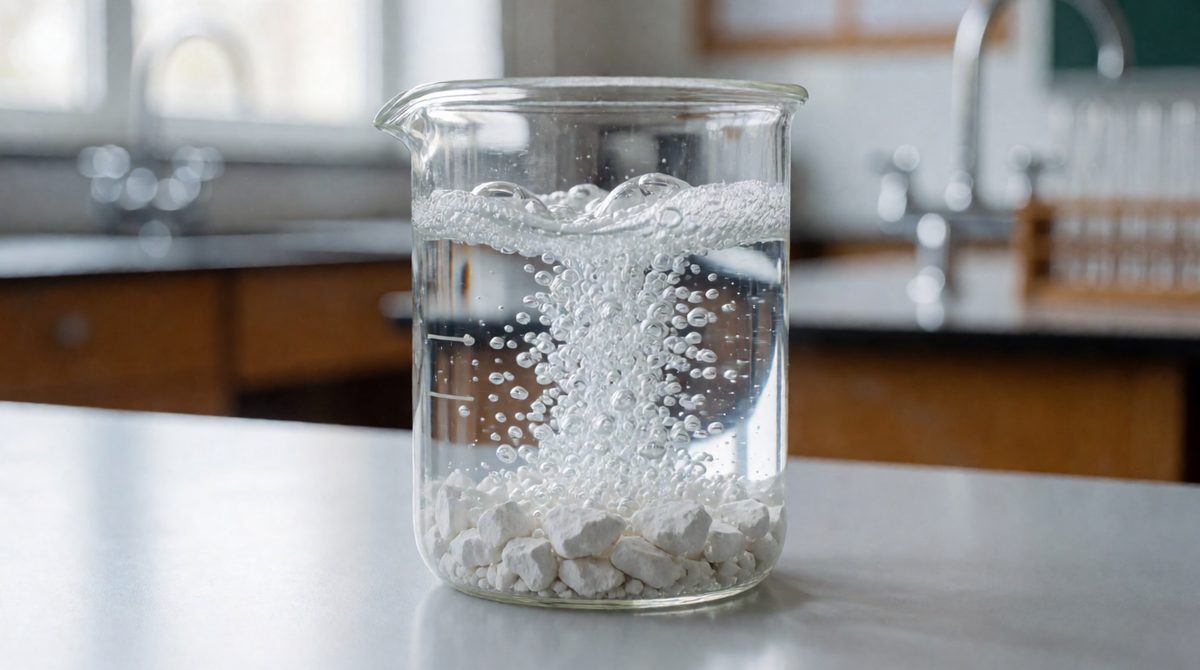
Limestone chips fizzing in acid: weigh what reacts and what forms, convert to moles, and the balancing numbers pop out
You already know how to balance an equation by counting atoms. There is a second way. If you know the masses of the reactants and products, you can work out the balancing numbers with a calculation.
The spec says: the balancing numbers in a symbol equation can be calculated from the masses of reactants and products by converting the masses in grams to amounts in moles and converting the numbers of moles to simple whole number ratios.
Why does this work? Remember, the balancing numbers in an equation give the mole ratio of the substances. So if you find how many moles of each substance reacted or were made, you have found the ratio. Then you just tidy it up into small whole numbers.
This is useful because it is how chemists find out what really happens in a reaction. They measure masses in the lab, then work backwards to the equation.
Key terms:
Every question of this type uses the same method. Learn these four steps.
Step 1: work out the Mr of every substance.
Step 2: change each mass into moles using moles = mass ÷ Mr.
Step 3: divide every number of moles by the smallest one.
Step 4: if any answer is not a whole number, multiply them all by the same number until they are. These are your balancing numbers.
Make sure every formula is correct before you start. You never change a formula to balance an equation. You only put numbers in front.
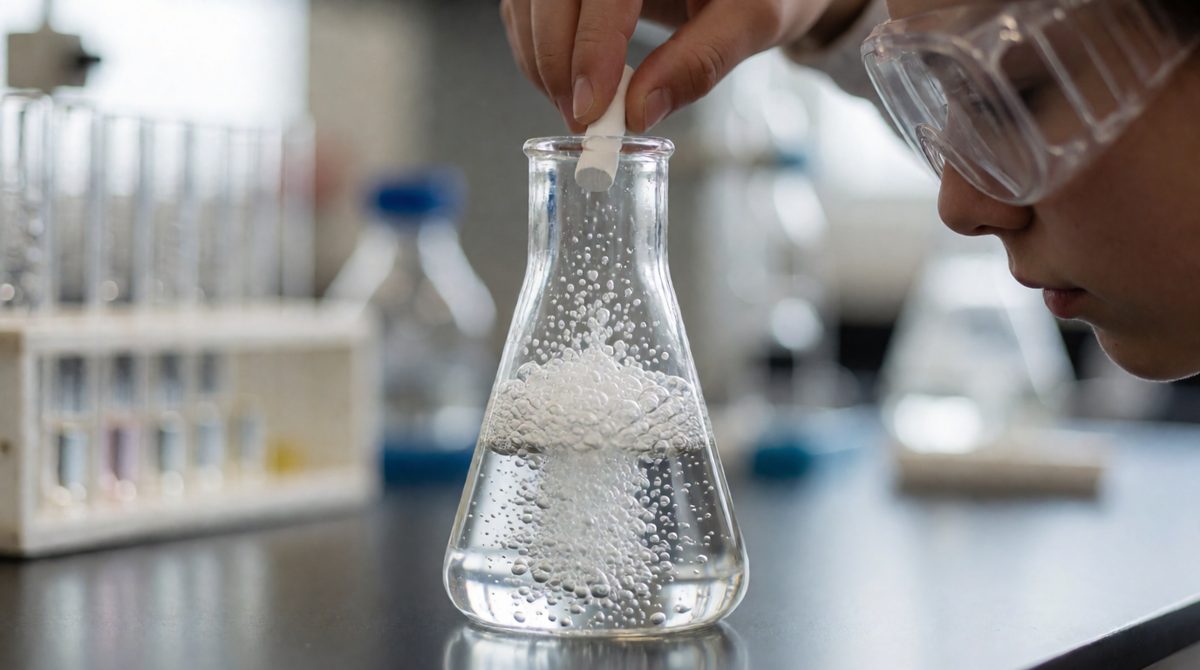
10.0 g of CaCO3 is 0.1 mol, and the gas escaping here is CO2: CaCO3 + 2HCl → CaCl2 + H2O + CO2
Some calcium carbonate reacts with hydrochloric acid. 10.0 g of CaCO3 reacts with 7.3 g of HCl to make 11.1 g of CaCl2, 1.8 g of H2O and 4.4 g of CO2. Balance the equation.
__CaCO3 + __HCl → __CaCl2 + __H2O + __CO2
(Ar: Ca = 40, C = 12, O = 16, H = 1, Cl = 35.5)
CaCO3 + 2HCl → CaCl2 + H2O + CO2
Sometimes step 3 gives you a number like 1.5. That is not a mistake. It just means you need step 4.
5.4 g of aluminium reacts with 21.3 g of chlorine to make 26.7 g of aluminium chloride. Balance the equation.
__Al + __Cl2 → __AlCl3
(Ar: Al = 27, Cl = 35.5)
2Al + 3Cl2 → 2AlCl3
Count the atoms to check: 2 Al and 6 Cl on each side. It balances.
A quick guide for step 4: if you get a number ending in .5, multiply by 2. If you get a number ending in .33 or .67, multiply by 3.
Sometimes a question leaves out one mass. Remember, mass is conserved in a reaction, so the total mass of the products equals the total mass of the reactants. You can use that to find the missing mass first.
2.8 g of ethene burns in 9.6 g of oxygen. It makes 8.8 g of carbon dioxide and some water. Balance the equation.
__C2H4 + __O2 → __CO2 + __H2O
(Ar: C = 12, H = 1, O = 16)
C2H4 + 3O2 → 2CO2 + 2H2O
The spec also says you should be able to change the subject of a mathematical equation. In this topic, that means using the moles equation in any of its three forms:
moles = mass ÷ Mr
mass = moles × Mr
Mr = mass ÷ moles
To rearrange, do the same thing to both sides. Start with moles = mass ÷ Mr. Multiply both sides by Mr and you get mass = moles × Mr. Then divide both sides by moles and you get Mr = mass ÷ moles.
The second form is a great way to check your answer. In worked example 2, 2 mol of Al has a mass of 2 × 27 = 54 g. 3 mol of Cl2 is 3 × 71 = 213 g. 2 mol of AlCl3 is 2 × 133.5 = 267 g. And 54 + 213 = 267. These masses are ten times the masses in the question, in the same ratio, so the balancing numbers are right.
Iron is made by reacting iron(III) oxide with carbon monoxide. In a test, 16.0 g of Fe2O3 reacted with 8.4 g of CO to make 11.2 g of Fe and 13.2 g of CO2.
__Fe2O3 + __CO → __Fe + __CO2
Use the masses to balance the equation. You must show your working. (Ar: Fe = 56, O = 16, C = 12) [4 marks]
Lay out your working in a table with one column for each substance and rows for mass, Mr, moles and ratio. It keeps your numbers tidy and earns method marks even if you slip up on one value.