↑ More limiting reactant
If you add more of the limiting reactant, you make more product. Double the moles of the limiting reactant and you double the moles of product, as long as there is still enough of the other reactant.
Everything in this lesson is Higher tier only. If you are sitting Foundation papers, you will not be asked about limiting reactants.
Sign up to access the complete lesson and track your progress!
Unlock This Course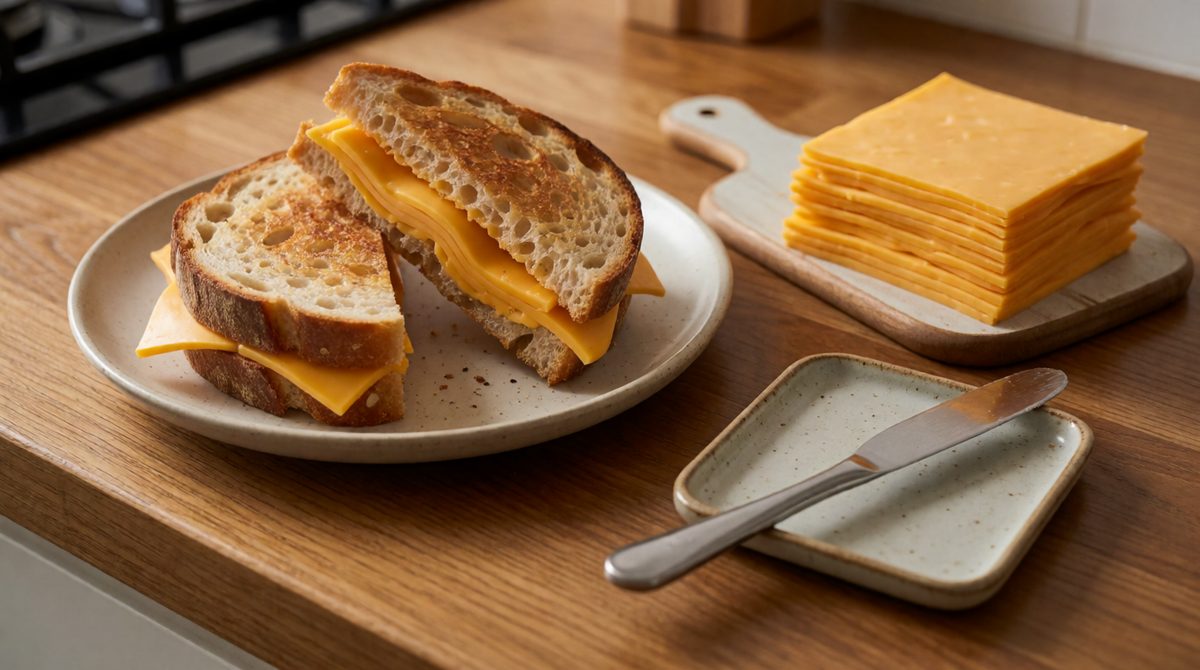
Two slices of bread per sandwich: when the bread runs out the leftover cheese is in excess, just like a limiting reactant
Think about making cheese sandwiches. Each sandwich needs 2 slices of bread and 1 slice of cheese. You have 10 slices of bread and 8 slices of cheese. How many sandwiches can you make?
The bread runs out after 5 sandwiches. You still have 3 slices of cheese left over. The bread decides how many sandwiches you get, not the cheese. Buying more cheese would not help at all.
Chemical reactions work in the same way. In a reaction with two reactants, chemists often add more of one reactant than is needed. This makes sure that all of the other reactant is used up. The reactant that is completely used up is called the limiting reactant, because it limits the amount of products that can be made. The reactant that is left over is in excess.
Once the limiting reactant has all reacted, the reaction stops. Some of the reactant in excess is still there, unreacted.
Key terms:
The amount of product depends only on the amount of the limiting reactant. This is the key idea the spec wants you to explain.
If you add more of the limiting reactant, you make more product. Double the moles of the limiting reactant and you double the moles of product, as long as there is still enough of the other reactant.
If you add more of the reactant that is already in excess, you make no extra product. There is nothing left for it to react with. You just end up with more left over.
Why add an excess at all? If one reactant is expensive, chemists can add an excess of a cheaper one. Then none of the expensive one is wasted, because it all reacts.
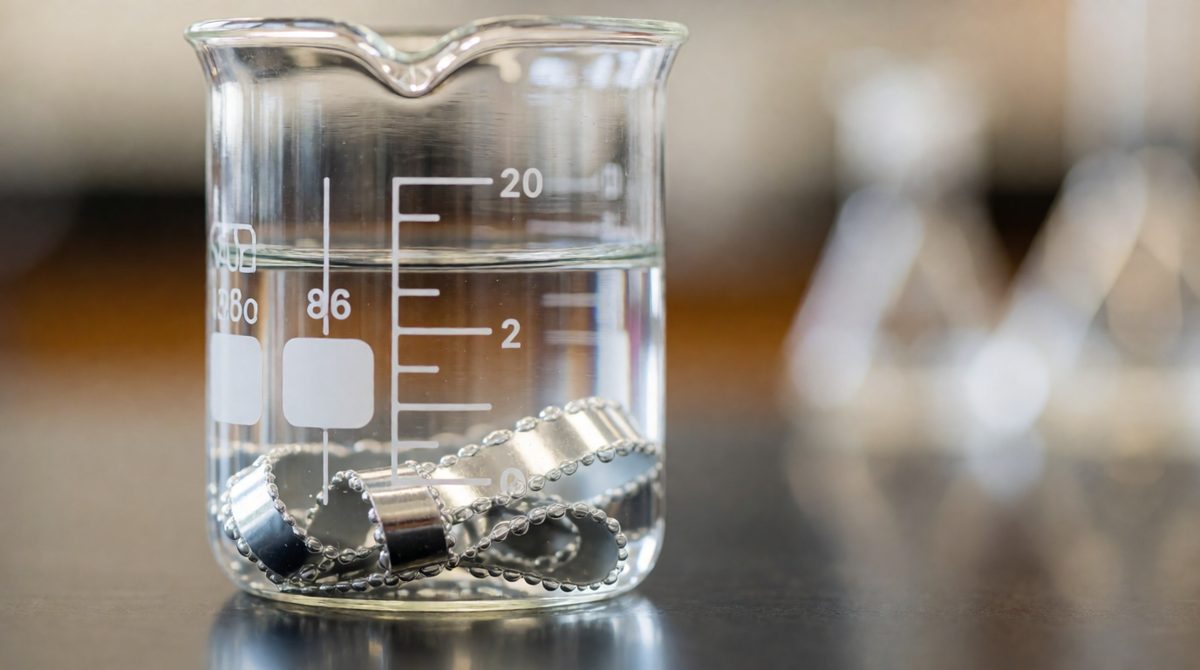
Leftover magnesium ribbon means the acid ran out first, so the acid was the limiting reactant
You cannot find the limiting reactant just by comparing masses in grams. A small mass of one substance can contain more moles than a big mass of another. You must compare moles, and you must use the balanced equation. Remember, the balancing numbers give the mole ratio.
Follow these steps:
Sulfur dioxide reacts with oxygen to make sulfur trioxide: 2SO2 + O2 → 2SO3
A mixture has 3.0 mol of SO2 and 2.0 mol of O2. Which is the limiting reactant, and how many moles of SO3 form?
Step 1: The ratio SO2 : O2 is 2 : 1. So 3.0 mol of SO2 needs 3.0 ÷ 2 = 1.5 mol of O2.
Step 2: There is 2.0 mol of O2. That is more than 1.5 mol, so oxygen is in excess. Sulfur dioxide is the limiting reactant.
Step 3: The ratio SO2 : SO3 is 2 : 2, which is 1 : 1. So 3.0 mol of SO2 makes 3.0 mol of SO3.
Left over: 2.0 − 1.5 = 0.5 mol of O2 does not react.
Notice there were fewer moles of oxygen than sulfur dioxide, but oxygen was still in excess. Always use the ratio, not just the bigger number.
Zinc reacts with sulfur when heated: Zn + S → ZnS
A student heats 6.5 g of zinc with 4.0 g of sulfur. Find the limiting reactant and the maximum mass of zinc sulfide. (Ar: Zn = 65, S = 32)
Moles of Zn = 6.5 ÷ 65 = 0.10 mol
Moles of S = 4.0 ÷ 32 = 0.125 mol
Compare: the ratio Zn : S is 1 : 1. So 0.10 mol of Zn needs 0.10 mol of S. There is 0.125 mol of S, which is more than enough. Sulfur is in excess. Zinc is the limiting reactant.
Product: the ratio Zn : ZnS is 1 : 1, so 0.10 mol of ZnS forms. Mr of ZnS = 65 + 32 = 97.
Mass of ZnS = 0.10 × 97 = 9.7 g
Left over: 0.125 − 0.10 = 0.025 mol of S. Mass = 0.025 × 32 = 0.80 g of sulfur stays unreacted.
Check: 6.5 g + 4.0 g = 10.5 g at the start. 9.7 g + 0.80 g = 10.5 g at the end. Mass is conserved.
Using the zinc and sulfur reaction again:
(a) The student uses 8.0 g of sulfur instead of 4.0 g, with the same 6.5 g of zinc. Zinc is still limiting, so the mass of ZnS is still 9.7 g. The extra sulfur is just left over.
(b) The student uses 3.25 g of zinc with 4.0 g of sulfur. Moles of Zn = 3.25 ÷ 65 = 0.050 mol. Zinc is still limiting, so only 0.050 mol of ZnS forms. Mass = 0.050 × 97 = 4.85 g. Halving the limiting reactant halves the product.
Some exam questions ask you to explain, not calculate. A good explanation links three ideas:
Say which reactant is limiting and which is in excess.
Say there are not enough moles of the limiting reactant to react with all of the other one, using the ratio.
Say the limiting reactant is all used up, so the reaction stops and no more product can form.
Comparing grams, not moles. The reactant with the smaller mass is not always the limiting reactant. In worked example 2, there was less sulfur by mass, but sulfur was in excess.
Forgetting the ratio. If the ratio is not 1 : 1, the reactant with fewer moles may still be in excess. Check how many moles each one needs.
Using the excess reactant to find the product. Always calculate the product from the limiting reactant. Using the excess one gives an answer that is too big.
Saying both reactants are used up. When one reactant is in excess, some of it is left over at the end.
Magnesium burns in oxygen to make magnesium oxide: 2Mg + O2 → 2MgO
9.6 g of magnesium is heated with 3.2 g of oxygen. (Ar: Mg = 24, O = 16)
(a) Show that oxygen is the limiting reactant. [3 marks]
(b) Calculate the maximum mass of magnesium oxide that can be made. [2 marks]
(a) Moles of Mg = 9.6 ÷ 24 = 0.40 mol. Mr of O2 = 32, so moles of O2 = 3.2 ÷ 32 = 0.10 mol. The ratio Mg : O2 is 2 : 1, so 0.40 mol of Mg would need 0.20 mol of O2. There is only 0.10 mol of O2, so oxygen runs out first. Oxygen is the limiting reactant and magnesium is in excess.
(b) The ratio O2 : MgO is 1 : 2, so 0.10 mol of O2 makes 0.20 mol of MgO. Mr of MgO = 24 + 16 = 40. Mass = 0.20 × 40 = 8.0 g.
Write down the mole ratio from the equation before you compare anything. Then say clearly which reactant is limiting, using the words "limiting reactant" and "in excess".
Real reactions often make less than this maximum mass. You will find out why in Percentage Yield.