➗ cm3 to dm3
Divide by 1000.
250 cm3 ÷ 1000 = 0.25 dm3
50 cm3 ÷ 1000 = 0.050 dm3
Sign up to access the complete lesson and track your progress!
Unlock This Course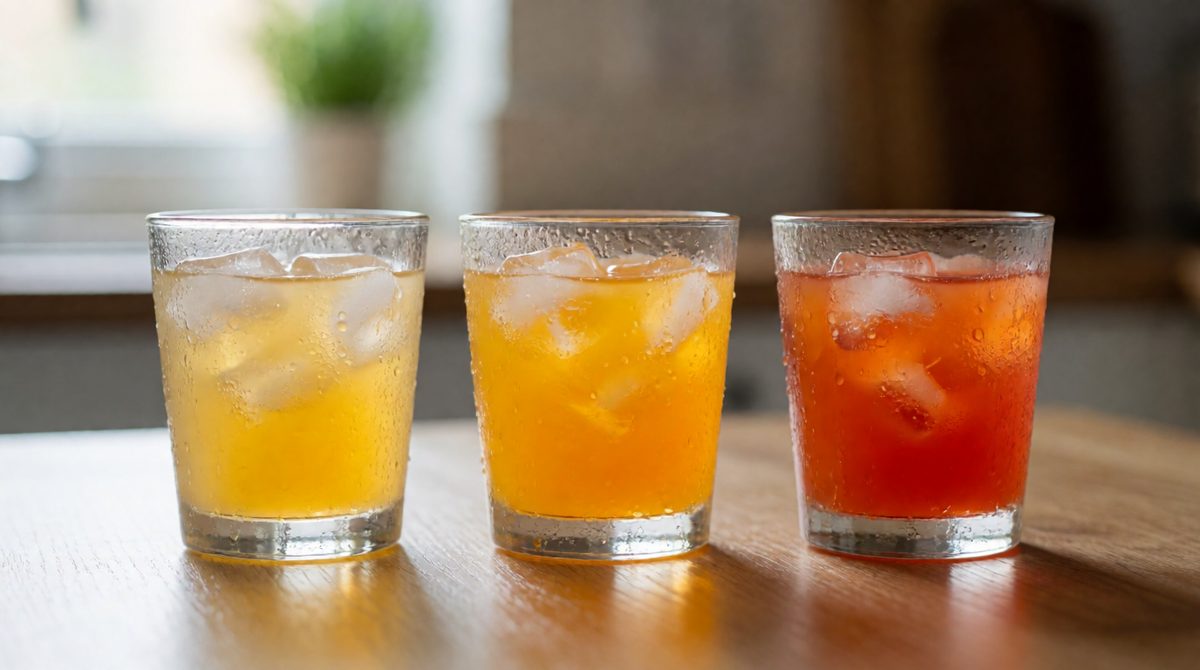
More squash in the same water means a stronger drink: concentration is mass of solute per dm³ of solution
Many chemical reactions take place in solutions. Remember, a solution is made when a solute dissolves in a solvent, such as water.
Think about making a glass of squash. A small splash of squash in a big glass of water tastes weak. A lot of squash in a small amount of water tastes strong. The difference is how much squash there is in each bit of the drink. Chemists call this the concentration.
The concentration of a solution tells you how much solute is dissolved in a certain volume of the solution. It can be measured as a mass per given volume of solution. At GCSE, the unit we use for this is grams per dm3, written g/dm3.
So a sugar solution with a concentration of 50 g/dm3 has 50 g of sugar dissolved in every 1 dm3 of solution.
Key terms:
In the lab, you usually measure volumes in cm3, for example with a measuring cylinder. But concentration in g/dm3 needs the volume in dm3. So you often need to convert first.
Divide by 1000.
250 cm3 ÷ 1000 = 0.25 dm3
50 cm3 ÷ 1000 = 0.050 dm3
Multiply by 1000.
0.4 dm3 × 1000 = 400 cm3
2 dm3 × 1000 = 2000 cm3
A quick check: a volume in dm3 should always be a smaller number than the same volume in cm3, because a dm3 is a much bigger unit.
To work out concentration in g/dm3, use this equation:
concentration (g/dm3) = mass of solute (g) ÷ volume of solution (dm3)
You can change the subject of the equation to find the other two quantities:
concentration = mass ÷ volume
mass = concentration × volume
volume = mass ÷ concentration
Note that the volume is the volume of the whole solution, not just the water you started with.
25 g of glucose is dissolved in water to make 0.50 dm3 of solution. Calculate the concentration in g/dm3.
concentration = 25 ÷ 0.50 = 50 g/dm3
4.0 g of potassium nitrate is dissolved in water to make 250 cm3 of solution. Calculate the concentration in g/dm3.
Step 1: volume = 250 ÷ 1000 = 0.250 dm3
Step 2: concentration = 4.0 ÷ 0.250 = 16 g/dm3
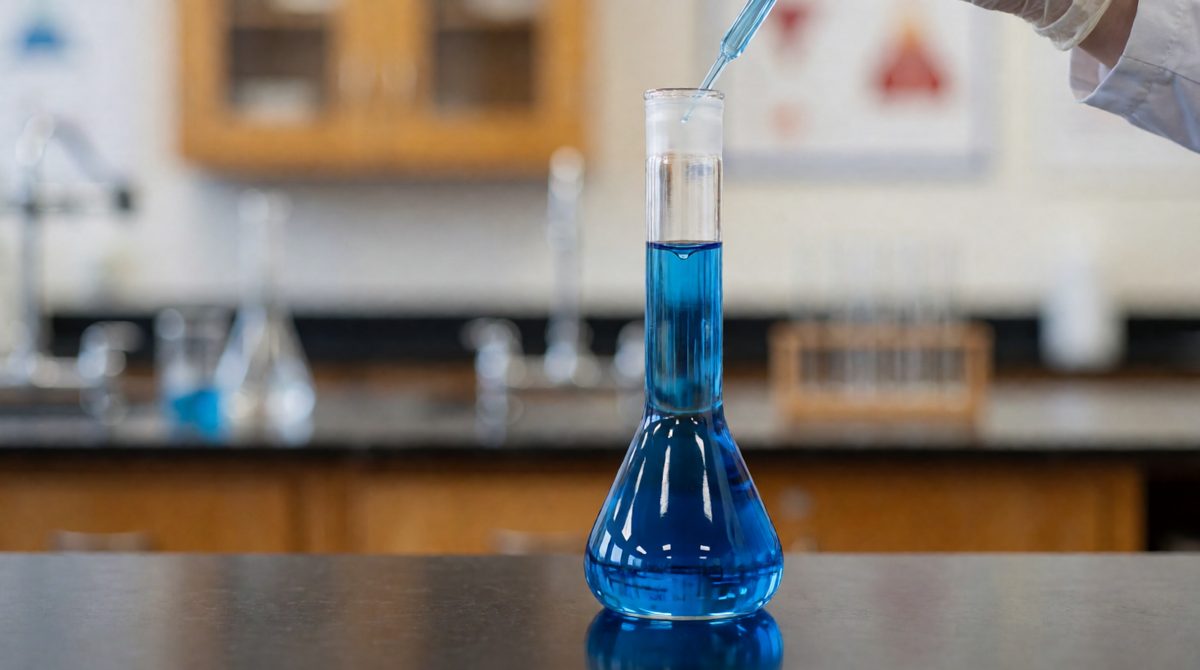
Blue copper sulfate dissolving: concentration × volume in dm³ tells you how many grams are in the flask
You must be able to calculate the mass of solute in a given volume of a solution when you know its concentration. Multiply the concentration by the volume in dm3.
A bottle contains sodium hydroxide solution with a concentration of 30 g/dm3. What mass of sodium hydroxide is in 200 cm3 of this solution?
Step 1: volume = 200 ÷ 1000 = 0.200 dm3
Step 2: mass = 30 × 0.200 = 6.0 g
A magnesium sulfate solution has a concentration of 40 g/dm3. What volume of this solution contains 10 g of magnesium sulfate? Give your answer in cm3.
Step 1: volume = 10 ÷ 40 = 0.25 dm3
Step 2: 0.25 × 1000 = 250 cm3
A good sense check: if the volume is less than 1 dm3, the mass of solute must be less than the number in the concentration. In example 3, 200 cm3 is a fifth of a dm3, so it holds a fifth of 30 g, which is 6 g.
How mass and volume affect concentration
You need to explain how the mass of solute and the volume of solution are related to the concentration. Look at the equation: concentration = mass ÷ volume.
For example, 20 g of solute in 500 cm3 of solution has a concentration of 20 ÷ 0.500 = 40 g/dm3. If water is added to make the volume 1000 cm3, there is still 20 g of solute, so the concentration becomes 20 ÷ 1.000 = 20 g/dm3. The volume doubled, so the concentration halved.
Forgetting to convert cm3 to dm3. 4.0 g in 250 cm3 is not 4.0 ÷ 250 = 0.016 g/dm3. That answer is 1000 times too small.
Converting the wrong way. Students multiply by 1000 instead of dividing. Ask yourself if the number should get smaller (cm3 to dm3) or bigger (dm3 to cm3).
Dividing the wrong way round. Concentration is mass ÷ volume, not volume ÷ mass. Checking the unit helps: g/dm3 means grams divided by dm3.
Missing or wrong units. Always write g/dm3 after a concentration and g after a mass.
A student dissolves 12.5 g of magnesium sulfate in water. They make the solution up to a total volume of 250 cm3.
(a) Calculate the concentration of the solution in g/dm3. [2 marks]
(b) Calculate the mass of magnesium sulfate in 40 cm3 of this solution. [2 marks]
(c) (Higher tier only) The student adds water to the solution until the total volume is 500 cm3. Explain what happens to the concentration. [2 marks]
(a) volume = 250 ÷ 1000 = 0.250 dm3 (1 mark). concentration = 12.5 ÷ 0.250 = 50 g/dm3 (1 mark).
(b) volume = 40 ÷ 1000 = 0.040 dm3 (1 mark). mass = 50 × 0.040 = 2.0 g (1 mark).
(c) The mass of magnesium sulfate stays the same, but the volume of solution doubles (1 mark). So the concentration halves, to 25 g/dm3 (1 mark).
Before you put any volume into the equation, look at the unit. If it is in cm3, divide by 1000 first. Show this step in your working, because it can earn you a mark even if your final answer is wrong.