✅ High percentage yield
Most of the reactants turned into the product you wanted, and very little was lost. Less reactant is wasted, which saves money and resources.
Sign up to access the complete lesson and track your progress!
Unlock This Course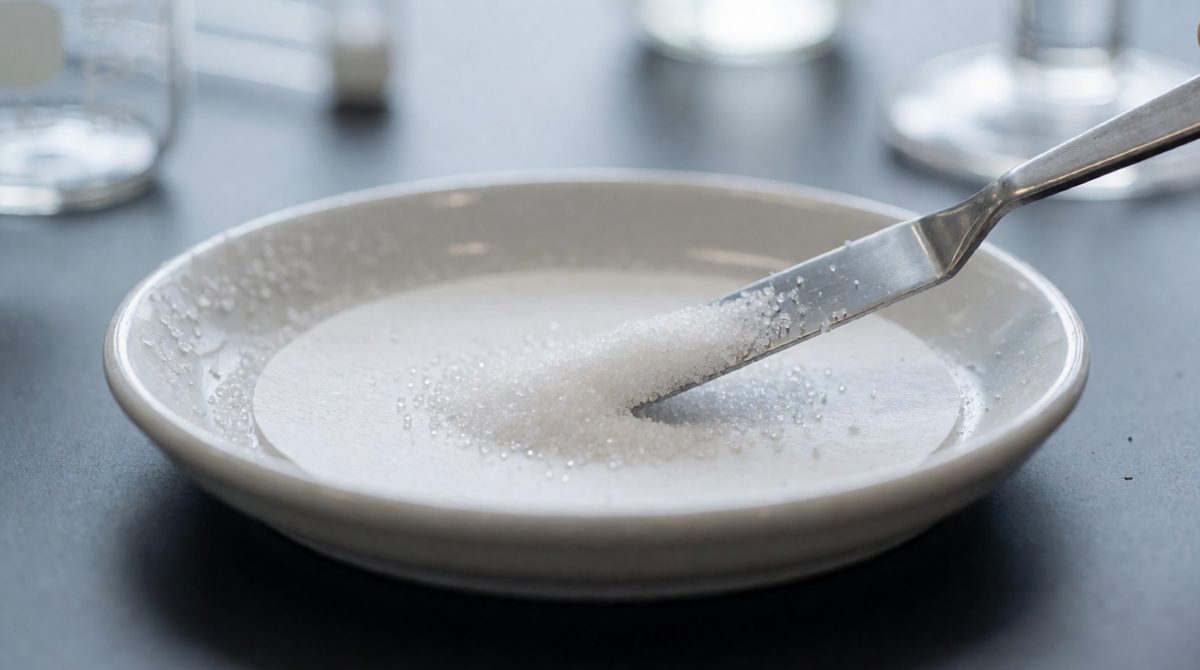
A little of these crystals always stays stuck to the dish or filter paper, which is why real yields fall short of 100%
Remember, no atoms are gained or lost in a chemical reaction. So in theory, you can use the reactant masses to work out exactly how much product you should make. In a real lab, though, you almost always end up with less than this calculated amount.
Think about baking a batch of biscuits. The recipe says it makes 20. But some dough sticks to the bowl, a bit stays on the spoon, and one biscuit gets burnt. You end up with 17. Chemistry is similar. The atoms do not vanish, but not all of them end up as the product in your container.
The spec gives three reasons why it is not always possible to obtain the calculated amount of a product:
You will meet reversible reactions in more detail in the lesson Reversible Reactions and Equilibrium. For now, you just need to know that they stop a reaction going to completion.
Key terms:
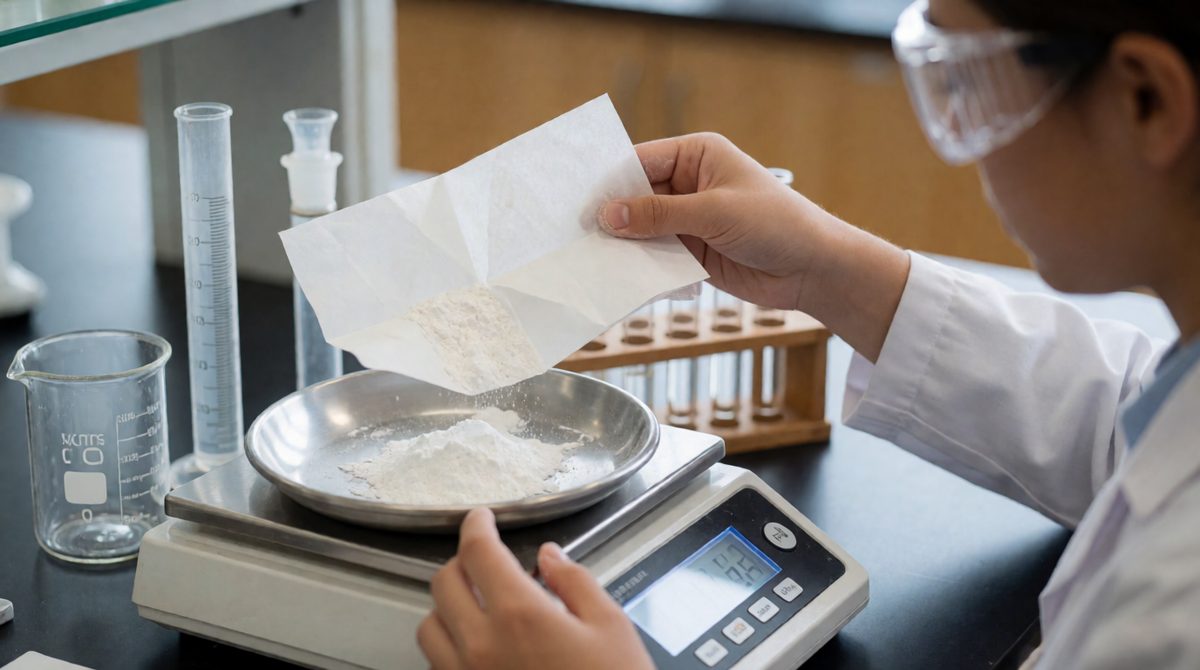
Weigh what you actually made, divide by the theoretical maximum, times 100, and that's your percentage yield
The percentage yield tells you how much of the possible product you actually made. Use this equation:
% yield = (mass of product actually made ÷ maximum theoretical mass of product) × 100
A percentage yield of 100% would mean you made every bit of product possible. In practice this almost never happens. For a pure, dry product, the percentage yield can never be more than 100%.
Most of the reactants turned into the product you wanted, and very little was lost. Less reactant is wasted, which saves money and resources.
A lot of the possible product was not obtained. Maybe the reaction is reversible, there were side reactions, or a lot was lost while separating it.
A student calculates that a reaction should make 40.0 g of product. They actually make 32.0 g. What is the percentage yield?
% yield = (32.0 ÷ 40.0) × 100 = 0.800 × 100 = 80.0%
The maximum theoretical mass of a product is 6.40 g. A student collects 5.12 g. Calculate the percentage yield.
% yield = (5.12 ÷ 6.40) × 100 = 80.0%
The data has 3 significant figures, so the answer is given to 3 significant figures too.
Sometimes the question gives you the percentage yield and asks for one of the masses. You need to change the subject of the equation.
A reaction has a percentage yield of 75%. The maximum theoretical mass is 12.0 g. What mass of product is actually made?
Mass actually made = (75 × 12.0) ÷ 100 = 9.0 g
Check: 9.0 ÷ 12.0 × 100 = 75%. Correct.
A company makes 450 kg of product with a percentage yield of 90%. What was the maximum theoretical mass?
Maximum theoretical mass = (450 × 100) ÷ 90 = 500 kg
The units stay the same as the masses you were given. You do not need to change kg into g.
At Higher tier you may have to work out the maximum theoretical mass yourself, from a given mass of reactant and the balanced equation. Use the same three steps you used for masses from equations:
This mass is the theoretical yield. You then use it in the percentage yield equation.
Zinc displaces copper from copper sulfate solution:
Zn + CuSO4 → ZnSO4 + Cu
A student adds 13.0 g of zinc to excess copper sulfate solution. They filter, wash and dry the copper and get 11.43 g. Calculate the percentage yield. (Ar: Zn = 65, Cu = 63.5)
Some of the fine copper powder was probably lost on the filter paper or when it was moved between containers.
Dividing the wrong way round. Always put the actual mass on top and the theoretical mass on the bottom. If your answer is over 100%, check this first.
A percentage yield over 100% from a real experiment. This does not mean extra atoms appeared. Usually the product was still wet or contained impurities, so it weighed too much.
Higher tier: forgetting the balancing numbers. If the ratio in the equation is 2 : 1, the moles of product are not the same as the moles of reactant. Always use the ratio from the balanced equation.
Using the mass of reactant as the theoretical yield. The theoretical yield is the maximum mass of product, not the mass of reactant you started with.
Magnesium oxide reacts with hydrochloric acid to make magnesium chloride:
MgO + 2HCl → MgCl2 + H2O
(a) A student made 19.0 g of magnesium chloride. The maximum theoretical mass was 23.75 g. Calculate the percentage yield. [2 marks]
(b) Give two reasons why the student did not obtain the maximum theoretical mass. [2 marks]
(c) Higher tier only: Show that 10.0 g of magnesium oxide can make a maximum of 23.75 g of magnesium chloride. (Mr: MgO = 40, MgCl2 = 95) [3 marks]
(a) % yield = (19.0 ÷ 23.75) × 100 = 80.0% (1 mark for the working, 1 mark for the answer)
(b) Any two from: some magnesium chloride solution was left behind in the beaker or lost when it was poured; some solid was left on the filter paper or stuck to the evaporating basin when the crystals were separated; some magnesium chloride stayed dissolved and did not form crystals. (1 mark each) This reaction is not reversible, so "the reaction is reversible" would not score here.
(c) Moles of MgO = 10.0 ÷ 40 = 0.250 mol (1 mark). The ratio MgO : MgCl2 is 1 : 1, so 0.250 mol of MgCl2 can be made (1 mark). Mass = 0.250 × 95 = 23.75 g (1 mark).
For "give a reason" questions, use the spec's own wording, but only pick reasons that fit the reaction in the question: the reaction is reversible, product was lost during separation, or reactants reacted in an unexpected way. Vague answers like "human error" will not get the mark.