What is atom economy?
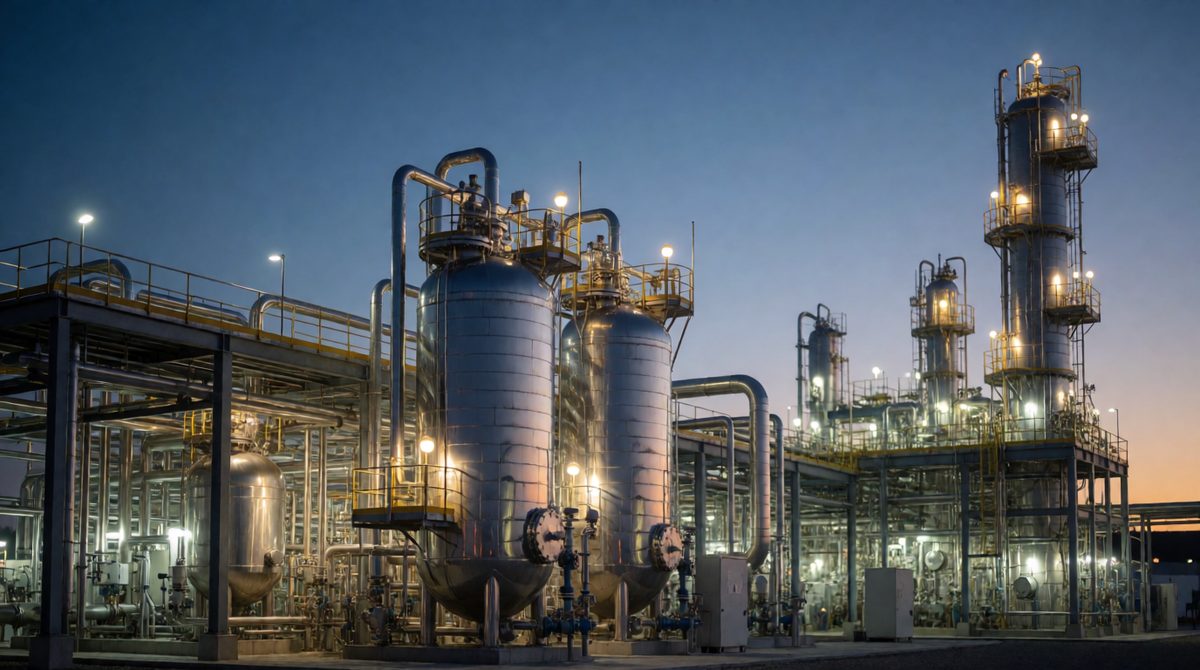
Every atom that ends up in a waste tank is a wasted atom: atom economy shows how much of the reactants becomes the product you want
Most reactions make more than one product. Usually only one of them is the thing you actually want. This is called the desired product. The other products are by-products. Sometimes they are useful, but often they are just waste.
Atom economy tells you how much of your starting materials ends up in the product you want. The spec says: the atom economy (atom utilisation) is a measure of the amount of starting materials that end up as useful products.
Think of it like cutting shapes out of a sheet of pastry. If you cut one small shape and throw the rest away, most of your pastry is wasted. If your shapes fit together with no gaps, almost nothing is wasted. A reaction with a high atom economy is like the second sheet: most of the reactant atoms end up in the useful product.
Atom economy is not the same as percentage yield. Percentage yield compares what you actually made with what you could make. Atom economy is worked out only from the balanced equation, before you do anything in the lab. A reaction can have a 100% atom economy and still give a poor yield.
Key terms:
- Atom economy (atom utilisation): a measure of the amount of starting materials that end up as useful products.
- Desired product: the product you want to make from a reaction.
- By-product: any other product of the reaction that is not the desired product.
Calculating percentage atom economy
You calculate atom economy using the balanced equation and relative formula masses (Mr):
The equation
percentage atom economy = (Mr of desired product from equation ÷ sum of Mr of all reactants from equation) × 100
"From equation" is the important part. You must multiply each Mr by its balancing number in the equation. Follow these steps:
- Write the balanced equation.
- Work out the Mr of every reactant. Multiply each by its balancing number, then add them up.
- Work out the Mr of the desired product and multiply it by its balancing number.
- Divide the product total by the reactant total, then multiply by 100.
Because mass is conserved, the total Mr of the reactants always equals the total Mr of the products. This gives you a handy check on your arithmetic.
Worked example 1: copper sulfate
Copper(II) sulfate can be made from copper(II) oxide and sulfuric acid. Calculate the atom economy. (Ar: Cu = 63.5, S = 32, O = 16, H = 1)
CuO + H2SO4 → CuSO4 + H2O
Reactants: CuO = 63.5 + 16 = 79.5 and H2SO4 = 98. Total = 79.5 + 98 = 177.5
Desired product: CuSO4 = 63.5 + 32 + (4 × 16) = 159.5
Atom economy = (159.5 ÷ 177.5) × 100 = 89.9%
Check: products 159.5 + 18 = 177.5, the same as the reactants.
Worked example 2: hydrogen from water
Hydrogen can be made by splitting water using electricity. Calculate the atom economy for making hydrogen.
2H2O → 2H2 + O2
Reactants: 2 × 18 = 36
Desired product: 2 × 2 = 4
Atom economy = (4 ÷ 36) × 100 = 11.1%
Most of the mass ends up as oxygen. If the oxygen is collected and sold, it becomes a useful product too. Then much less of the starting material is wasted.
Worked example 3: two ways to make ethanol
Route A, from ethene and steam: C2H4 + H2O → C2H5OH
Reactants: 28 + 18 = 46. Desired product: 46. Atom economy = (46 ÷ 46) × 100 = 100%
Route B, fermenting glucose: C6H12O6 → 2C2H5OH + 2CO2
Reactants: 180. Desired product: 2 × 46 = 92. Atom economy = (92 ÷ 180) × 100 = 51.1%
When a reaction has only one product, the atom economy is always 100%.
Changing the subject and using decimals
Sometimes a question gives you the atom economy and asks for a missing Mr. Rearrange the equation:
Mr of desired product = (atom economy ÷ 100) × sum of Mr of reactants
For example, a reaction has an atom economy of 75% and the reactants add up to 200. The desired product totals 0.75 × 200 = 150.
You may also see atom economy as a decimal. 0.629 is the same as 62.9%. Multiply by 100 to turn a decimal into a percentage.
Why a high atom economy matters
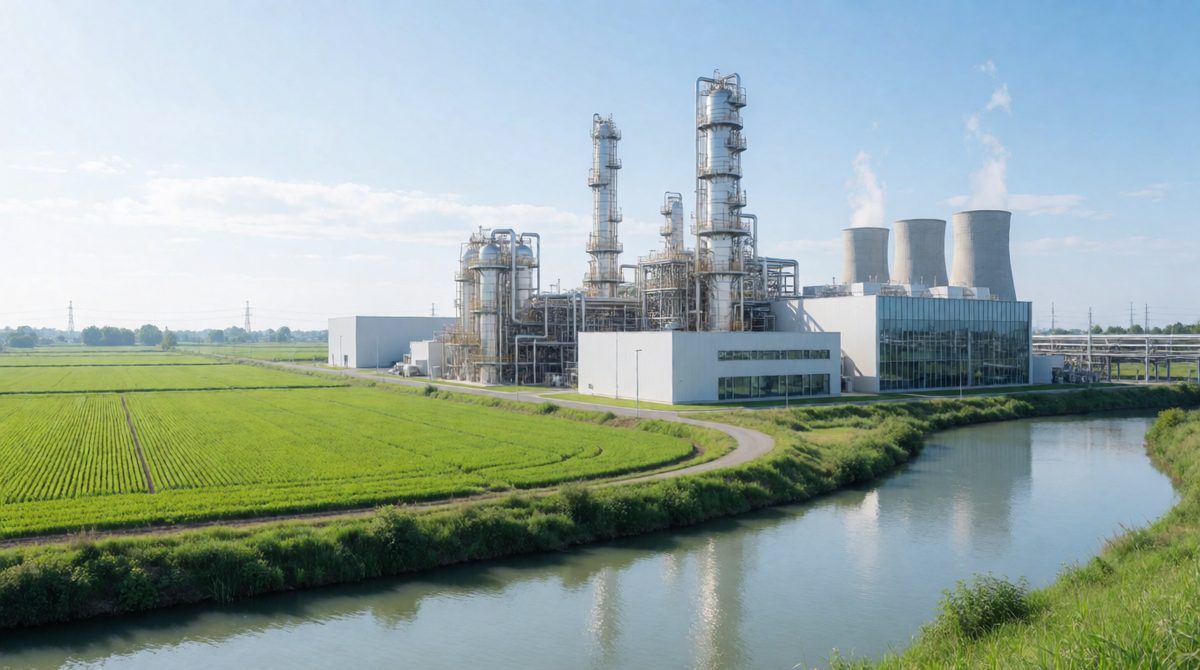
A high atom economy means fewer raw materials and less waste, which is greener and cheaper for factories like this
The spec says it is important for sustainable development and for economic reasons to use reactions with high atom economy.
🌱 Sustainability
A high atom economy means fewer raw materials are used to make the same amount of product. Less waste is made, so there is less to get rid of. This helps resources such as crude oil and metal ores last longer. You will meet sustainable development properly in its own lesson later.
💰 Money
Companies pay for every kilogram of reactant. If most of it becomes waste, they are paying for something they cannot sell. They may also have to pay to treat or dispose of the waste safely. A high atom economy usually means lower costs and more profit.
A low atom economy is not always a disaster. If a by-product can be sold or used, the reaction becomes much less wasteful.
Higher tier only: choosing a reaction pathway
There is often more than one reaction that makes the same product. You may be given data and asked to explain why one pathway is chosen. Atom economy is only one factor. Look at all of these:
- Atom economy: higher means less waste.
- Yield: higher means more product from the reactants.
- Rate: a faster reaction makes more product in a given time.
- Equilibrium position: for a reversible reaction, a position further towards the products gives more product (see Reversible Reactions and Equilibrium).
- Usefulness of by-products: a by-product that can be sold or used reduces waste.
Weigh these up using the data you are given. A pathway with a lower atom economy can still be chosen if it has a much higher yield, a faster rate or a by-product that can be sold. Always say which piece of data supports your choice.
Common mistakes
- Forgetting balancing numbers. In 2H2O you must use 2 × 18, not 18.
- Mixing it up with percentage yield. Atom economy uses Mr values from the equation. It never uses masses you weighed in the lab.
- Leaving out a reactant. The bottom of the fraction is the sum of all the reactants.
- Choosing a route on atom economy alone in a Higher tier question. Use every piece of data in the table.
Exam-style question
Iron can be made by heating iron(III) oxide with carbon:
2Fe2O3 + 3C → 4Fe + 3CO2
(a) Calculate the percentage atom economy for making iron. (Ar: Fe = 56, O = 16, C = 12) [3 marks]
(b) Give one reason why a company would prefer a reaction with a higher atom economy. [1 mark]
Model answer
(a) Reactants: 2 × Fe2O3 = 2 × 160 = 320, and 3 × C = 36. Total = 356 (1 mark)
Desired product: 4 × Fe = 224 (1 mark)
Atom economy = (224 ÷ 356) × 100 = 62.9% (1 mark)
(b) Less of the reactants is wasted, so less money is spent on raw materials for each tonne of iron made (or: less waste to dispose of).
Exam tip
Write out the Mr of each substance with its balancing number before you divide. Then check that the reactant total equals the product total. If it does not, you have made a slip.