⚖ More mass, higher concentration
Dissolve a bigger mass of solute to make the same volume of solution and you have more moles in that volume. The concentration goes up. Double the mass and you double the concentration.
Everything in this lesson is Higher tier only, and it is in GCSE Chemistry only (not Combined Science). If you are sitting Foundation papers, you will not be asked about concentrations in mol/dm3.
Sign up to access the complete lesson and track your progress!
Unlock This Course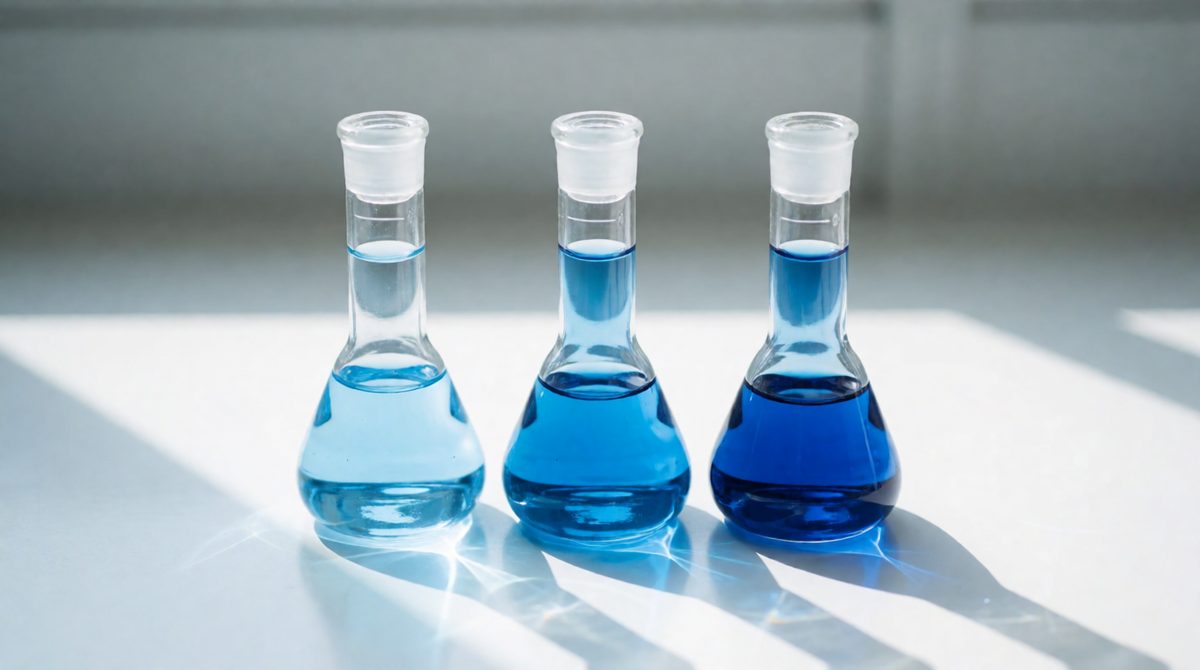
Same flask, same volume: the deeper the blue, the more moles of copper sulfate in each dm³
You have already met concentration in g/dm3. That tells you the mass of solute in each cubic decimetre of solution. Chemists often prefer to count particles instead of weighing them, so they also measure concentration in moles per cubic decimetre, written mol/dm3.
A solution of 1 mol/dm3 has 1 mole of solute dissolved in every 1 dm3 of solution. A solution of 2 mol/dm3 has twice as many solute particles in the same volume.
Why bother? Reactions happen between particles, and balanced equations are read in moles. If you know a solution's concentration in mol/dm3, you can go straight from a volume of solution to a number of moles. That makes reacting solutions much easier to work with.
Key terms:
concentration (mol/dm3) = amount of solute (mol) ÷ volume of solution (dm3)
Rearranged: amount (mol) = concentration (mol/dm3) × volume (dm3)
The volume must be in dm3. Remember, divide cm3 by 1000 to get dm3.
0.40 mol of hydrogen chloride, HCl, is dissolved in water to make 2.0 dm3 of hydrochloric acid. What is its concentration?
concentration = 0.40 ÷ 2.0 = 0.20 mol/dm3
How many moles of sodium hydroxide are in 25.0 cm3 of 0.100 mol/dm3 sodium hydroxide solution?
Volume = 25.0 ÷ 1000 = 0.0250 dm3
amount = 0.100 × 0.0250 = 0.00250 mol
Small numbers like this are often written in standard form: 0.00250 mol = 2.50 × 10⁻³ mol. Both are correct in an exam.
The spec asks you to explain how the concentration in mol/dm3 is related to the mass of the solute and the volume of the solution. The link is the mole: moles = mass ÷ Mr.
Dissolve a bigger mass of solute to make the same volume of solution and you have more moles in that volume. The concentration goes up. Double the mass and you double the concentration.
Dissolve the same mass to make a bigger volume of solution and the moles are spread out more. The concentration goes down. Double the volume and you halve the concentration.
So to find the mass of solute in a solution, work out the moles first, then multiply by Mr.
What mass of sodium carbonate, Na2CO3, is needed to make 250 cm3 of a 0.100 mol/dm3 solution? (Mr of Na2CO3 = 106)
Volume = 250 ÷ 1000 = 0.250 dm3
moles = 0.100 × 0.250 = 0.0250 mol
mass = 0.0250 × 106 = 2.65 g
Both units describe how much solute is in each 1 dm3 of solution. One counts moles, the other weighs grams. The Mr links them:
a) Convert 0.50 mol/dm3 sodium hydroxide, NaOH (Mr = 40), into g/dm3.
0.50 × 40 = 20 g/dm3
b) A hydrochloric acid solution contains 7.3 g/dm3 of HCl (Mr = 36.5). What is its concentration in mol/dm3?
7.3 ÷ 36.5 = 0.20 mol/dm3
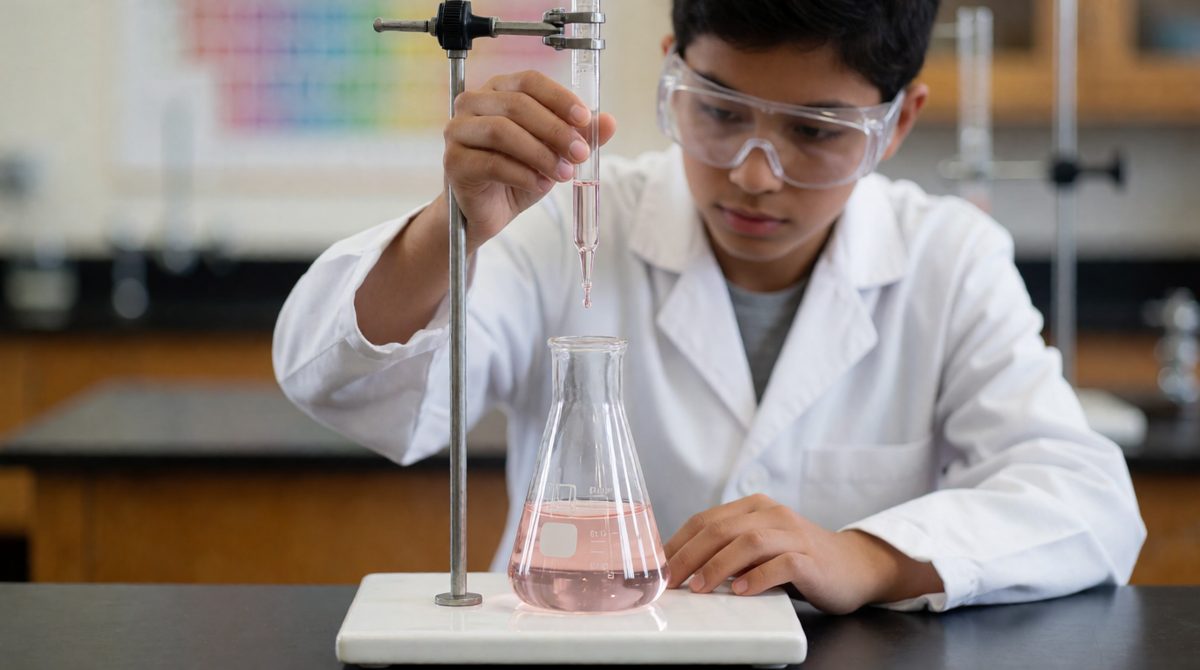
The pink just vanished: that's the end point, and with the burette volume you can calculate the unknown concentration
In a titration you find the exact volumes of two solutions that react completely. (You will learn how to carry one out in the lesson on titrations.) If you know the concentration of one solution, you can calculate the concentration of the other. Follow four steps:
25.0 cm3 of sodium hydroxide solution reacts completely with 20.0 cm3 of 0.100 mol/dm3 hydrochloric acid. Find the concentration of the sodium hydroxide.
NaOH + HCl → NaCl + H2O
Step 1: moles HCl = 0.100 × (20.0 ÷ 1000) = 0.00200 mol
Step 2: ratio NaOH : HCl = 1 : 1
Step 3: moles NaOH = 0.00200 mol
Step 4: concentration NaOH = 0.00200 ÷ (25.0 ÷ 1000) = 0.0800 mol/dm3
25.0 cm3 of 0.200 mol/dm3 sodium hydroxide reacts completely with 20.0 cm3 of sulfuric acid. Find the concentration of the acid in mol/dm3 and in g/dm3. (Mr of H2SO4 = 98)
H2SO4 + 2NaOH → Na2SO4 + 2H2O
Step 1: moles NaOH = 0.200 × 0.0250 = 0.00500 mol
Step 2: ratio H2SO4 : NaOH = 1 : 2
Step 3: moles H2SO4 = 0.00500 ÷ 2 = 0.00250 mol
Step 4: concentration = 0.00250 ÷ 0.0200 = 0.125 mol/dm3
In g/dm3: 0.125 × 98 = 12.25, so about 12.3 g/dm3
Forgetting to convert cm3 to dm3. Using 25.0 instead of 0.0250 makes your answer 1000 times too big or too small.
Ignoring the mole ratio. In worked example 6, students who skip step 2 get 0.250 mol/dm3, double the right answer. Always look at the balancing numbers.
Using the wrong volume in step 4. Divide by the volume of the solution you are finding the concentration of, not the one you started with.
Mixing up multiply and divide by Mr. When Mr is more than 1, the number in g/dm3 is always bigger than the number in mol/dm3. Use this to check which way you went.
A student found that 25.0 cm3 of potassium hydroxide solution, KOH, reacted completely with 22.50 cm3 of 0.150 mol/dm3 nitric acid, HNO3.
KOH + HNO3 → KNO3 + H2O
a) Calculate the concentration of the potassium hydroxide solution in mol/dm3. [3 marks]
b) Calculate the concentration of the potassium hydroxide solution in g/dm3. (Mr of KOH = 56) [1 mark]
a) moles HNO3 = 0.150 × (22.50 ÷ 1000) = 0.003375 mol, or 3.375 × 10⁻³ mol (1)
The ratio is 1 : 1, so moles KOH = 0.003375 mol (1)
concentration KOH = 0.003375 ÷ 0.0250 = 0.135 mol/dm3 (1)
b) 0.135 × 56 = 7.56 g/dm3 (1)
Write the four titration steps out in full, with units, even when the ratio is 1 : 1. If you make a slip in the arithmetic, the examiner can still give you marks for each correct step.