➡ Moles to volume
0.50 mol of nitrogen, N2, at RTP.
volume = 0.50 × 24 = 12 dm3
Everything in this lesson is Higher tier only, and it is in GCSE Chemistry only (not Combined Science). If you are sitting Foundation papers, you will not be asked about gas volumes in this way.
Sign up to access the complete lesson and track your progress!
Unlock This Course
Whether it's helium or carbon dioxide, one mole of any gas fills 24 dm³ at room temperature and pressure
In a gas, the particles are very far apart compared with their own size. Most of a gas is empty space. This means the volume a gas takes up depends on how many particles there are, not on how big or heavy each particle is.
So the spec rule is: equal amounts in moles of gases occupy the same volume under the same conditions of temperature and pressure.
At room temperature and pressure, the volume of one mole of any gas is 24 dm3. Room temperature and pressure (RTP) means 20°C and 1 atmosphere pressure.
Think about what this means. One mole of hydrogen, H2, has a mass of just 2 g. One mole of chlorine, Cl2, has a mass of 71 g. Yet at RTP both take up exactly the same space: 24 dm3. The chlorine is much denser, but it does not have more particles.
Remember, 1 dm3 = 1000 cm3. So one mole of any gas at RTP is also 24 000 cm3.
Key terms:
volume of gas (dm3) = amount of gas (mol) × 24
Rearranged: amount of gas (mol) = volume of gas (dm3) ÷ 24
If the volume is in cm3, use 24 000 instead of 24.
Changing the subject of the equation is a skill the exam tests. Start from volume = moles × 24. To get moles on its own, divide both sides by 24.
0.50 mol of nitrogen, N2, at RTP.
volume = 0.50 × 24 = 12 dm3
360 cm3 of argon at RTP.
moles = 360 ÷ 24 000 = 0.015 mol
The spec says you must calculate the volume of a gas at RTP from its mass and relative formula mass. This takes two steps.
What volume does 3.4 g of ammonia, NH3, occupy at RTP?
Mr of NH3 = 14 + (3 × 1) = 17
moles = 3.4 ÷ 17 = 0.20 mol
volume = 0.20 × 24 = 4.8 dm3
What is the mass of 600 cm3 of chlorine gas, Cl2, at RTP?
moles = 600 ÷ 24 000 = 0.025 mol
Mr of Cl2 = 2 × 35.5 = 71
mass = 0.025 × 71 = 1.775 g = 1.78 g (3 significant figures)
The volumes of gaseous reactants and products can be calculated from the balanced equation. Because equal moles of gases have equal volumes, the ratio of volumes is the same as the ratio of moles for gases at the same temperature and pressure. So you can read the balancing numbers straight off as volume ratios. You do not even need the 24.
Nitrogen monoxide reacts with oxygen to make nitrogen dioxide:
2NO(g) + O2(g) → 2NO2(g)
The ratio is 2 : 1 : 2. If 40 cm3 of nitrogen monoxide reacts completely:
oxygen needed = 40 ÷ 2 = 20 cm3
nitrogen dioxide made = 40 cm3 (same as the NO, because the ratio is 2 : 2)
Notice 60 cm3 of gas becomes 40 cm3. Volume is not conserved in a reaction, even though mass is.
Ethane burns in oxygen:
2C2H6(g) + 7O2(g) → 4CO2(g) + 6H2O(l)
The ratio of ethane to oxygen to carbon dioxide is 2 : 7 : 4. So 20 cm3 of ethane needs 20 × 7 ÷ 2 = 70 cm3 of oxygen and makes 20 × 4 ÷ 2 = 40 cm3 of carbon dioxide.
The water is a liquid at room temperature, so the volume rule does not apply to it. Only use volume ratios for substances shown as (g).
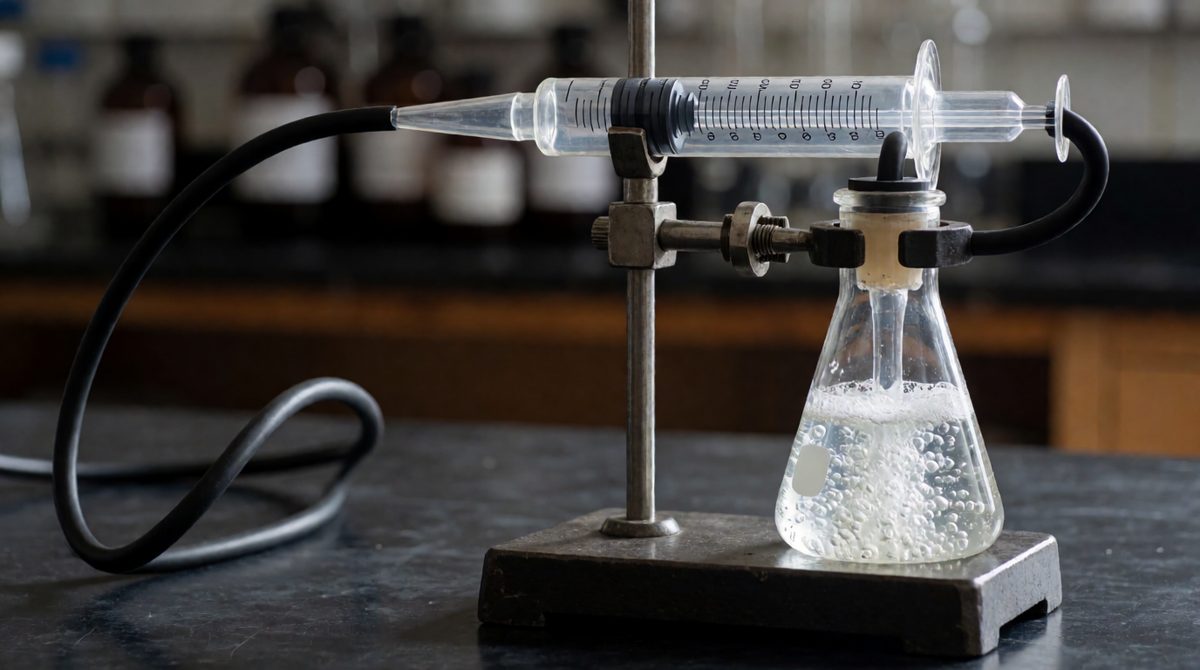
Gas from the reaction pushes the syringe out, and moles × 24 tells you how many dm³ to expect
Sometimes you start with the mass of a solid and need the volume of gas it gives off. Combine the steps: mass to moles, use the mole ratio, then moles to volume.
Zinc reacts with hydrochloric acid to give off hydrogen:
Zn(s) + 2HCl(aq) → ZnCl2(aq) + H2(g)
What volume of hydrogen forms at RTP when 1.3 g of zinc reacts with excess acid? (Ar of Zn = 65)
moles of Zn = 1.3 ÷ 65 = 0.020 mol
ratio Zn : H2 = 1 : 1, so 0.020 mol of H2
volume = 0.020 × 24 = 0.48 dm3 (or 480 cm3)
Mixing up units. Using 24 with a volume in cm3 gives an answer 1000 times too big. Match 24 with dm3 and 24 000 with cm3.
Using 24 dm3 for liquids or solids. The rule is only for gases. One mole of liquid water does not take up 24 dm3.
Forgetting the balancing numbers. In 2NO + O2, the oxygen volume is half the nitrogen monoxide volume, not the same.
Thinking heavier gases take up more room. At the same temperature and pressure, 1 mol of any gas has the same volume, whatever its Mr.
Using it at other conditions. 24 dm3 is only the molar volume at 20°C and 1 atmosphere.
Carbon monoxide burns in oxygen to make carbon dioxide:
2CO(g) + O2(g) → 2CO2(g)
(a) Calculate the volume of oxygen needed to burn 60 cm3 of carbon monoxide. (1 mark)
(b) Calculate the mass of carbon dioxide made. All volumes are measured at room temperature and pressure. The volume of one mole of any gas at room temperature and pressure is 24 dm3. Relative atomic masses (Ar): C = 12, O = 16. (3 marks)
(a) Ratio CO : O2 = 2 : 1, so oxygen = 60 ÷ 2 = 30 cm3
(b) Ratio CO : CO2 = 2 : 2, so 60 cm3 of CO2 is made.
moles of CO2 = 60 ÷ 24 000 = 0.0025 mol (2.5 × 10⁻³ mol)
Mr of CO2 = 12 + (2 × 16) = 44
mass = 0.0025 × 44 = 0.11 g
Before you start, circle the units in the question. If the volume is in cm3, either divide by 24 000 or change it to dm3 first. Always show each step, as you can still get method marks if the final number is wrong.