🍮 Plum pudding model
A ball of positive charge with electrons embedded in it. Positive charge and mass spread evenly through the whole atom. No nucleus. No empty space.
Sign up to access the complete lesson and track your progress!
Unlock This Course
Nobody can see an atom with a magnifying glass, so scientists build models that fit the evidence and swap them when new results turn up
Nobody can see an atom with their eyes. So scientists use a model: a simple picture or idea that explains what experiments show.
A model is only as good as the evidence behind it. When a new experiment gives results the old model cannot explain, the model has to be changed or replaced. That is exactly what happened to the model of the atom, several times, over about 130 years.
As you read this lesson, keep asking one question: what new evidence made scientists change their minds? That is what the exam wants you to explain.
Key terms:
In the early 1800s, John Dalton suggested that everything is made of atoms. Before the electron was discovered, atoms were thought to be tiny spheres that could not be divided. Think of a solid snooker ball, but far, far smaller. There was nothing inside it. It could not be broken into smaller parts.
In 1897, J.J. Thomson discovered the electron, a tiny particle with a negative charge. This was new evidence. If electrons could come out of atoms, then atoms could not be solid spheres that cannot be divided. They must have smaller parts inside.
Electrons are negative, so scientists reasoned there must also be some positive charge in the atom. The discovery of the electron led to the plum pudding model. It suggested that the atom is a ball of positive charge with negative electrons embedded in it, like dried fruit dotted through a pudding.
In this model the positive charge and the mass are spread out evenly through the whole atom.
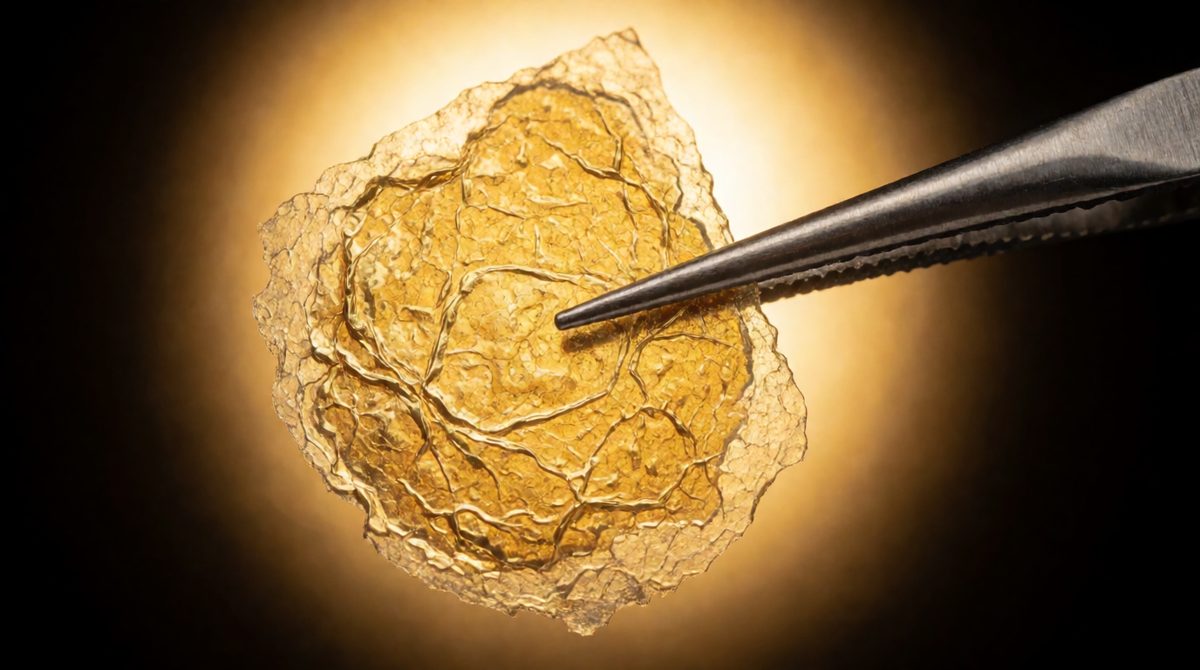
Gold beaten this thin let Geiger and Marsden fire alpha particles straight through - most passed, but a few bounced back, revealing the tiny nucleus
In about 1909, Hans Geiger and Ernest Marsden, working with Ernest Rutherford, fired alpha particles at a very thin sheet of gold foil. A detector around the foil showed where the alpha particles went.
If the plum pudding model were right, the positive charge and mass would be spread thinly everywhere. The alpha particles should all pass straight through, or be deflected only very slightly. The results were a big surprise.
So most of the atom must be empty space.
Something in the atom pushed the positive alpha particles away. So the centre must be charged (positive charges repel).
Only something with a lot of mass packed into a tiny space could do this. So the mass is concentrated at the centre.
These results led to the conclusion that the mass of an atom is concentrated at the centre, in a nucleus, and that the nucleus is charged. In 1911 Rutherford put forward the nuclear model, and it replaced the plum pudding model, because the old model could not explain the new evidence.
A ball of positive charge with electrons embedded in it. Positive charge and mass spread evenly through the whole atom. No nucleus. No empty space.
Positive charge and almost all the mass concentrated in a tiny nucleus at the centre. Electrons are outside the nucleus. Most of the atom is empty space.
Niels Bohr adapted the nuclear model in 1913. He suggested that electrons orbit the nucleus at specific distances. These fixed distances are what we now call shells or energy levels. Electrons cannot sit anywhere in between.
Bohr's theoretical calculations agreed with experimental observations. This agreement between theory and experiment is why scientists accepted his idea. You do not need to know the details of the experiments that supported it. You will use shells to write electron arrangements in the lesson Electronic Structure.
Later experiments showed that the positive charge of any nucleus could be subdivided into a whole number of smaller particles, each with the same amount of positive charge. These particles were named protons.
In 1932, the experimental work of James Chadwick provided the evidence that neutrons exist inside the nucleus too. This was about 20 years after the nucleus became an accepted scientific idea. You do not need to know how Chadwick did his experiments.
This gives us the model you use today: a nucleus made of protons and neutrons, with electrons in shells around it. The charges and sizes of these particles are covered in the lesson Protons, Neutrons and Electrons.
Tiny spheres (early 1800s) → electron found, plum pudding model (1897 to 1904) → alpha scattering, nuclear model (1909 to 1911) → Bohr's shells (1913) → protons named (around 1920) → Chadwick finds the neutron (1932).
Mixing up the two models. The plum pudding model has no nucleus. Students often draw electrons orbiting in it. They don't. They are embedded in the positive ball.
Describing results without conclusions. Saying 'some alpha particles bounced back' is only half an answer. Always add what it tells us: the mass is concentrated in a tiny central nucleus.
Saying the nucleus is negative. The alpha particles are positive and were repelled, so the nucleus must be positive too.
Getting the order wrong. The neutron was found last, about 20 years after the nucleus was accepted.
The alpha particle scattering experiment led scientists to replace the plum pudding model with the nuclear model. Describe the results of the experiment and explain why they led to this change. [4 marks]
Most of the alpha particles passed straight through the gold foil, so most of the atom is empty space (1). Some alpha particles were deflected, so the centre of the atom must be charged (1). A very small number bounced back, so the mass must be concentrated in a tiny nucleus at the centre (1). The plum pudding model, with mass and positive charge spread out evenly, could not explain these results, so it was replaced by the nuclear model (1).
For any 'why did the model change' question, use the pattern: result, then what it shows, then why the old model could not explain it. That structure picks up every mark.