Metals and oxygen
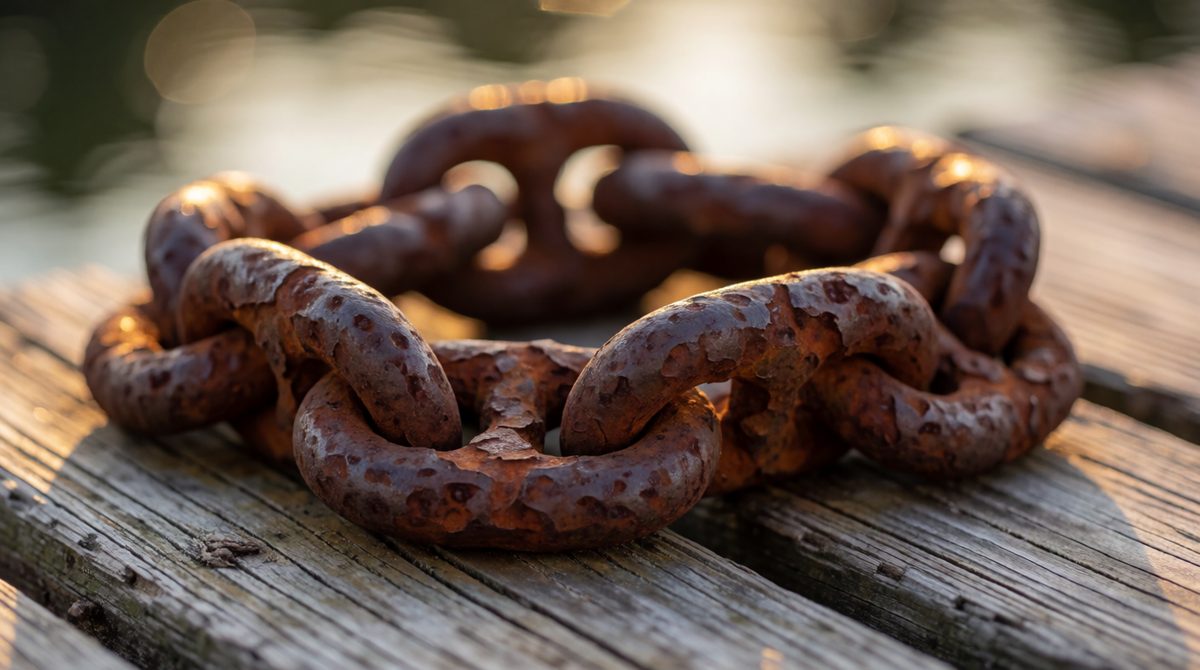
Rust is iron that has gained oxygen, and gaining oxygen is oxidation
Most metals react with oxygen to make a metal oxide. You see this when a metal goes dull in air, or when a metal burns in a flame.
For example, zinc reacts with oxygen to make zinc oxide:
zinc + oxygen → zinc oxide
2Zn + O2 → 2ZnO
Iron does the same thing when it is heated strongly in oxygen:
iron + oxygen → iron oxide
4Fe + 3O2 → 2Fe2O3
In both reactions the metal has gained oxygen. A reaction where a substance gains oxygen is called oxidation. So every metal reacting with oxygen is an oxidation reaction.
The opposite can happen too. When a substance loses oxygen, it is reduced. For example, if hydrogen gas is passed over hot copper oxide, the copper oxide loses its oxygen and turns into copper:
copper oxide + hydrogen → copper + water
CuO + H2 → Cu + H2O
Here the copper oxide is reduced because it loses oxygen. At the same time the hydrogen gains oxygen to become water, so the hydrogen is oxidised. Oxidation and reduction often happen together in the same reaction.
Key terms:
- Metal oxide: the compound made when a metal reacts with oxygen.
- Oxidation: a reaction in which a substance gains oxygen.
- Reduction: a reaction in which a substance loses oxygen.
What makes a metal reactive?
Remember, metal atoms form positive ions when they react. This is the key idea: the reactivity of a metal is related to its tendency to form positive ions.
A metal that forms its positive ion very easily reacts quickly and strongly. A metal that does not form its positive ion easily reacts slowly, or not at all. Potassium forms K+ ions very easily, so it is very reactive. Copper does not form Cu2+ ions easily, so it is very unreactive.
We can list metals from most reactive to least reactive. This list is called the reactivity series.
Key terms:
- Reactivity series: a list of metals in order of how reactive they are, most reactive at the top.
Reactions with water and dilute acids
We can put metals in order by watching how they react with cold water and with dilute acids, such as dilute hydrochloric acid. The faster hydrogen bubbles are given off, the more reactive the metal. These descriptions are all at room temperature.
💧 With cold water
Potassium, sodium, lithium: react quickly, fizzing on the surface. Potassium is the most violent of the three and lithium the gentlest (you met these in Group 1: The Alkali Metals).
Calcium: reacts steadily, fizzing and giving off hydrogen. The water goes cloudy as calcium hydroxide forms.
Magnesium: reacts extremely slowly. You may see only a few bubbles after a long time.
Zinc, iron, copper: no reaction you can see with cold water.
⚗ With dilute acid
Potassium, sodium, lithium: react dangerously, even explosively. They are never added to acid in school.
Calcium: reacts very vigorously with lots of fizzing.
Magnesium: fizzes quickly and the ribbon soon disappears.
Zinc: steady bubbles.
Iron: slow bubbles.
Copper: no reaction.
Remember, a metal that reacts with water makes a metal hydroxide and hydrogen. The products of metals reacting with acids are covered in Acids Reacting with Metals.
Putting all of these observations together gives this order:
The reactivity series
potassium (most reactive)
sodium
lithium
calcium
magnesium
carbon
zinc
iron
hydrogen
copper (least reactive)
Notice that two non-metals, carbon and hydrogen, are often included. They are not metals, but showing them in the list is useful for comparing metals with them.
- Hydrogen sits above copper. Metals above hydrogen react with dilute acids to give hydrogen gas. Copper is below hydrogen, which is why it does not react with dilute acids.
- Carbon sits between magnesium and zinc. Its position matters for getting metals out of their ores, which you will see in Extracting Metals by Reduction.
Displacement reactions
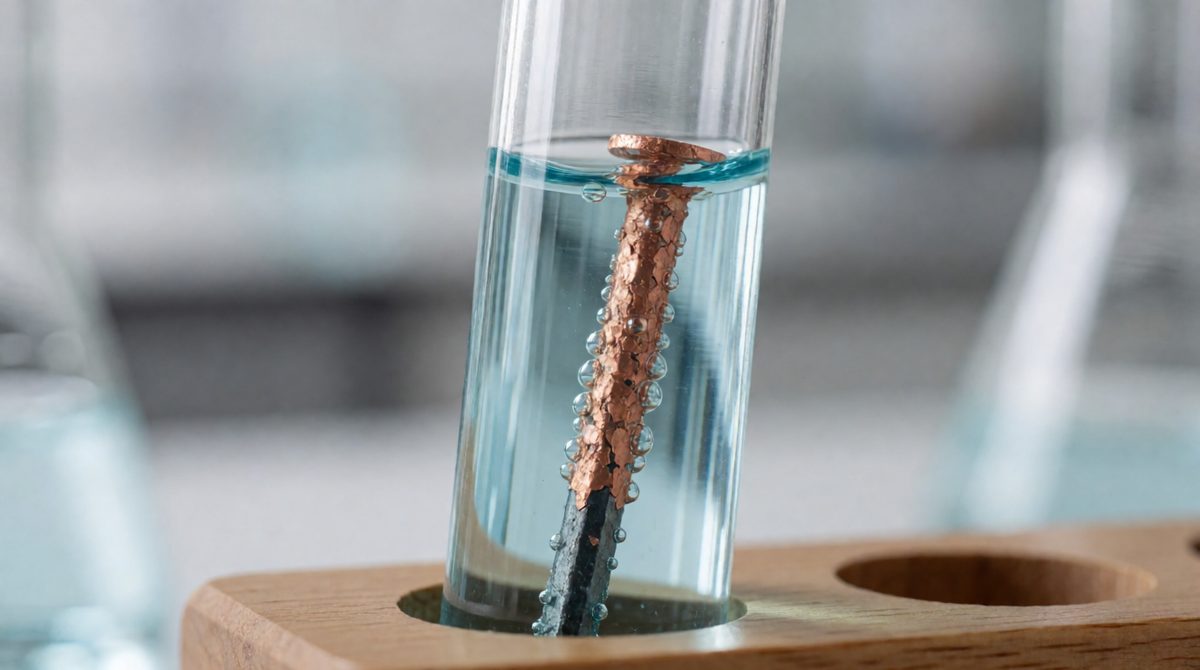
The iron nail gets a coppery coat because iron is more reactive than copper and pushes it out of the solution
Remember, in a displacement reaction a more reactive element takes the place of a less reactive one in a compound. For metals the rule is: a more reactive metal can displace a less reactive metal from a compound.
🔩 In a solution
Put an iron nail into blue copper sulfate solution. Iron is more reactive than copper, so it displaces it. A pink-brown coating of copper forms on the nail and the blue colour fades.
iron + copper sulfate → iron sulfate + copper
Fe + CuSO4 → FeSO4 + Cu
Put copper into iron sulfate solution and nothing happens, because copper is less reactive than iron.
🔥 With a metal oxide
Heat magnesium powder with copper oxide. Magnesium is more reactive, so it takes the oxygen from the copper.
magnesium + copper oxide → magnesium oxide + copper
Mg + CuO → MgO + Cu
The copper oxide loses oxygen, so it is reduced. The magnesium gains oxygen, so it is oxidised.
The more reactive metal ends up in the compound because it has the greater tendency to form positive ions.
Deducing an order from results
You need to be able to work out an order of reactivity from experimental results. You will often get metals you have not met, labelled with letters.
Worked example
A student adds three metals, P, Q and R, to solutions of each other's sulfates. A tick means a reaction happened.
P added to Q sulfate: ✓ P added to R sulfate: ✓
Q added to P sulfate: ✗ Q added to R sulfate: ✗
R added to P sulfate: ✗ R added to Q sulfate: ✓
Step 1: Count the reactions for each metal. P displaced two metals, R displaced one, Q displaced none.
Step 2: The metal that displaces the most is the most reactive.
Order: P (most reactive), then R, then Q (least reactive).
You can also compare how fast metals react with the same acid. Keep it fair: use the same acid, the same concentration, the same volume, the same temperature and pieces of metal the same size. Then compare the rate of bubbling, or the volume of gas made in a set time. More bubbles in the same time means a more reactive metal.
Common mistakes
Mixing up oxidation and reduction. Gaining oxygen is oxidation. Losing oxygen is reduction. A metal reacting with oxygen is always oxidised.
Saying copper reacts with dilute acid. It does not, because copper is below hydrogen in the series.
Getting the displacement the wrong way round. The free metal must be more reactive than the metal in the compound. Copper metal will not displace iron from iron sulfate.
Forgetting to link to ions. When asked to explain reactivity, say the more reactive metal has a greater tendency to form positive ions.
Exam-style question
A student adds small, equal-sized pieces of calcium, copper and zinc to separate test tubes of the same dilute hydrochloric acid.
(a) Describe what the student would see for each metal. [3 marks]
(b) Explain the order of reactivity of these three metals in terms of ions. [2 marks]
Model answer
(a) Calcium: very vigorous fizzing and the calcium quickly disappears (1). Zinc: steady bubbles (1). Copper: no bubbles, no reaction (1).
(b) The order is calcium, then zinc, then copper (1). Calcium has the greatest tendency to form positive ions and copper has the least, so calcium reacts fastest and copper does not react (1).
Exam tip
Learn the order with a memory phrase, for example: Please Stop Letting Cats Make Clumsy Zebras Into Hungry Crocodiles (potassium, sodium, lithium, calcium, magnesium, carbon, zinc, iron, hydrogen, copper).