✅ Carbon can extract these
Metals below carbon in the reactivity series, such as zinc, iron, lead and copper.
Heating their oxides with carbon gives the metal.
Sign up to access the complete lesson and track your progress!
Unlock This Course
Gold is so unreactive it's found as the metal itself, no extraction needed
Metals come from the Earth's crust, but most of them are not lying around as shiny metal. How a metal is found depends on how reactive it is.
Unreactive metals such as gold are found in the Earth as the metal itself. Gold does not react with oxygen or water, so over millions of years it stays as gold. Miners can find it as flakes, grains or nuggets. A metal found like this is called a native metal. Silver and platinum can also be found native.
Most metals are more reactive than this. They have reacted with other elements, such as oxygen or sulfur, and are found as compounds in rocks. To get the metal out, a chemical reaction is needed. Getting a metal out of its compound is called extraction.
A rock that contains enough of a metal compound to make extracting the metal worthwhile is called an ore. Many ores contain metal oxides, which is why this lesson focuses on oxides.
Key terms:
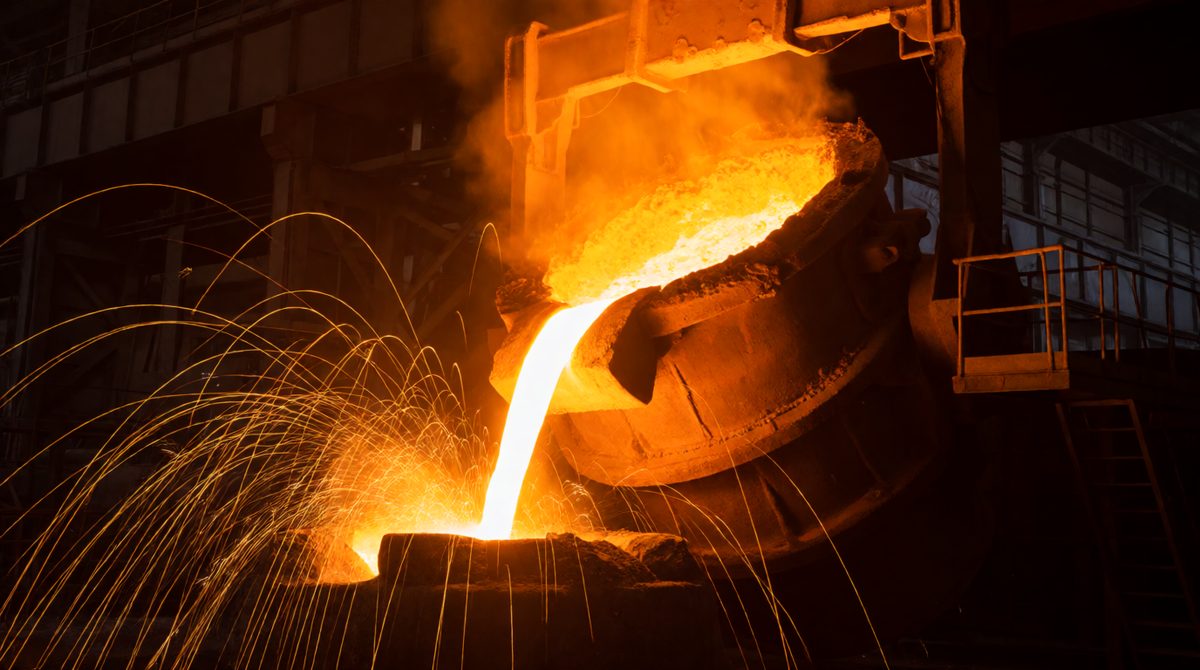
Carbon is more reactive than iron, so a blast furnace can strip the oxygen off iron oxide and reduce it to iron
Remember, reduction is the loss of oxygen. To get a metal from its oxide, we need to take the oxygen away, so the metal oxide must be reduced.
Carbon can do this job. In the reactivity series, carbon sits between magnesium and zinc. The key rule is:
Metals less reactive than carbon can be extracted from their oxides by reduction with carbon.
When a metal oxide is heated with carbon, the carbon takes the oxygen away from the metal. This only works if carbon is more reactive than the metal, because the more reactive element ends up with the oxygen.
Metals below carbon in the reactivity series, such as zinc, iron, lead and copper.
Heating their oxides with carbon gives the metal.
Metals above carbon, such as potassium, sodium, calcium, magnesium and aluminium.
They hold on to oxygen more strongly than carbon can, so heating their oxides with carbon does not release the metal. These metals are extracted a different way, covered in Extracting Metals by Electrolysis.
Carbon is a good choice for the metals it can extract because it is cheap and easy to get, for example as coke made from coal.
In every reduction with carbon, two things happen at once. The metal oxide loses oxygen, so it is reduced. The carbon gains oxygen, so it is oxidised. The carbon usually becomes carbon dioxide or carbon monoxide.
Here is copper oxide heated with carbon powder:
copper oxide + carbon → copper + carbon dioxide
2CuO + C → 2Cu + CO2
The black copper oxide powder turns into pink-brown copper.
Zinc oxide is heated with carbon:
ZnO + C → Zn + CO
Step 1: Find the substance that loses oxygen. ZnO has oxygen, Zn does not. So zinc oxide is reduced.
Step 2: Find the substance that gains oxygen. C has no oxygen, CO does. So carbon is oxidised.
Step 3: Check it makes sense. Zinc is below carbon in the reactivity series, so carbon can take its oxygen.
Lead oxide is heated with carbon:
2PbO + C → 2Pb + CO2
Lead oxide (PbO) loses oxygen to become lead (Pb), so lead oxide is reduced. Carbon gains oxygen to become CO2, so carbon is oxidised.
A quick way to do this: look at each substance on the left, then find it on the right. If it has lost its oxygen it was reduced. If it has picked up oxygen it was oxidised.
You do not need to learn the details of any industrial extraction process. But you may be given information about one and asked to explain or judge it. Use the reactivity series and the idea of oxidation and reduction.
A student is given this information:
Metal X oxide heated with carbon: metal formed
Metal Y oxide heated with carbon: no reaction
What does this tell you? Metal X is less reactive than carbon, because carbon took its oxygen. Metal Y is more reactive than carbon, because carbon could not take its oxygen. So the order is Y, then carbon, then X. Metal Y must be extracted another way.
When you evaluate a method, think about points like these:
Only use the facts you are given plus what you know. Do not guess at details of a process that the question does not tell you.
Saying the metal is reduced. It is the metal oxide that is reduced, because it is the oxide that loses oxygen. Name the compound, for example 'zinc oxide is reduced'.
Forgetting the carbon. Reduction and oxidation happen together. If the question asks what is oxidised, the answer is carbon.
Mixing up the rule. Carbon extracts metals less reactive than itself, not more reactive. Magnesium oxide cannot be reduced by carbon.
Thinking all metals are found as compounds. Unreactive metals like gold are found as the metal itself.
Nickel can be extracted by heating nickel oxide with carbon.
NiO + C → Ni + CO
(a) Name the substance that is reduced in this reaction. Explain your answer. [2 marks]
(b) What does this reaction tell you about the reactivity of nickel compared with carbon? [1 mark]
(c) Gold is found in the Earth as the metal itself. Explain why gold does not need to be extracted by reduction. [2 marks]
(a) Nickel oxide (1). It loses oxygen (1).
(b) Nickel is less reactive than carbon (1).
(c) Gold is very unreactive (1), so it is found as the uncombined metal and is not combined with oxygen, so there is no oxygen to remove (1).
When asked what is oxidised or reduced, always say which substance and give the reason in terms of gain or loss of oxygen. 'Nickel oxide is reduced because it loses oxygen' gets both marks.