⬆ Charge goes up: oxidised
If the charge becomes more positive, the species has lost electrons. For example, Mg (0) becomes Mg2+ (+2). Magnesium is oxidised. I− (−1) becomes I2 (0). Iodide ions are oxidised.
Everything in this lesson is Higher tier only. If you are sitting Foundation papers, you only need oxidation and reduction in terms of oxygen.
Sign up to access the complete lesson and track your progress!
Unlock This Course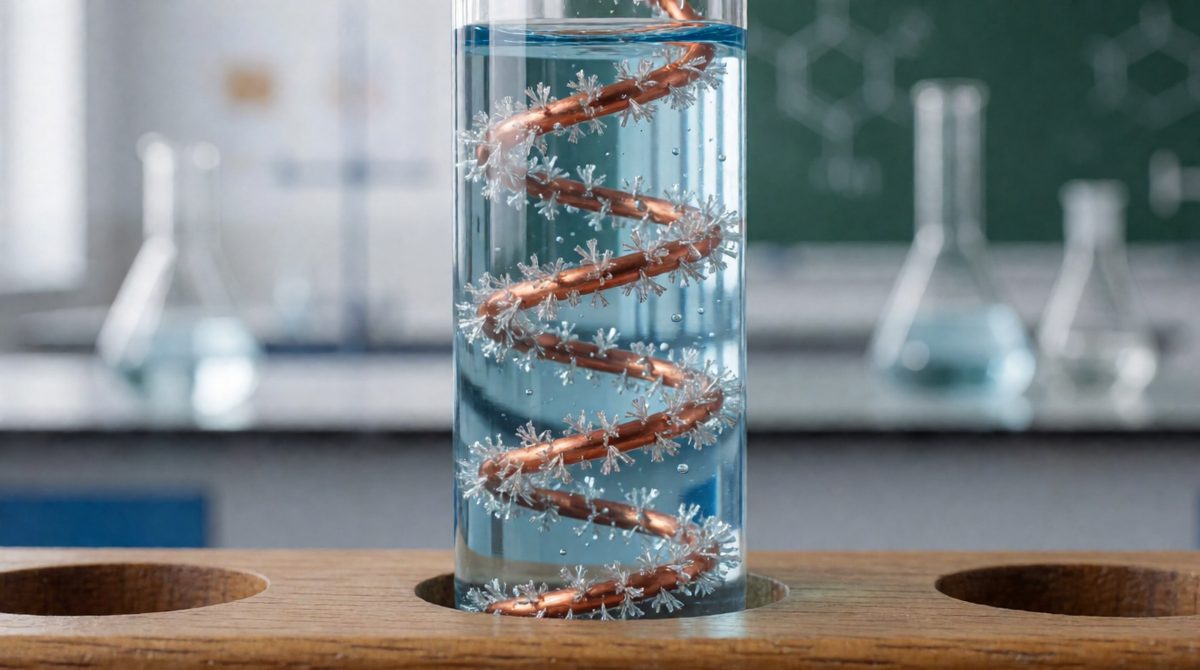
Silver crystals grow on copper wire as copper atoms lose electrons (oxidised) and silver ions gain them (reduced)
You already know one way to describe these reactions: oxidation is gain of oxygen and reduction is loss of oxygen. That works well for metals reacting with oxygen. But lots of reactions have no oxygen in them at all. Chemists needed a better way to describe what is really going on, so they looked at the electrons.
When a metal atom reacts, it loses electrons and becomes a positive ion. When a non-metal reacts with a metal, it gains those electrons and becomes a negative ion. So the AQA definitions are:
Oxidation is the loss of electrons and reduction is the gain of electrons.
A handy way to remember it is OIL RIG: Oxidation Is Loss, Reduction Is Gain.
Electrons cannot just vanish. If one particle loses electrons, another particle must gain them. That means oxidation and reduction always happen together in these reactions. One species is oxidised and another is reduced.
Look at magnesium burning in chlorine:
Mg + Cl2 → MgCl2
There is no oxygen here, but this is still oxidation and reduction. Each magnesium atom loses 2 electrons to become Mg2+, so magnesium is oxidised. The chlorine molecule gains those 2 electrons to become two Cl− ions, so chlorine is reduced.
Key terms:
Remember, in a displacement reaction a more reactive element takes the place of a less reactive one in its compound. Remember too that an ionic equation shows only the particles that change, and spectator ions are left out.
In a metal displacement reaction, the metal compound is dissolved, so it is split up into ions. The negative ion (such as sulfate or nitrate) does not change. It is a spectator ion. You can write the ionic equation in four steps:
Magnesium is more reactive than zinc, so it displaces zinc. Grey zinc forms on the magnesium.
Step 1: Mg(s) + ZnSO4(aq) → MgSO4(aq) + Zn(s)
Step 2: Mg(s) + Zn2+(aq) + SO42−(aq) → Mg2+(aq) + SO42−(aq) + Zn(s)
Step 3: SO42− is on both sides, so cross it out.
Step 4: Mg(s) + Zn2+(aq) → Mg2+(aq) + Zn(s)
Charge check: left side 0 + 2 = +2, right side +2 + 0 = +2. Balanced.
Copper is more reactive than silver. Shiny silver crystals grow on the copper and the solution slowly turns blue.
Step 1: Cu(s) + 2AgNO3(aq) → Cu(NO3)2(aq) + 2Ag(s)
Step 2: Cu(s) + 2Ag+(aq) + 2NO3−(aq) → Cu2+(aq) + 2NO3−(aq) + 2Ag(s)
Step 3: Cross out the nitrate ions, 2NO3−.
Step 4: Cu(s) + 2Ag+(aq) → Cu2+(aq) + 2Ag(s)
Notice the 2 in front of Ag+. One copper atom loses 2 electrons, but each silver ion only needs 1. So two silver ions are needed. Charge check: +2 on both sides.
Halogen displacement works in the same way. When chlorine water is added to potassium iodide solution, iodine is displaced:
Cl2(aq) + 2KI(aq) → 2KCl(aq) + I2(aq)
The potassium ion is the spectator here, so the ionic equation is:
Cl2(aq) + 2I−(aq) → 2Cl−(aq) + I2(aq)
The trick is to follow the charge on each species from the left side to the right side. Electrons are negative, so:
If the charge becomes more positive, the species has lost electrons. For example, Mg (0) becomes Mg2+ (+2). Magnesium is oxidised. I− (−1) becomes I2 (0). Iodide ions are oxidised.
If the charge becomes less positive or more negative, the species has gained electrons. For example, Zn2+ (+2) becomes Zn (0). Zinc ions are reduced. Cl2 (0) becomes Cl− (−1). Chlorine is reduced.
In a metal displacement reaction, the pattern is always the same. The more reactive metal atom is oxidised to its ion. The less reactive metal ion is reduced to its atom.
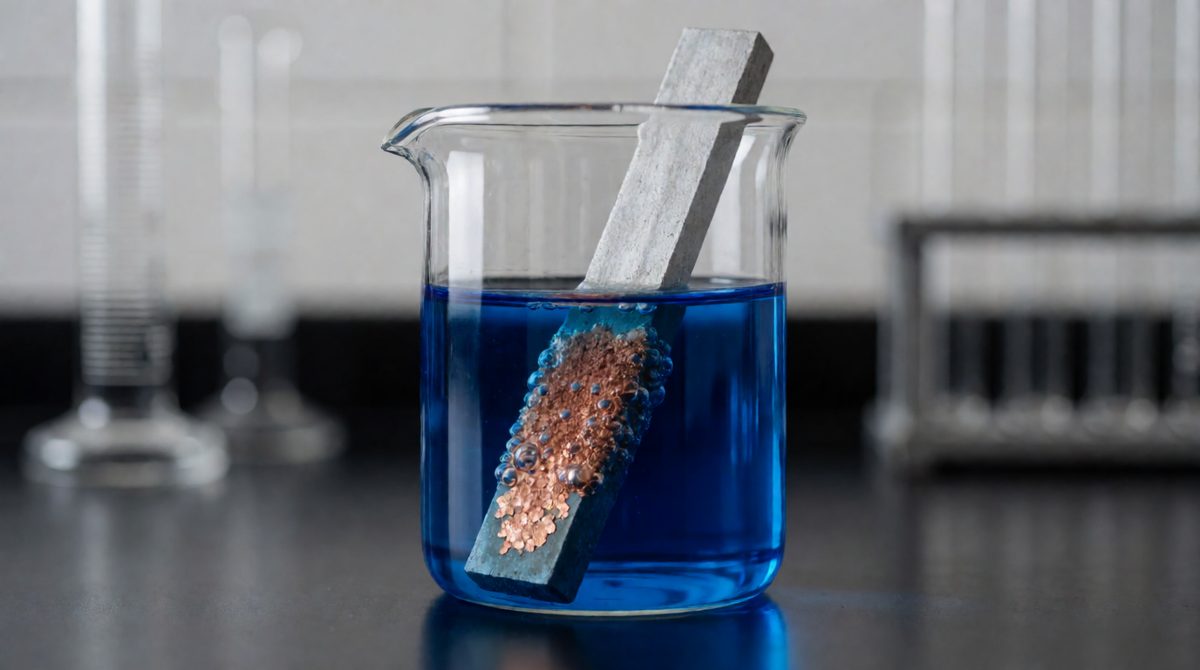
Zinc turns copper-coloured here: Cu²⁺ + 2e⁻ → Cu, electrons gained, so the copper ions are reduced
Remember, a half equation shows just one species and the electrons it loses or gains. They make the job easy:
These two half equations are the two halves of the copper and silver nitrate reaction above. The rule works for any half equation, even ones with ions on both sides. In Fe2+ → Fe3+ + e−, the electron is on the right, so the iron(II) ion is oxidised.
Zinc reacts with silver nitrate solution.
Zn(s) + 2AgNO3(aq) → Zn(NO3)2(aq) + 2Ag(s)
(a) Write the ionic equation for this reaction. [2 marks]
(b) Which species is oxidised? Explain your answer in terms of electrons. [2 marks]
(a) Zn(s) + 2Ag+(aq) → Zn2+(aq) + 2Ag(s). One mark for the correct species, one mark for balancing. (State symbols are not needed unless the question asks.)
(b) Zinc (zinc atoms) is oxidised (1). Each zinc atom loses two electrons to form a Zn2+ ion (1).
When a question says "in terms of electrons", the words loses electrons or gains electrons must appear in your answer. Saying "gains oxygen" or "loses oxygen" will not get the mark.