⚗ Hydrochloric acid
Makes salts called chlorides. Magnesium makes magnesium chloride, zinc makes zinc chloride, and iron makes iron(II) chloride.
Sign up to access the complete lesson and track your progress!
Unlock This Course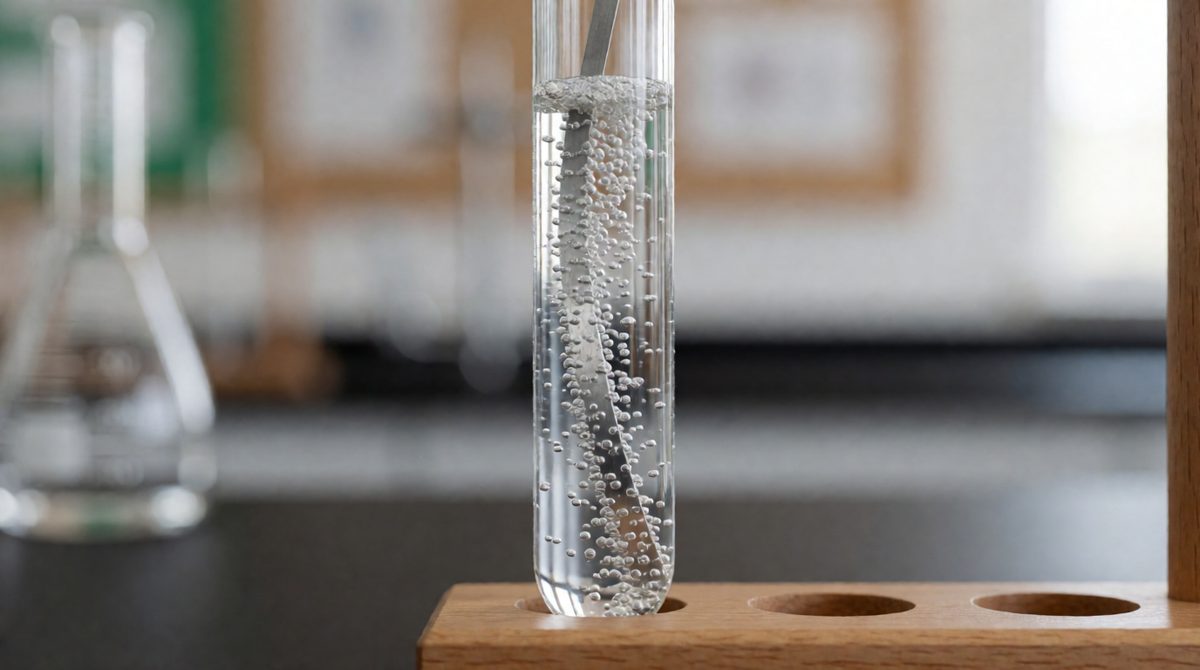
The fizz is hydrogen gas: magnesium + hydrochloric acid → magnesium chloride + hydrogen
Drop a strip of magnesium ribbon into dilute hydrochloric acid and it starts to fizz straight away. Tiny bubbles stream off the metal, the ribbon gets smaller, and in the end it disappears. The bubbles are hydrogen gas. The magnesium has not just vanished. It has turned into a new substance that is dissolved in the solution.
AQA sums this up in one sentence: acids react with some metals to produce salts and hydrogen. The general word equation is:
metal + acid → salt + hydrogen
A salt is the compound you get when the hydrogen in an acid is replaced by a metal. Hydrochloric acid is HCl and sulfuric acid is H2SO4. In the reaction, the metal takes the place of the hydrogen, and the hydrogen is given off as H2 gas.
The word "some" matters. Remember, metals below hydrogen in the reactivity series, such as copper, do not react with dilute acids. For your exam, AQA only expects you to know the reactions of magnesium, zinc and iron with hydrochloric acid and sulfuric acid.
Key terms:
The first part of the salt's name comes from the metal. The second part comes from the acid:
Makes salts called chlorides. Magnesium makes magnesium chloride, zinc makes zinc chloride, and iron makes iron(II) chloride.
Makes salts called sulfates. Magnesium makes magnesium sulfate, zinc makes zinc sulfate, and iron makes iron(II) sulfate.
You will learn the full naming rules for salts, including other acids, in Neutralisation and Naming Salts. For now, these two patterns are all you need.
Here are the word and symbol equations for all six reactions in the spec. Look for the pattern rather than learning each one separately.
magnesium + hydrochloric acid → magnesium chloride + hydrogen
Mg(s) + 2HCl(aq) → MgCl2(aq) + H2(g)
zinc + hydrochloric acid → zinc chloride + hydrogen
Zn(s) + 2HCl(aq) → ZnCl2(aq) + H2(g)
iron + hydrochloric acid → iron(II) chloride + hydrogen
Fe(s) + 2HCl(aq) → FeCl2(aq) + H2(g)
magnesium + sulfuric acid → magnesium sulfate + hydrogen
Mg(s) + H2SO4(aq) → MgSO4(aq) + H2(g)
zinc + sulfuric acid → zinc sulfate + hydrogen
Zn(s) + H2SO4(aq) → ZnSO4(aq) + H2(g)
iron + sulfuric acid → iron(II) sulfate + hydrogen
Fe(s) + H2SO4(aq) → FeSO4(aq) + H2(g)
All three metals form 2+ ions here: Mg2+, Zn2+ and Fe2+. A chloride ion is Cl−, so each metal ion needs two of them, giving MgCl2, ZnCl2 and FeCl2. That is why hydrochloric acid always needs a 2 in front of it. A sulfate ion is SO42−, which already has a 2− charge, so one metal ion matches one sulfate. The sulfuric acid equations balance with no extra numbers at all.
Write a balanced symbol equation for zinc reacting with hydrochloric acid.
Step 1: Words first: zinc + hydrochloric acid → zinc chloride + hydrogen.
Step 2: Formulae: Zn + HCl → ZnCl2 + H2. Zinc forms Zn2+, so it needs two Cl− ions. Hydrogen gas is always H2, never just H.
Step 3: Count atoms. Right side: 2 Cl and 2 H. Left side: only 1 Cl and 1 H.
Step 4: Put a 2 in front of HCl: Zn + 2HCl → ZnCl2 + H2. Now 1 Zn, 2 H and 2 Cl on each side. Balanced.
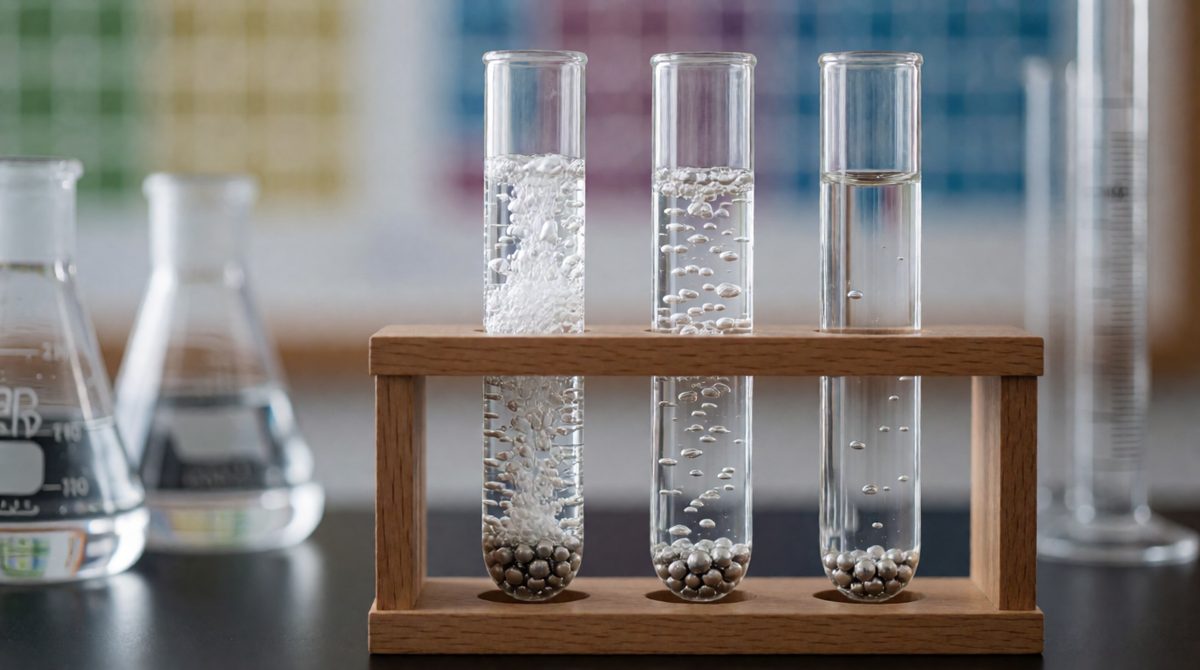
Magnesium bubbles fastest, zinc slower, iron slowest, because the more reactive the metal, the faster it reacts
All six reactions show the same signs. Remember, the more reactive the metal, the faster it reacts, so magnesium bubbles fastest and iron slowest.
Fizzing at the surface of the metal. This is the hydrogen gas being given off.
The piece of metal gets smaller as its atoms turn into ions in the solution.
The salt stays dissolved. Magnesium and zinc salts are colourless. Iron(II) salts make the solution slowly turn pale green.
If you evaporated the water off, you would be left with the solid salt. You can identify the gas with a simple test, which is covered in Tests for Common Gases.
Remember, oxidation is loss of electrons and reduction is gain of electrons (OIL RIG). Acids contain hydrogen ions, H+. You will learn more about these in The pH Scale and Neutralisation.
Look at magnesium with hydrochloric acid. The chloride ions are spectator ions, because they are Cl− before and after. Take them out and the ionic equation is:
Mg(s) + 2H+(aq) → Mg2+(aq) + H2(g)
Now split it into two half equations:
Mg → Mg2+ + 2e− Magnesium atoms lose electrons, so magnesium is oxidised.
2H+ + 2e− → H2 Hydrogen ions gain electrons, so hydrogen ions are reduced.
The electrons lost by the metal are gained by the hydrogen ions. Both changes happen at the same time, so this is a redox reaction.
The same is true for all six reactions. With sulfuric acid, the sulfate ion SO42− is the spectator. So zinc with sulfuric acid becomes Zn + 2H+ → Zn2+ + H2, and iron with either acid becomes Fe + 2H+ → Fe2+ + H2. In every case, the metal is oxidised and the hydrogen ions are reduced.
Writing H instead of H2. Hydrogen gas is made of molecules with two atoms. Always write H2.
Forgetting the 2 in front of HCl. The chloride salts of these metals have two chlorines, so you need two HCl.
Saying the acid is oxidised (Higher). It is the H+ ions in the acid that gain electrons, so they are reduced. The chloride or sulfate ions do not change at all.
Saying the gas is oxygen or carbon dioxide. Magnesium, zinc and iron with these dilute acids always give hydrogen.
Thinking every metal reacts. Copper does not react with dilute hydrochloric or sulfuric acid.
A student adds a piece of iron to dilute sulfuric acid.
(a) Name the two products. [2 marks]
(b) Write a balanced symbol equation for the reaction. [2 marks]
(c) Higher tier only. The ionic equation is Fe + 2H+ → Fe2+ + H2. Explain which species is oxidised and which is reduced. [3 marks]
(a) Iron(II) sulfate (1) and hydrogen (1).
(b) Fe + H2SO4 → FeSO4 + H2. One mark for the correct formulae, one mark for it being balanced.
(c) Iron atoms lose two electrons to form Fe2+ ions, so iron is oxidised (1). Hydrogen ions gain electrons to form hydrogen molecules, so the hydrogen ions are reduced (1). Oxidation and reduction happen at the same time, so it is a redox reaction (1).
In Higher questions, always say what happens to the electrons. Writing "iron is oxidised" on its own often scores nothing. Writing "iron loses electrons, so it is oxidised" gets the mark.