⚗ The acid used
This gives the second part of the name.
- Hydrochloric acid (HCl) makes chlorides
- Nitric acid (HNO3) makes nitrates
- Sulfuric acid (H2SO4) makes sulfates
Sign up to access the complete lesson and track your progress!
Unlock This Course
Indigestion tablets neutralise extra stomach acid, making a salt and water
When an acid reacts with the right substance, it is used up and a salt is made instead. This is called neutralisation.
AQA lists three types of substance that neutralise acids:
An alkali is a base that dissolves in water. So every alkali is a base, but not every base is an alkali.
Key terms:
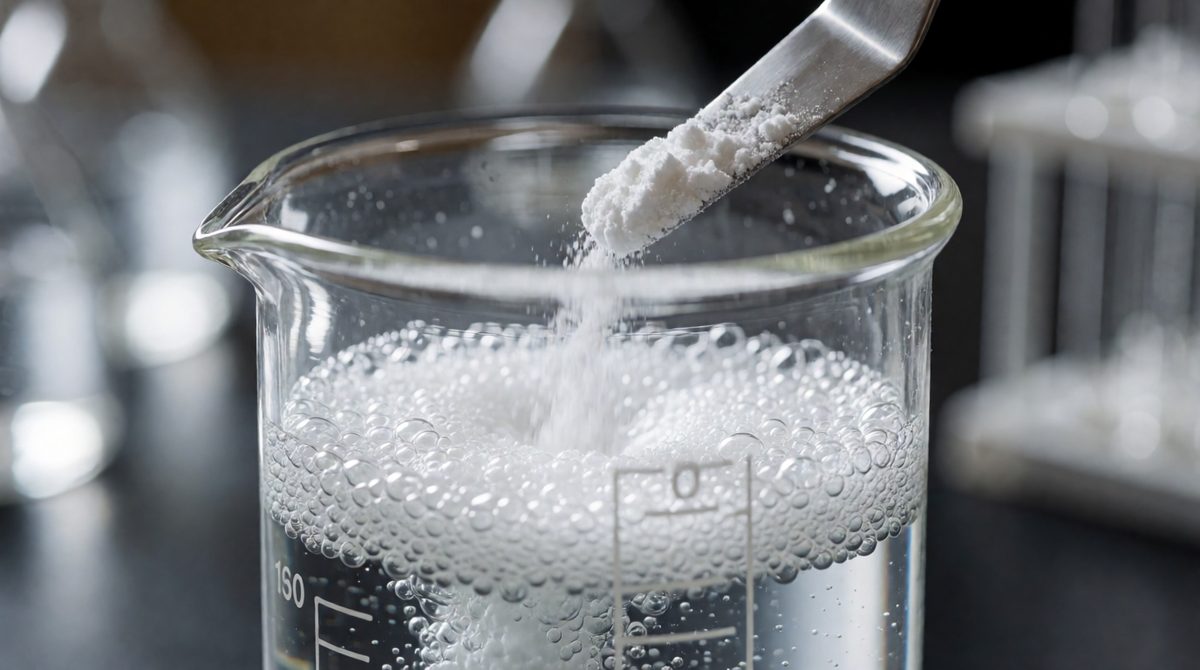
Those bubbles mean a carbonate: acid + metal carbonate → salt + water + carbon dioxide
Learn these three word equations. They are the key to the whole lesson.
acid + alkali → salt + water
acid + base → salt + water
acid + metal carbonate → salt + water + carbon dioxide
Notice that water is always made. A carbonate also gives carbon dioxide, so you see fizzing. Unlike the reactions of acids with metals, none of these make hydrogen.
lithium hydroxide + hydrochloric acid → lithium chloride + water
LiOH + HCl → LiCl + H2O
copper(II) oxide + hydrochloric acid → copper(II) chloride + water
CuO + 2HCl → CuCl2 + H2O
zinc carbonate + sulfuric acid → zinc sulfate + water + carbon dioxide
ZnCO3 + H2SO4 → ZnSO4 + H2O + CO2
Here is an insoluble base at work in real life. Some indigestion tablets contain magnesium hydroxide. Your stomach contains hydrochloric acid, and the magnesium hydroxide neutralises some of it:
Mg(OH)2 + 2HCl → MgCl2 + 2H2O
There are two hydroxide groups in Mg(OH)2, so two molecules of water are made.
The salt made in any of these reactions depends on two things:
This gives the second part of the name.
This gives the first part of the name. It comes from the metal ion in the base, alkali or carbonate. Potassium hydroxide gives a potassium salt. Zinc oxide gives a zinc salt.
Put the two parts together. Lithium hydroxide and sulfuric acid make lithium sulfate. Zinc oxide and nitric acid make zinc nitrate. Iron(III) oxide and sulfuric acid make iron(III) sulfate.
The words oxide, hydroxide and carbonate do not appear in the salt's name. The oxygen and hydrogen end up in the water. The carbonate ends up as water and carbon dioxide.
To predict the products from given reactants, use three quick steps:
Potassium carbonate + nitric acid
Step 1: potassium carbonate is a metal carbonate.
Step 2: potassium + nitric acid gives potassium nitrate.
Step 3: it is a carbonate, so water and carbon dioxide are also made.
potassium carbonate + nitric acid → potassium nitrate + water + carbon dioxide
K2CO3 + 2HNO3 → 2KNO3 + H2O + CO2
Remember, an ionic compound has no overall charge, so the charges on its ions must cancel. A salt is made of the metal's positive ion and a negative ion from the acid. You need these negative ions:
Nitrate and sulfate are groups of atoms that stay together. If you need more than one, put the group in brackets and write the number outside, for example (NO3)2.
Ions: Zn2+ and NO3−. One 2+ ion needs two 1− ions to cancel.
Formula: Zn(NO3)2
Equation: ZnO + 2HNO3 → Zn(NO3)2 + H2O
Ions: K+ and SO42−. Two 1+ ions are needed to cancel one 2− ion.
Formula: K2SO4
Equation: 2KOH + H2SO4 → K2SO4 + 2H2O
Ions: Al3+ and NO3−. One 3+ ion needs three 1− ions.
Formula: Al(NO3)3
A quick check: if the charges are the same size, you need one of each (KNO3, ZnSO4). If they are different sizes, find the smallest numbers of each ion that make the charges cancel.
Saying hydrogen is made. Only acid + metal gives hydrogen. Alkalis, bases and carbonates give water, and carbonates also give carbon dioxide.
Mixing up the acids. Nitric acid makes nitrates, not nitrides. Sulfuric acid makes sulfates, not sulfides.
Keeping the old name. Iron(III) oxide and sulfuric acid make iron(III) sulfate, not "iron oxide sulfate".
Losing the brackets. Zn(NO3)2 is right. ZnNO32 is wrong, because it would mean 32 oxygen atoms.
Aluminium oxide reacts with dilute sulfuric acid.
(a) Name the salt produced. [1 mark]
(b) Aluminium ions are Al3+ and sulfate ions are SO42−. Work out the formula of the salt. [1 mark]
(c) Complete the balanced equation: Al2O3 + 3H2SO4 → ____ + ____ [2 marks]
(a) Aluminium sulfate.
(b) Two Al3+ ions give 6+ and three SO42− ions give 6−, so the formula is Al2(SO4)3.
(c) Al2O3 + 3H2SO4 → Al2(SO4)3 + 3H2O (1 mark for each correct product with its number).
Before you write any formula, write the two ions with their charges. Then make the total positive charge equal the total negative charge. It takes ten seconds and saves marks.