🏷 First word
The metal. Pick an insoluble solid that contains it: the metal itself, its oxide, its hydroxide or its carbonate.
Sign up to access the complete lesson and track your progress!
Unlock This Course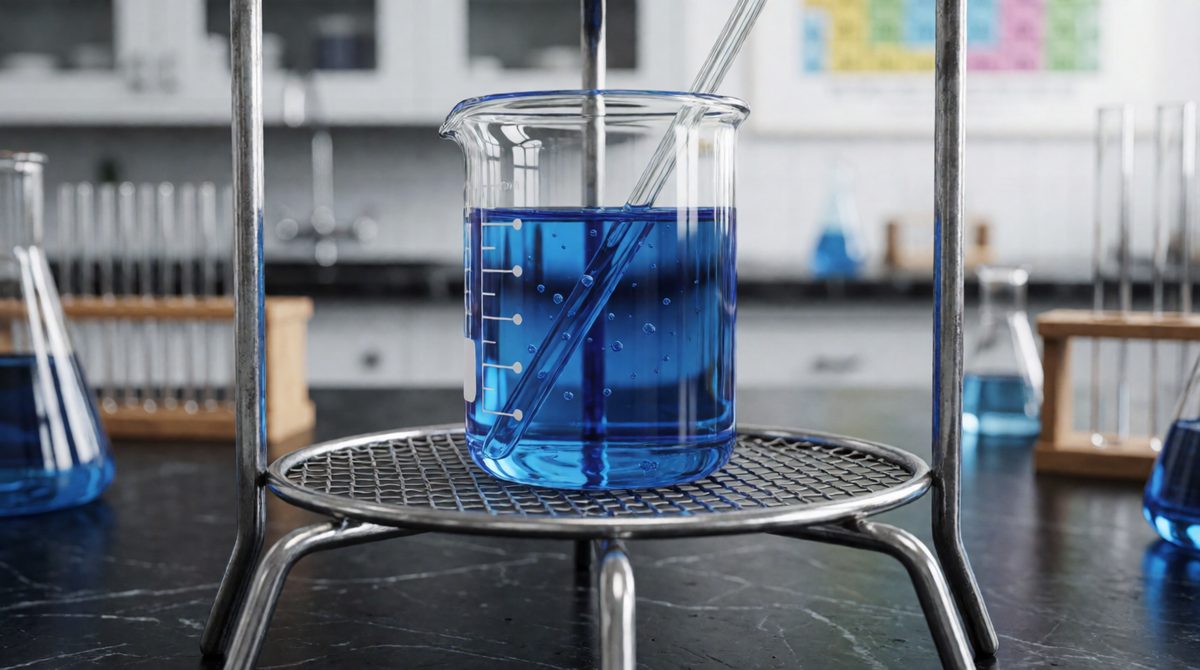
Black copper oxide plus sulfuric acid gives this lovely blue copper sulfate solution
You already know that acids react with metals, bases and carbonates to make salts. Now you will use those reactions to actually make a salt you can hold in your hand.
This lesson is about soluble salts. These are salts that dissolve in water, so at first they end up as a solution. Zinc sulfate, magnesium nitrate and copper(II) chloride are all soluble salts.
The spec says soluble salts can be made by reacting an acid with a solid insoluble substance. That solid can be:
The metal part of the salt comes from the solid. The other part comes from the acid.
Not every metal works. A very reactive metal reacts dangerously with acid. A metal below hydrogen in the reactivity series, such as copper, does not react with dilute acid at all.
Key terms:
Every soluble salt made this way follows the same three stages. Learn them and you can describe how to make any soluble salt from an insoluble solid.
Add the solid to the acid, a little at a time, and stir. Keep adding until no more reacts and some solid is left over.
Filter the mixture. The leftover solid stays in the filter paper. The salt solution passes through as the filtrate.
Heat the salt solution to evaporate some of the water, then leave it to cool. Crystals of the salt form.
Why keep adding solid until some is left over? Remember, an excess means more than is needed to react. If solid is left, you know all the acid has been used up.
That matters because you want a solution of just the salt in water. If any acid was left, it would end up in your final crystals and the salt would not be pure.
How do you know no more reacts?
Some oxides react slowly in cold acid, so the acid is often warmed first to speed things up.
The spare solid is insoluble, so filtering removes it easily. It stays behind as the residue. What passes through is a solution of the salt.
This is the big reason the solid must be insoluble. Because the leftover solid does not dissolve, you can remove every bit of it just by filtering. That leaves only salt and water.
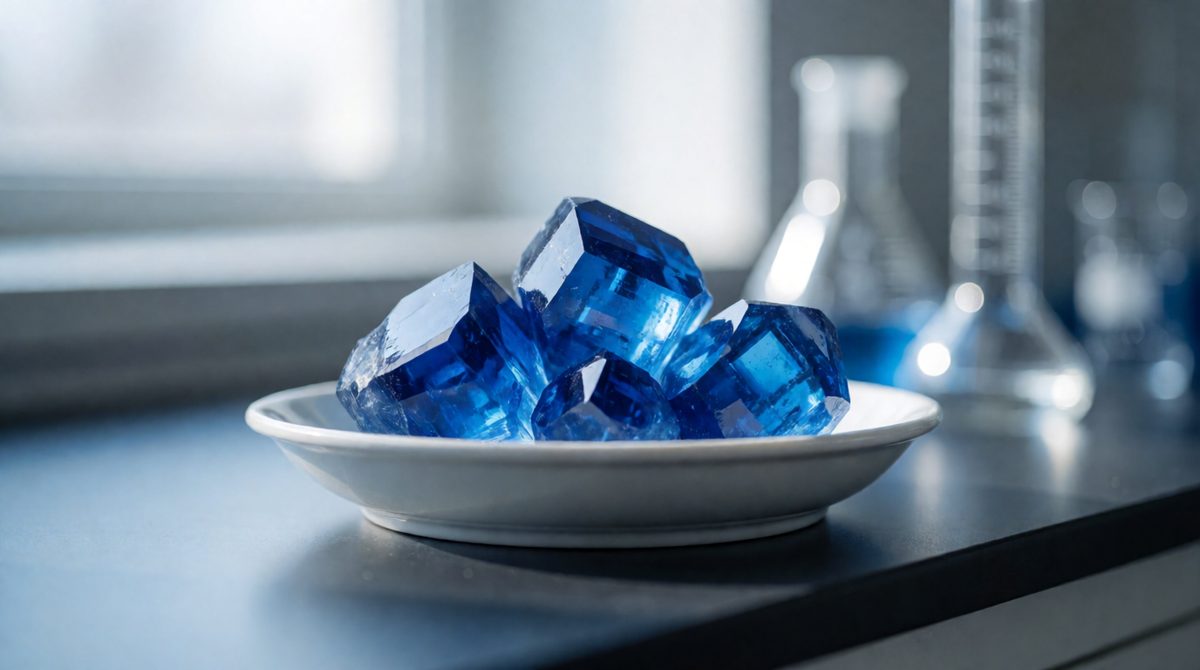
Heat gently, then leave it to cool, and blue copper sulfate crystals grow as the water evaporates
The spec says salt solutions can be crystallised to produce solid salts. To do this:
Do not boil all the water away. Heating to dryness gives a powder rather than crystals, and some salts break down if they get too hot.
The step-by-step practical, with the equipment, hazards and variables, is covered in the next lesson, Required Practical: Making a Pure Dry Salt.
Exam questions often name a salt and ask how you would make it. Work backwards from the name.
The metal. Pick an insoluble solid that contains it: the metal itself, its oxide, its hydroxide or its carbonate.
The acid. Chloride means hydrochloric acid, sulfate means sulfuric acid, nitrate means nitric acid.
Zinc oxide is an insoluble base. Sulfate means sulfuric acid.
zinc oxide + sulfuric acid → zinc sulfate + water
ZnO + H2SO4 → ZnSO4 + H2O
Warm the dilute sulfuric acid. Add zinc oxide powder a little at a time, stirring, until some stays undissolved. Filter off the extra zinc oxide. Heat the filtrate to evaporate some water, leave it to cool, then filter off and dry the zinc sulfate crystals.
Magnesium carbonate is insoluble. Nitrate means nitric acid.
magnesium carbonate + nitric acid → magnesium nitrate + water + carbon dioxide
MgCO3 + 2HNO3 → Mg(NO3)2 + H2O + CO2
Here the fizzing from the carbon dioxide is a handy sign. When adding more carbonate makes no more bubbles and solid is left over, all the acid has gone.
Copper(II) hydroxide is an insoluble hydroxide. Chloride means hydrochloric acid.
copper(II) hydroxide + hydrochloric acid → copper(II) chloride + water
Cu(OH)2 + 2HCl → CuCl2 + 2H2O
You could not use copper metal for this salt, because copper does not react with dilute hydrochloric acid.
Adding acid until the solid all dissolves. You want solid left over, so the acid is all used up. Add the solid to the acid.
Forgetting to filter. Without filtering, the spare solid ends up mixed with your crystals, so the salt is not pure.
Evaporating to dryness. Only evaporate some of the water, then let the crystals form as it cools.
Saying you filter off the salt at stage 2. At stage 2 the salt is in the filtrate. It is the excess solid that is filtered off.
Forgetting to dry. The question says pure and dry, so finish by drying the crystals.
Copper(II) carbonate is an insoluble green solid. Describe how you could make pure, dry crystals of copper(II) chloride from copper(II) carbonate and dilute hydrochloric acid. (6 marks)
Put some dilute hydrochloric acid in a beaker. Add copper(II) carbonate a little at a time and stir. Bubbles of carbon dioxide are given off. Keep adding until the fizzing stops and some green solid is left over, so all the acid has reacted. Filter the mixture to remove the excess copper(II) carbonate. The filtrate is copper(II) chloride solution. Heat the filtrate gently to evaporate some of the water until crystals start to form. Leave it to cool so more crystals form. Filter off the crystals and dry them between filter papers.
CuCO3 + 2HCl → CuCl2 + H2O + CO2
For a pure, dry salt question, check you have all three stages: add excess solid to the acid, filter off the excess, then crystallise and dry. Give a reason for the excess (to use up all the acid) for an easy extra mark.