🔥 Heating the acid
Measuring cylinder to measure the acid. Beaker to hold it. Bunsen burner, tripod and gauze to warm it. Heatproof mat under everything. Spatula to add the copper(II) oxide and a glass rod to stir.
Sign up to access the complete lesson and track your progress!
Unlock This Course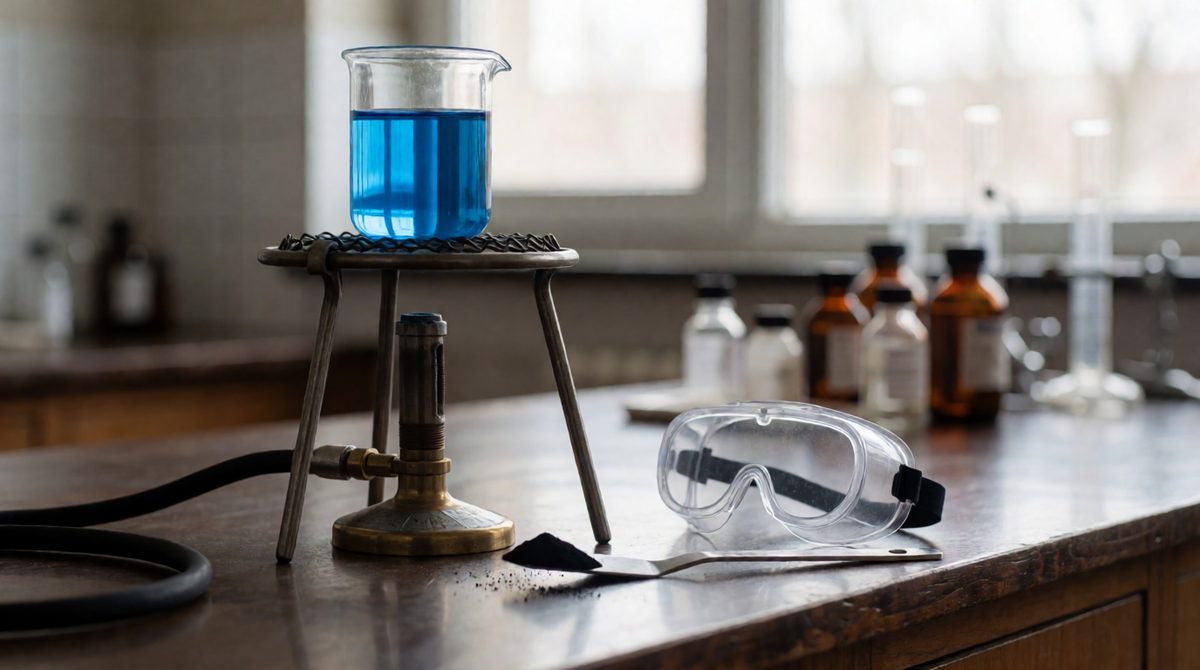
Copper(II) oxide + sulfuric acid → copper(II) sulfate + water, and that bright blue is the new salt
This is the first of the required practicals in AQA GCSE Chemistry. You may be asked about it in the exam even if you never did it yourself, so you need to know the method well enough to describe it, explain each step and spot mistakes in someone else's method.
The spec asks you to make a pure, dry sample of a soluble salt from an insoluble oxide or carbonate. You use a Bunsen burner to heat the dilute acid, then a water bath or electric heater to evaporate the solution.
The usual version, and the one most exam questions use, is making copper(II) sulfate from copper(II) oxide and dilute sulfuric acid:
copper(II) oxide + sulfuric acid → copper(II) sulfate + water
CuO + H2SO4 → CuSO4 + H2O
It is a good practical to learn because the colours tell you what is happening. Copper(II) oxide is a black powder. Copper(II) sulfate solution is blue. The crystals you finish with are blue too.
Key terms:
Part of this practical is choosing the right equipment for each job. Here is what you need and why.
Measuring cylinder to measure the acid. Beaker to hold it. Bunsen burner, tripod and gauze to warm it. Heatproof mat under everything. Spatula to add the copper(II) oxide and a glass rod to stir.
Filter funnel and filter paper, with a conical flask to collect the filtrate. Evaporating basin and a water bath or electric heater. Crystallising dish (or the basin itself) to leave crystals to form. Filter paper to dry them.
Here is the method as numbered steps. Learn the order and the reason for each step, because 6-mark questions reward both.
The spec also allows an insoluble carbonate, such as copper(II) carbonate. The method is the same, with one useful difference: the carbonate fizzes as it reacts, because carbon dioxide is given off. When adding more carbonate gives no more fizzing and solid is left over, the acid is used up.
Add the carbonate slowly. If you tip it in all at once, the froth can rise up and spill over the top of the beaker.
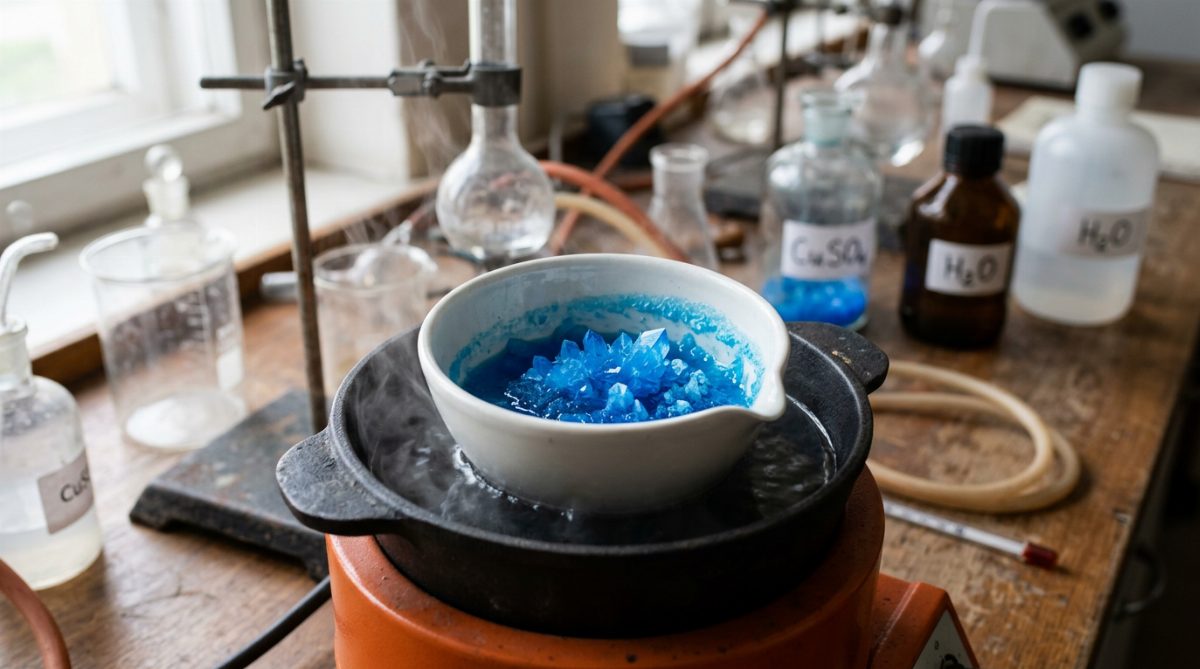
Heat gently over a water bath and the blue copper(II) sulfate crystals grow without being damaged
This is one of the most common questions on this practical, and the spec names both heaters, so make sure you can explain it.
The acid only needs warming to speed up the reaction. A Bunsen burner does this quickly. It is easy to control at this stage and there is plenty of liquid in the beaker.
Heating is gentle and steady. The solution does not boil hard or spit hot liquid out of the basin. It is much harder to overheat the salt and dry it out completely, which would give a powder rather than good crystals.
A water bath cannot get hotter than the boiling point of water, which is what makes it so gentle. An electric heater does a similar job with no naked flame.
Exam questions often ask for a hazard and how to reduce the risk. Always pair the two.
Most required practicals change one thing and measure another. This one is different. You are not testing anything, you are making a product. So you will not be asked for an independent or dependent variable here. Instead, questions focus on the method, the reasons for each step, the choice of apparatus and safety.
You might be asked how to get a better result. Larger crystals form when the solution cools and evaporates slowly, so leave it longer in a cool place rather than speeding it up.
Adding the oxide to the acid while it is still being heated. Turn the Bunsen burner off first. Then you are not leaning over a flame and the mixture cannot boil over.
Stopping before the oxide is in excess. If there is no black powder left, some acid may remain and end up in your crystals.
Heating the solution to dryness with a Bunsen burner. You get a powder, not crystals, and the solid can spit.
Mixing up filtrate and residue. The blue filtrate is what you keep. The black residue is the spare copper(II) oxide you throw away.
Vague safety answers. "Be careful" scores nothing. Name the hazard and the precaution, such as "wear eye protection because the acid is an irritant".
Question: Why does the student keep adding copper(II) oxide until some is left over? (2 marks)
Answer: So that all the sulfuric acid reacts (1). This means there is no acid left in the solution, so the crystals are pure (1).
A student wrote this method to make copper(II) sulfate crystals.
Suggest three improvements to the method and give a reason for each. (6 marks)
1. Warm the acid gently before adding the copper(II) oxide (1), so the reaction is faster (1).
2. Keep adding copper(II) oxide a little at a time until some is left unreacted (1), so that all the acid is used up and none ends up in the crystals (1).
3. Evaporate the filtrate on a water bath or electric heater only until crystals start to form, then leave it to cool and crystallise (1), because strong heating to dryness gives a powder rather than crystals and can make hot solution spit out (1).
Also allowed: dry the crystals between filter papers (1) so the sample is dry (1).
When asked to improve a method, give the change and the reason in the same sentence. Look for the four things examiners check: warm acid, excess solid, gentle evaporation, and drying the crystals.