🧪 The pipette
A pipette and a pipette filler measure out a fixed volume of one solution, for example 25.0 cm3 of alkali. It is far more accurate than a measuring cylinder. The measured solution goes into a conical flask.
Sign up to access the complete lesson and track your progress!
Unlock This CourseYou know that an acid and an alkali neutralise each other. But how much acid is needed to neutralise a certain amount of alkali? You cannot see the answer by looking at two colourless liquids. A titration is a way of measuring exactly how much of one solution reacts with another.
In a titration, you add one solution to a measured volume of the other, a little at a time, until the reaction is just complete. You then read off the volume you added. This tells you the reacting volumes.
At GCSE you only use strong acids and strong alkalis. The acids are hydrochloric, sulfuric and nitric acid. The alkali is usually sodium hydroxide.
Key terms:
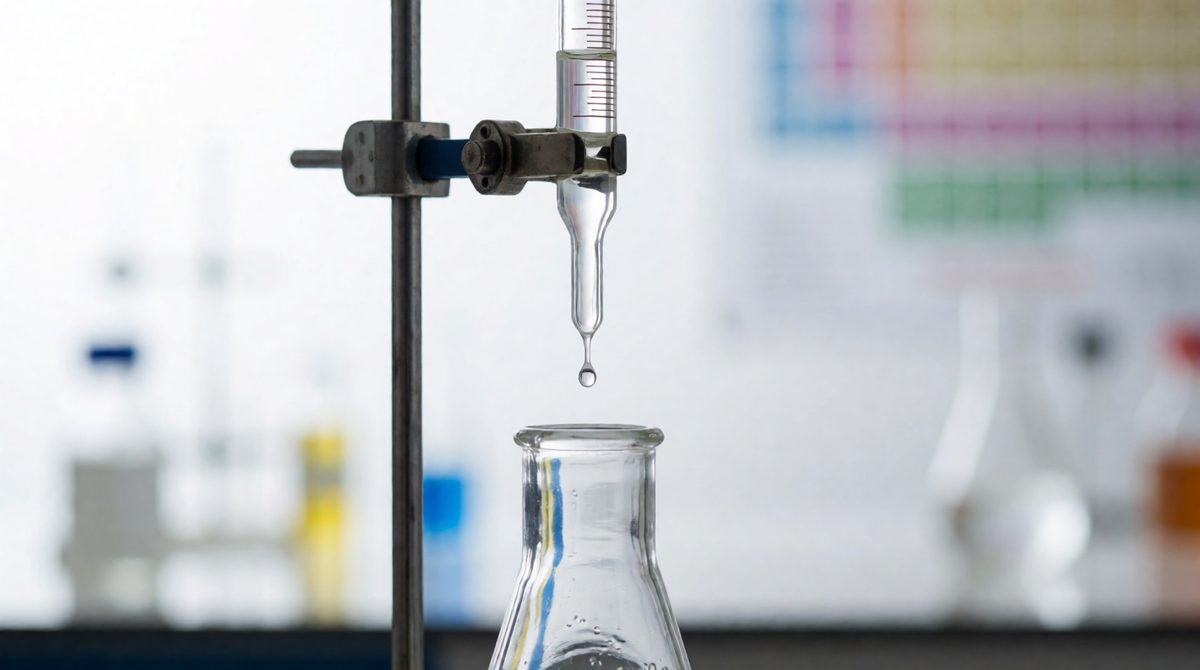
The burette lets you add acid drop by drop and read the volume to the nearest 0.05 cm³
A pipette and a pipette filler measure out a fixed volume of one solution, for example 25.0 cm3 of alkali. It is far more accurate than a measuring cylinder. The measured solution goes into a conical flask.
The burette holds the other solution, for example the acid. You open the tap to let it run into the flask. You can control the flow drop by drop. You read the volume on the scale before and after.
The volume you added is the difference between the two burette readings. This volume is called the titre.
Always read the burette at eye level, at the bottom of the curved surface of the liquid. Swirl the flask all the time so the two solutions mix well.
Acid and alkali solutions are both colourless, so you cannot see when they have reacted. You add a few drops of an indicator to the flask. It changes colour depending on whether the solution is acidic or alkaline.
You need an indicator that changes colour sharply at the end point. Two good choices are:
Universal indicator is not used. It changes through many colours slowly, so it is hard to tell exactly when the reaction is complete.
Say you put the alkali in the flask with phenolphthalein. The solution is pink. You add acid from the burette. At the end point, one drop of acid turns the solution from pink to colourless. Stop there and read the burette.
The step-by-step method is in the next lesson, Required Practical: Titration.
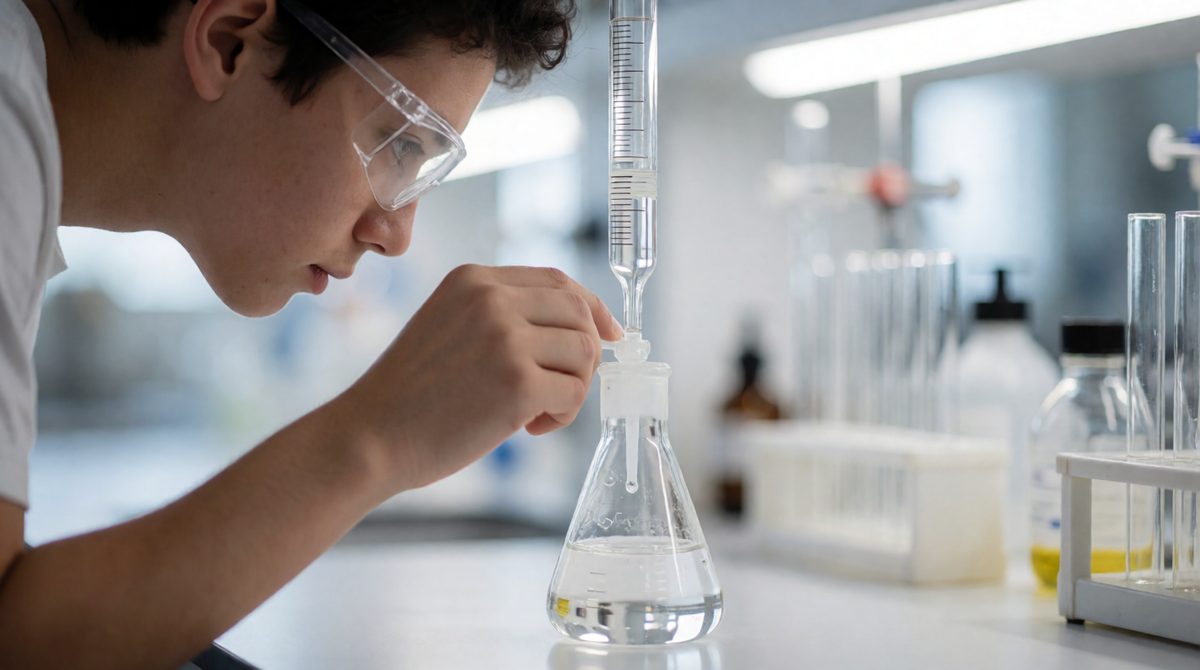
Repeat until your titres are concordant - within 0.10 cm³ of each other - then take the mean
One titration could be wrong if you add the last drop too fast. So you repeat it. The first go is often a rough trial. Then you do more careful titrations, adding the acid drop by drop near the end point.
Results that are close together are called concordant. Concordant results are within 0.10 cm3 of each other. You find the mean of the concordant titres only. Ignore any result that is far away from the rest.
A student gets these titres: 26.10 cm3 (rough), 24.55 cm3, 24.45 cm3 and 24.50 cm3.
The rough result is far from the others, so it is ignored. The other three are within 0.10 cm3 of each other, so they are concordant.
Mean titre = (24.55 + 24.45 + 24.50) ÷ 3 = 24.50 cm3.
The reacting volumes and the known concentration of one solution let you find the concentration of the other. You use the same ideas as in Concentrations in Moles per Cubic Decimetre. Here is a quick example with new numbers.
Question: 20.0 cm3 of sodium hydroxide solution is neutralised by 15.0 cm3 of 0.200 mol/dm3 nitric acid. Find the concentration of the sodium hydroxide in mol/dm3 and g/dm3.
NaOH + HNO3 → NaNO3 + H2O
Step 1: moles of acid = 0.200 × (15.0 ÷ 1000) = 0.00300 mol.
Step 2: the equation is 1 : 1, so moles of NaOH = 0.00300 mol.
Step 3: concentration = 0.00300 ÷ (20.0 ÷ 1000) = 0.150 mol/dm3.
Step 4: Mr of NaOH = 40, so 0.150 × 40 = 6.0 g/dm3.
If the equation is not 1 : 1, use the ratio in the equation at Step 2.
Using universal indicator, which has no sharp end point. Averaging the rough result with the others. Forgetting to change cm3 into dm3 by dividing by 1000. Not swirling the flask, so the colour change comes too early.
A student titrates 25.0 cm3 of sodium hydroxide solution with hydrochloric acid from a burette. The titres are 25.80, 24.40, 24.35 and 24.30 cm3.
(a) Which of the results are concordant? (b) Calculate the mean titre. (c) Why does the student use an indicator?
(a) 24.40, 24.35 and 24.30 cm3, because they are within 0.10 cm3 of each other.
(b) (24.40 + 24.35 + 24.30) ÷ 3 = 24.35 cm3.
(c) The solutions are colourless, so the indicator changes colour at the end point to show when the reaction is just complete.
When asked for a mean titre, say which results you used and why. Leaving out the rough result earns a mark.