🔬 Apparatus
Burette and stand, pipette and pipette filler, conical flask, white tile, small funnel, beakers, indicator, hydrochloric acid and sodium hydroxide solution, distilled water.
Sign up to access the complete lesson and track your progress!
Unlock This CourseIn this required practical you find the volumes of a strong acid and a strong alkali that react together exactly. You will use hydrochloric acid (a strong acid) and sodium hydroxide solution (a strong alkali). The idea of a titration is explained in the lesson called Titrations. Here we focus on doing it well, step by step, and getting results you can trust.
This practical is a chance to show you can use apparatus to make and record accurate measurements, including the volume of liquids. It is also how you determine the concentration of a strong acid or a strong alkali.
Key terms:
Burette and stand, pipette and pipette filler, conical flask, white tile, small funnel, beakers, indicator, hydrochloric acid and sodium hydroxide solution, distilled water.
Wear eye protection. Sodium hydroxide is corrosive and can harm eyes and skin. Wipe up spills at once and rinse splashes with plenty of water. Never use your mouth to fill a pipette. Take the funnel out of the burette before you start.
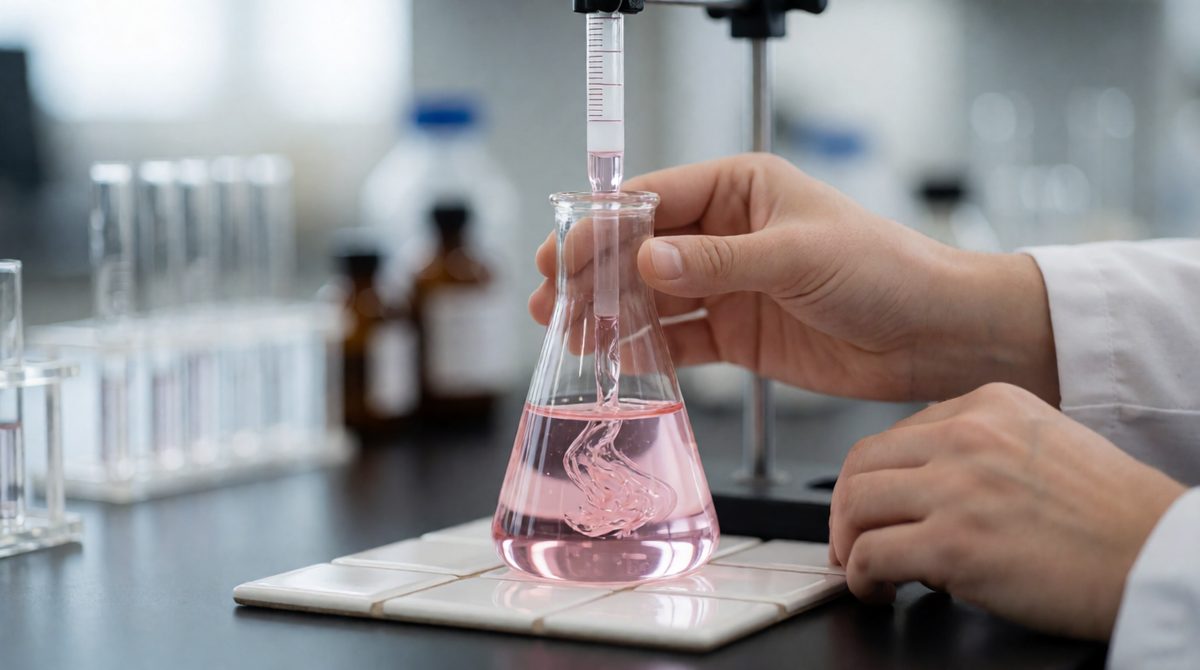
The white tile under the flask makes that colour change at the end point easy to spot
Draw a results table before you start. Give each column a heading with units, for example "Final reading (cm3)", "Start reading (cm3)" and "Volume of acid used (cm3)". Record every burette reading to two decimal places, ending in 0 or 5.
Find the mean using only the concordant results. Leave out the rough titration and any result that does not agree. Concordant results are explained in the lesson called Titrations.
Volumes of acid used for 25.0 cm3 of alkali: rough 23.10, run 2 22.45, run 3 22.40, run 4 22.35 (all cm3).
Leave out the rough value. Runs 2, 3 and 4 are within 0.10 cm3 of each other, so use all three.
Mean = (22.45 + 22.40 + 22.35) ÷ 3 = 67.20 ÷ 3 = 22.40 cm3.
So 22.40 cm3 of acid reacts exactly with 25.0 cm3 of alkali.
Rinsing with the solution you will put in stops water changing its concentration. Never rinse the conical flask with the alkali, because extra alkali would change the amount in it.
Swirling mixes the solutions, so the colour change shows up where the reaction is happening.
One extra drop is a tiny volume. Adding drops near the end stops you overshooting the end point.
A conical flask can be rinsed with distilled water, because water does not change the number of moles of alkali you put in. The pipette and burette should not be left wet with water, because that would dilute the solution they hold. Rinse them with the solution they will hold.
You can use the mean titre and the known concentration of one solution to find the concentration of the other, in mol/dm3 and g/dm3.
Example: 25.0 cm3 of sodium hydroxide solution of unknown concentration needs a mean of 22.40 cm3 of 0.150 mol/dm3 hydrochloric acid.
Step 1: moles of HCl = 0.150 × 22.40 ÷ 1000 = 0.00336 mol.
Step 2: the equation NaOH + HCl → NaCl + H2O shows 1 mol reacts with 1 mol, so moles of NaOH = 0.00336 mol.
Step 3: concentration of NaOH = 0.00336 ÷ (25.0 ÷ 1000) = 0.134 mol/dm3 (3 significant figures).
Step 4: the relative formula mass of NaOH is 40, so the concentration is 0.1344 × 40 = 5.4 g/dm3 (2 significant figures).
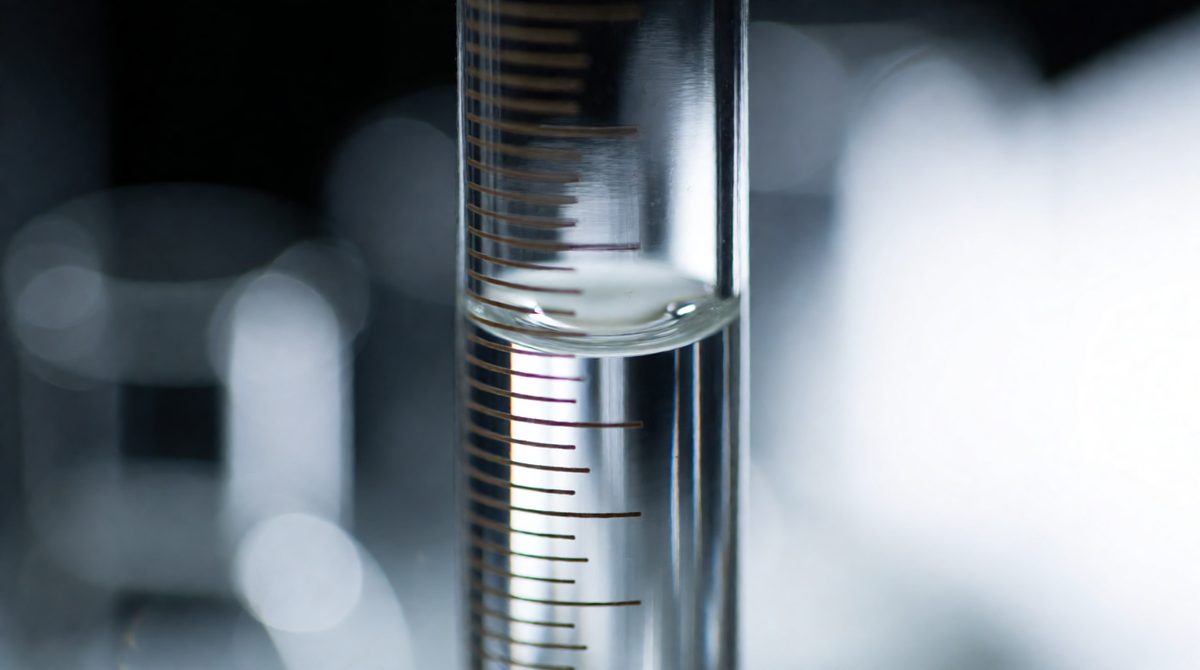
Read the burette at eye level, at the bottom of the meniscus, or your titre will be off
Including the rough titration in the mean. Giving the final burette reading instead of the volume used (final minus start). Rinsing the pipette with water instead of the alkali. Forgetting units in the table headings.
A student does a titration. They use a pipette to put 25.0 cm3 of sodium hydroxide solution into a conical flask and add acid from a burette. Their titres are 21.60, 20.85, 20.80 and 20.90 cm3. (a) Which result should the student not use to work out the mean? Explain why. (b) Calculate the mean titre. (c) Give one way the student can make sure they add the acid accurately near the end point.
(a) 21.60 cm3, because it is not within 0.10 cm3 of the other results, so it is not concordant (it was probably the rough titration).
(b) (20.85 + 20.80 + 20.90) ÷ 3 = 62.55 ÷ 3 = 20.85 cm3.
(c) Add the acid drop by drop while swirling the flask, until one drop changes the colour.
If a question asks why you do a rough titration, say it shows roughly where the end point is, so the later runs can be done carefully and accurately.