✅ Same element
All atoms of a particular element have the same number of protons. Every sodium atom has 11.
Sign up to access the complete lesson and track your progress!
Unlock This Course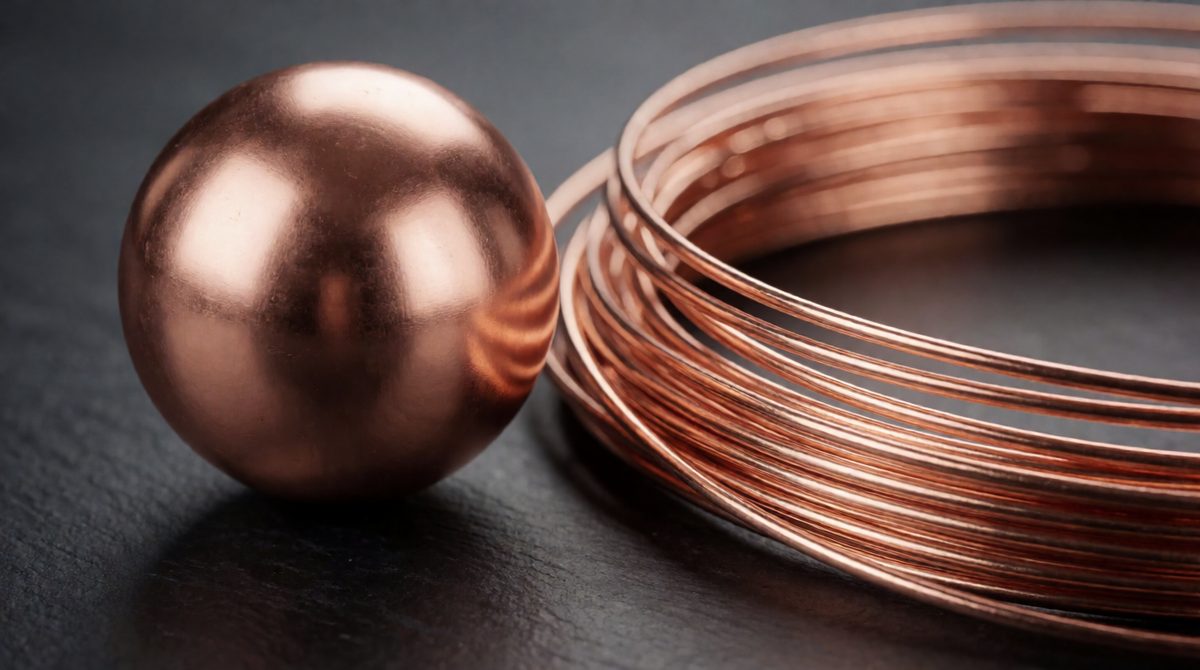
Every atom in this shiny metal has a tiny nucleus of protons and neutrons with electrons around it
You can use the nuclear model to describe any atom. At the centre is a tiny nucleus. It contains protons and neutrons. Around the nucleus are electrons. These three are called subatomic particles because they are smaller than an atom.
Instead of using real units, scientists compare the charges with each other. These are called relative charges. A proton's charge is given as +1 and everything else is compared with it.
Key terms:
Learn this table.
Where: in the nucleus
Relative charge: +1
Relative mass: 1
Where: in the nucleus
Relative charge: 0
Relative mass: 1
Where: outside the nucleus
Relative charge: −1
Relative mass: very small
Protons and neutrons have almost the same mass, so each is given a relative mass of 1. An electron is far lighter. You need about 2,000 electrons to match the mass of one proton. That is why almost all of the mass of an atom is in the nucleus. The electrons add almost nothing.
In an atom, the number of electrons is equal to the number of protons in the nucleus. Each proton is +1 and each electron is −1, so the charges cancel out exactly. Neutrons have no charge, so they do not change anything.
So atoms have no overall electrical charge. For example, a carbon atom has 6 protons (+6) and 6 electrons (−6). The total is 0.
The number of protons decides which element an atom is. Every atom with 6 protons is carbon. Every atom with 8 protons is oxygen. If you could add a proton to a carbon atom, it would no longer be carbon.
All atoms of a particular element have the same number of protons. Every sodium atom has 11.
Atoms of different elements have different numbers of protons. No other element has 11 protons.
Atoms of the same element can have different numbers of neutrons, though. You will meet these in the lesson Isotopes and Relative Atomic Mass.
Atoms can be written with two numbers next to the symbol. For sodium:
2311Na
A handy way to remember it: the mass number is never smaller than the atomic number, because it counts the protons and the neutrons. For almost every atom it is the bigger number.
Use these three rules for an atom:
How many of each particle are in 2311Na?
Protons = 11
Neutrons = 23 − 11 = 12
Electrons = 11
Chlorine has atomic number 17 and mass number 35.
Protons = 17
Neutrons = 35 − 17 = 18
Electrons = 17
You must also be able to do this for ions. Remember, an ion is an atom (or group of atoms) that has gained or lost electrons, so it has a charge. Only the electrons change. The protons and neutrons stay the same.
Magnesium has atomic number 12 and mass number 24. How many of each particle are in Mg2+?
Protons = 12
Neutrons = 24 − 12 = 12
Electrons = 12 − 2 = 10 (it has lost 2 electrons)
Check: +12 and −10 gives an overall charge of +2. Correct.
Oxygen has atomic number 8 and mass number 16. How many of each particle are in O2−?
Protons = 8
Neutrons = 16 − 8 = 8
Electrons = 8 + 2 = 10 (it has gained 2 electrons)
Check: +8 and −10 gives −2. Correct.
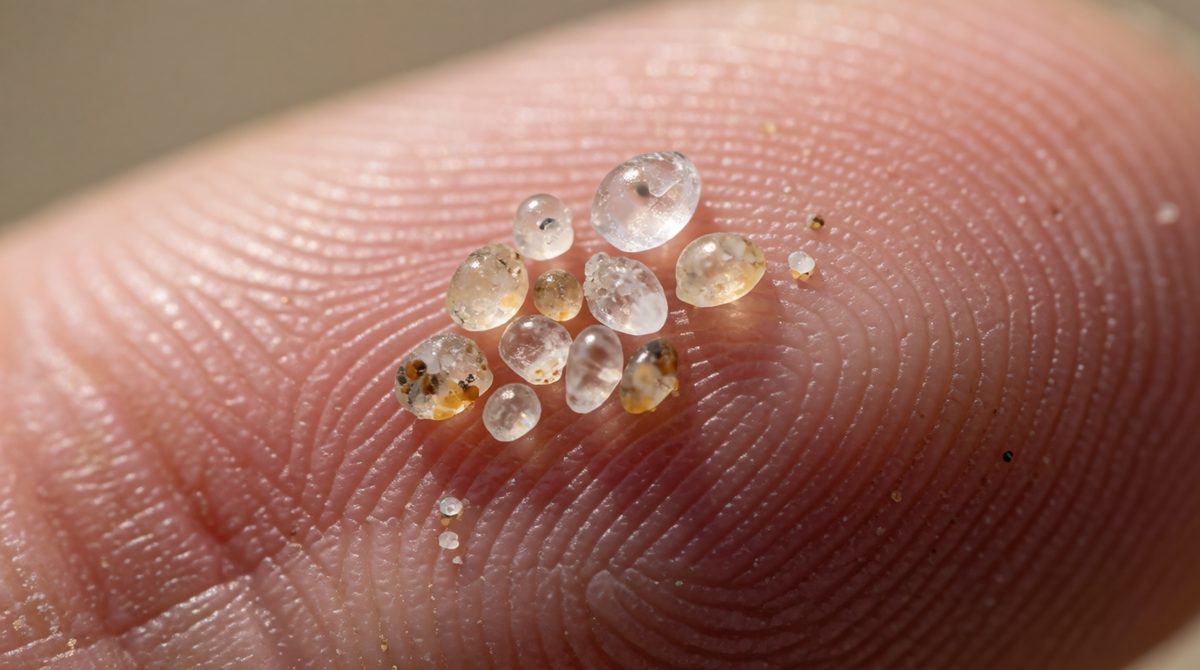
Even a single grain of sand holds countless atoms - each one has a radius of only about 0.1 nm (1 × 10⁻¹⁰ m)
Atoms are very small. They have a radius of about 0.1 nm. The nm stands for nanometre. The prefix nano means one thousand millionth, so 1 nm = 1 × 10⁻⁹ m.
In metres, the radius of an atom is about 1 × 10⁻¹⁰ m. This is standard form. The negative power tells you it is a very small number: 0.0000000001 m.
The nucleus is far smaller still. Its radius is less than 1/10 000 of the radius of the atom, about 1 × 10⁻¹⁴ m.
How many times bigger is the radius of an atom than the radius of its nucleus?
1 × 10⁻¹⁰ ÷ 1 × 10−14 = 1 × 104 = 10 000 times bigger.
Tip: when you divide powers of ten, subtract the powers: −10 − (−14) = 4.
These numbers are hard to picture, so it helps to scale them up.
If a nucleus were 1 cm across, about the size of a pea, the whole atom would be 10 000 times wider: 100 m across, about the length of a football pitch. Almost all of it would be empty space.
One atom is about 2 × 10⁻¹⁰ m across (twice its radius). So across 1 mm (1 × 10⁻³ m) you could line up about 5 million atoms.
Swapping the two numbers. The atomic number is never the bigger number. If you get a negative number of neutrons, you have swapped them.
Getting ion electrons the wrong way round. A 2+ ion has fewer electrons than protons, not more. Think: losing negative charge leaves the ion positive.
Changing the protons in an ion. Forming an ion never changes the number of protons. If the protons changed, it would be a different element.
Saying an electron has a mass of 0. Its relative mass is very small, not zero.
Saying the mass number is the number of neutrons. It is protons plus neutrons.
An atom of potassium is shown as 3919K.
(a) Give the number of protons, neutrons and electrons in this atom. [3 marks]
(b) Potassium forms the ion K+. How many electrons does this ion have? Explain your answer. [2 marks]
(c) Explain why a potassium atom has no overall charge. [2 marks]
(a) Protons = 19 (1). Neutrons = 39 − 19 = 20 (1). Electrons = 19 (1).
(b) 18 electrons (1). The atom has lost one electron to form a 1+ ion, so it has one fewer electron than protons (1).
(c) It has the same number of electrons as protons, 19 of each (1). Each proton has a charge of +1 and each electron has a charge of −1, so the charges cancel out (1).
Always show your subtraction for neutrons, for example 39 − 19 = 20. For ions, finish with a quick charge check: protons minus electrons should equal the charge on the ion.