➕ Positive ions
Positively charged ions move to the negative electrode, the cathode.
Sign up to access the complete lesson and track your progress!
Unlock This CourseIonic compounds are made of charged particles called ions. In a solid, the ions are locked in place, so the solid cannot carry a current. But when an ionic compound is melted or dissolved in water, the ions are free to move about within the liquid or solution. Moving charged particles can carry an electric current.
These liquids and solutions conduct electricity, and they are called electrolytes.
Key terms:
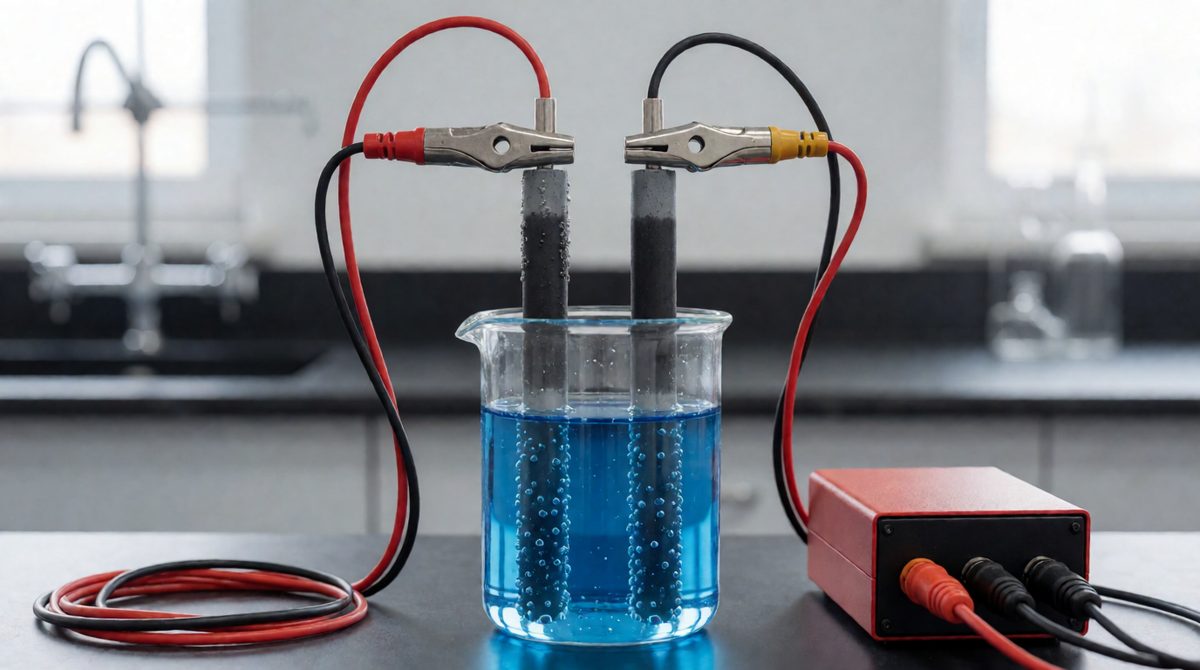
Switch on and the ions move: positive ions to the cathode, negative ions to the anode
To carry out electrolysis, two electrodes are dipped into the electrolyte and joined to a power supply. One electrode becomes negative and the other becomes positive. The ions then move.
Positively charged ions move to the negative electrode, the cathode.
Negatively charged ions move to the positive electrode, the anode.
Opposite charges attract. That is why each type of ion heads for the electrode with the opposite charge.
When the ions arrive, they are discharged. This means they are turned into the uncharged element. So electrolysis breaks an ionic compound down into its elements.
A good way to remember which is which: PANIC - Positive Anode, Negative Is Cathode.
The simplest case is a molten ionic compound. There is no water, so the only ions present are the two that make up the compound.
Lead bromide is a good example. It contains lead ions (positive) and bromide ions (negative). When lead bromide is melted and electrolysed using inert electrodes:
The overall reaction is: lead bromide → lead + bromine.
Inert means the electrodes do not react. They only carry the current. If they did react, they would get used up and the products would be confusing.
The metal is always produced at the cathode. The non-metal is always produced at the anode.
This makes sense. Metals form positive ions, so they go to the negative cathode. Non-metals form negative ions, so they go to the positive anode.
A solid ionic compound will not electrolyse, because its ions cannot move. The compound has to be melted first. This takes a lot of heat, because ionic compounds have high melting points.

Lead bromide makes toxic bromine, so it's electrolysed in a fume cupboard like this one
Bromine is a toxic, choking gas, and lead compounds are poisonous. This experiment must be done in a fume cupboard.
The spec says a safer alternative for practical work is anhydrous zinc chloride. Anhydrous means it contains no water.
You should be able to predict the products of the electrolysis of a binary ionic compound in the molten state. Binary means the compound contains just two elements, such as lead bromide or zinc chloride.
Follow these steps:
Predict the products when molten zinc chloride is electrolysed.
Zinc chloride contains zinc (a metal) and chlorine (a non-metal). Zinc ions are positive, so they move to the cathode and zinc is produced there. Chloride ions are negative, so they move to the anode and chlorine is produced there.
Predict the products when molten potassium iodide is electrolysed.
Potassium is a metal, so potassium forms at the cathode. Iodine is a non-metal, so iodine forms at the anode.
Notice the name change. The compound ends in -ide (bromide, chloride, iodide). The element made is named without the ending (bromine, chlorine, iodine).
1. Mixing up the electrodes. Remember that the cathode is negative, so it attracts positive ions.
2. Writing the products with the ending -ide. The product at the anode is bromine, not bromide.
3. Saying electrons or the solid compound carry the current inside the liquid. In the electrolyte it is the moving ions.
4. Saying the electrodes are used up. Inert electrodes do not react.
Molten lead bromide is electrolysed using inert electrodes. (a) Why must the lead bromide be molten? (b) Name the product formed at the cathode. (c) Name the product formed at the anode. (d) Explain why the product at the cathode is formed there. [5 marks]
(a) The ions must be free to move so they can carry the current. In solid lead bromide the ions are held in place. [1]
(b) Lead. [1]
(c) Bromine. [1]
(d) Lead ions are positively charged, so they are attracted to the negative electrode (the cathode), where they are discharged to form lead. [2]
If a question asks for a product, name the element (bromine), not the ion (bromide). Always say whether it forms at the cathode or the anode.