🔧 Apparatus
Beaker, two inert graphite rods (electrodes), a low voltage d.c. power supply, leads, two small test tubes to collect gas, the solution, and gas test materials.
Sign up to access the complete lesson and track your progress!
Unlock This CourseIn this required practical you investigate what happens when aqueous solutions are electrolysed using inert electrodes. It is an investigation, so you do not just follow instructions. You first make a hypothesis, then you test it.
The practical uses these skills: setting up and using an electrochemical cell, monitoring a reaction, and using gas tests to identify products.
Key terms:
A good hypothesis uses the rules you already know. Remember, at the cathode you get a metal if it is less reactive than hydrogen, but hydrogen if the metal is more reactive. At the anode you get a halogen if a halide ion is present, but oxygen if not.
Solution: copper(II) chloride, CuCl2(aq).
Cathode: copper is less reactive than hydrogen, so I predict copper metal.
Anode: chloride ions are present, so I predict chlorine gas.
Hypothesis: "When copper(II) chloride solution is electrolysed, copper will form at the cathode and chlorine at the anode, because copper is less reactive than hydrogen and the solution contains halide ions."
Notice the hypothesis names the products and gives the reason. A prediction with no reason is not a hypothesis.
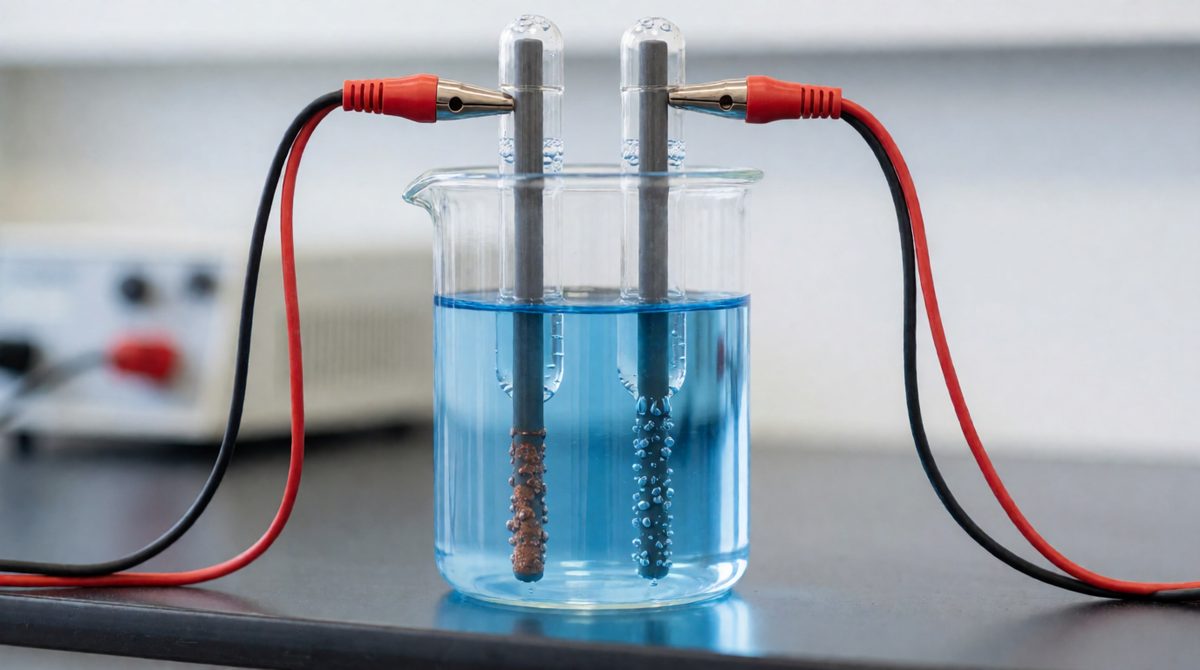
Inert graphite electrodes don't react, so whatever forms really came from the solution
Beaker, two inert graphite rods (electrodes), a low voltage d.c. power supply, leads, two small test tubes to collect gas, the solution, and gas test materials.
Graphite does not react with the solution or the products. So the products come only from the ions in the solution, not from the electrodes.
Method:
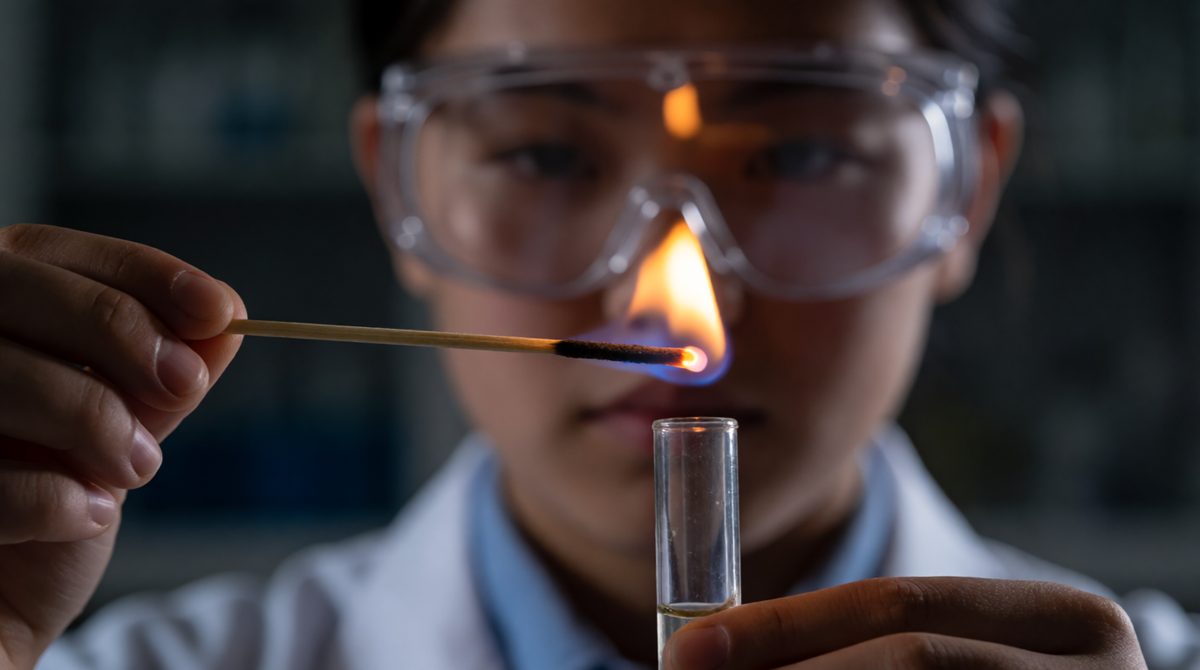
Squeaky pop! A lit splint at the mouth of the tube is the test for hydrogen gas
You must identify each product. Solids are seen on the electrode. Gases need a test.
| Gas | Test | Positive result |
|---|---|---|
| Hydrogen | Hold a lit splint at the mouth of the test tube | Squeaky pop |
| Oxygen | Put a glowing splint into the test tube | Splint relights |
| Chlorine | Hold damp blue litmus paper in the gas | Paper is bleached white |
Here are three solutions you could use, with the results you should find.
| Solution | At the cathode | At the anode |
|---|---|---|
| Copper(II) chloride | Brown-pink coating of copper | Bubbles of chlorine (pale green gas, bleaches litmus) |
| Sodium sulfate | Hydrogen (squeaky pop) | Oxygen (relights a glowing splint) |
| Magnesium chloride | Hydrogen (squeaky pop) | Chlorine (bleaches litmus) |
With sodium sulfate, sodium is more reactive than hydrogen, so hydrogen forms. There is no halide, so oxygen forms. With magnesium chloride, magnesium is more reactive than hydrogen, so hydrogen forms again, but the chloride ions give chlorine.
The solution used.
The product at each electrode and its test result.
Same electrodes, same voltage, same volume and concentration of solution, same time.
1. Using metal electrodes that react, such as copper. The electrode itself can take part, so you cannot tell where the product came from.
2. Testing for oxygen with a lit splint. Oxygen needs a glowing splint.
3. Saying chlorine "turns litmus red". It bleaches it, so say the paper ends up white.
4. Mixing up the terminals. The anode is connected to the positive terminal.
5. Writing a hypothesis with no reason.
6. Changing more than one variable, such as the solution and the voltage.
A student electrolyses sodium sulfate solution using graphite electrodes.
(a) Why are graphite electrodes used? (1 mark)
(b) Name the gas formed at the cathode and give a test for it. (2 marks)
(c) Name the gas formed at the anode and explain why this gas forms. (2 marks)
(a) Graphite is inert, so it does not react with the solution or the products.
(b) Hydrogen. A lit splint makes a squeaky pop.
(c) Oxygen. The solution has no halide ions, so hydroxide ions from the water are discharged to make oxygen.
For any gas test, give the test and the result together, for example "a glowing splint relights". Marks are lost for the result on its own.