− Cathode (negative)
Positive ions arrive. They gain electrons. This is reduction. Electrons are added, on the left.
This whole lesson is for Higher tier students. If you are sitting the Foundation paper, you do not need it.
Sign up to access the complete lesson and track your progress!
Unlock This CourseIn electrolysis, one change happens at each electrode. Remember, a half equation shows just one of these changes, with the electrons gained or lost. The electrons are written as e-. This lesson shows how to write them for the two electrodes.
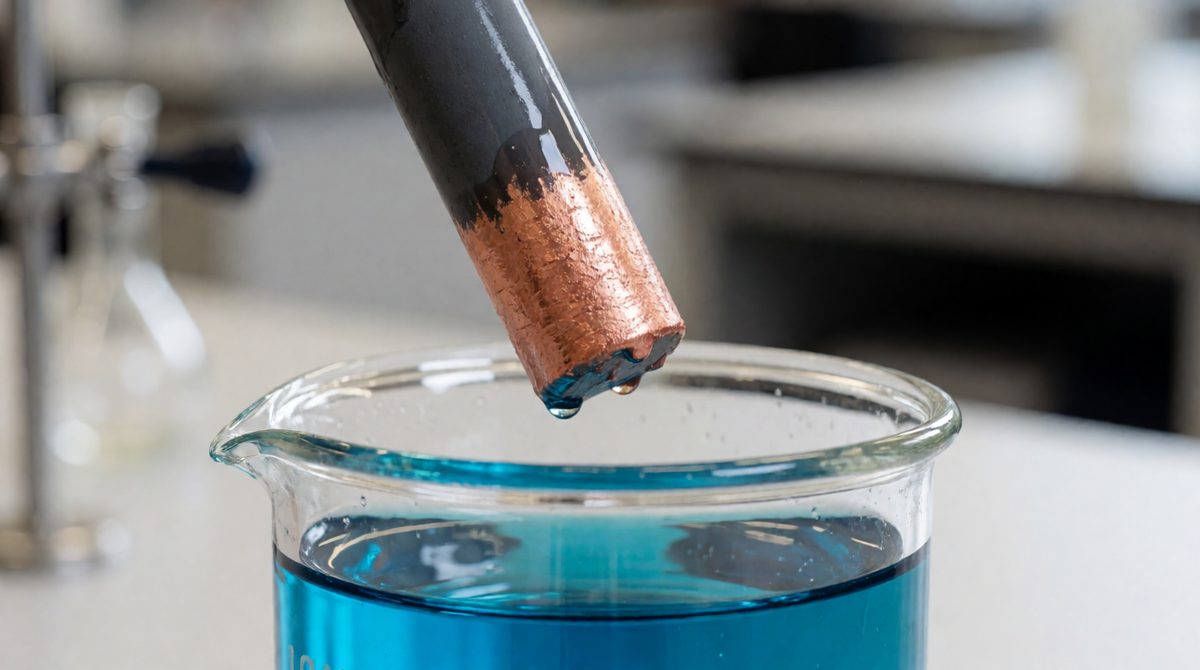
That copper coating grew by reduction at the cathode: Cu²⁺ + 2e⁻ → Cu
The cathode is the negative electrode. It attracts positive ions. When a positive ion reaches the cathode, it gains electrons. Gaining electrons is reduction, so the reaction at the cathode is always a reduction.
The electrons are added to the ion, so they are on the left of the arrow.
In molten sodium chloride, sodium ions move to the cathode.
Na+ + e- → Na
Each sodium ion gains one electron. The charge changes from +1 to 0, so this is reduction.
If the ion has a bigger charge, it gains more electrons. A 2+ ion gains two electrons.
Mg2+ + 2e- → Mg
The total charge on the left is (2+) + (2-) = 0. The charge on the right is 0. The charges match, so the equation is balanced.
Aluminium ions have a charge of 3+, so each gains three electrons at the cathode.
Al3+ + 3e- → Al
Charge on the left: (3+) + (3-) = 0. Charge on the right: 0. It is balanced.

At the anode chloride ions lose electrons - oxidation: 2Cl⁻ → Cl₂ + 2e⁻
The anode is the positive electrode. It attracts negative ions. When a negative ion reaches the anode, it loses electrons. Losing electrons is oxidation, so the reaction at the anode is always an oxidation.
The electrons are given away, so they are usually written on the right of the arrow.
In molten sodium chloride, chloride ions move to the anode. Chlorine is made as molecules, Cl2, so you need two chloride ions.
2Cl- → Cl2 + 2e-
Charge on the left: 2-. Charge on the right: 0 + 2- = 2-. It is balanced.
Positive ions arrive. They gain electrons. This is reduction. Electrons are added, on the left.
Negative ions arrive. They lose electrons. This is oxidation. Electrons are lost, usually on the right.
Oxide ions have a charge of 2-. Oxygen is made as O2, so you need two oxide ions, which carry a charge of 4-. Four electrons are lost.
2O2- → O2 + 4e-
Every half equation has to balance in two ways: the atoms and the charge. Follow these steps.
Step 1: Br- → Br2
Step 2: 2Br- → Br2
Step 3: The left has a charge of 2-. The right has 0. Add 2e- to the right.
2Br- → Br2 + 2e-
The electrons lost at the anode travel round the wires of the circuit to the cathode, where they are gained. So the number of electrons lost at the anode equals the number gained at the cathode.
In a solution, a tiny amount of the water breaks up into hydrogen ions and hydroxide ions. The spec gives a half equation for each.
At the cathode, hydrogen ions gain electrons and make hydrogen gas. This is reduction.
2H+ + 2e- → H2
At the anode, hydroxide ions lose electrons and make oxygen gas and water. This is oxidation.
4OH- → O2 + 2H2O + 4e-
The spec also shows this written as 4OH- - 4e- → O2 + 2H2O. It means the same thing: four electrons are lost.
Check the charge. On the left: 4 × (1-) = 4-. On the right: 0 + 0 + 4- = 4-. It balances.
Copper ions at the cathode gain two electrons each:
Cu2+ + 2e- → Cu
Hydroxide ions at the anode lose four electrons for each oxygen molecule made:
4OH- → O2 + 2H2O + 4e-
To compare the two, make the electrons equal. Doubling the copper half equation gives 2Cu2+ + 4e- → 2Cu. Now four electrons are gained and four are lost.
1. Putting the electrons on the wrong side. Electrons added (+ e- on the left) means reduction at the cathode. Electrons lost (+ e- on the right) means oxidation at the anode.
2. Forgetting that chlorine, bromine and hydrogen are molecules. Write Cl2, not Cl.
3. Balancing the atoms but not the charge. Always count the charge on both sides.
4. Writing the charge on the electron wrongly. Write 2e-, not e2-.
Molten magnesium bromide is electrolysed using inert electrodes.
(a) Write the half equation for the reaction at the cathode. (1 mark)
(b) Write the half equation for the reaction at the anode. (1 mark)
(c) Explain why the reaction at the anode is oxidation. (1 mark)
(a) Mg2+ + 2e- → Mg
(b) 2Br- → Br2 + 2e-
(c) Bromide ions lose electrons, and losing electrons is oxidation.
Check the charge on each side of your half equation before you move on. If the totals are different, you are missing electrons.