🍵 Polystyrene cup
Polystyrene is a good insulator. A cup stops heat escaping from an exothermic reaction, or entering during an endothermic one. This makes your temperature change closer to the true value.
Sign up to access the complete lesson and track your progress!
Unlock This CourseThis is required practical 4. You investigate the variables that affect temperature changes in reacting solutions. The spec gives these reaction types as examples: acid plus metals, acid plus carbonates, neutralisations and displacement of metals.
In each one you mix two things, stir, and watch the thermometer. A rise means the reaction is exothermic. A fall means it is endothermic. The practical is about measuring that change well, and finding out what makes it bigger or smaller.
Key terms:
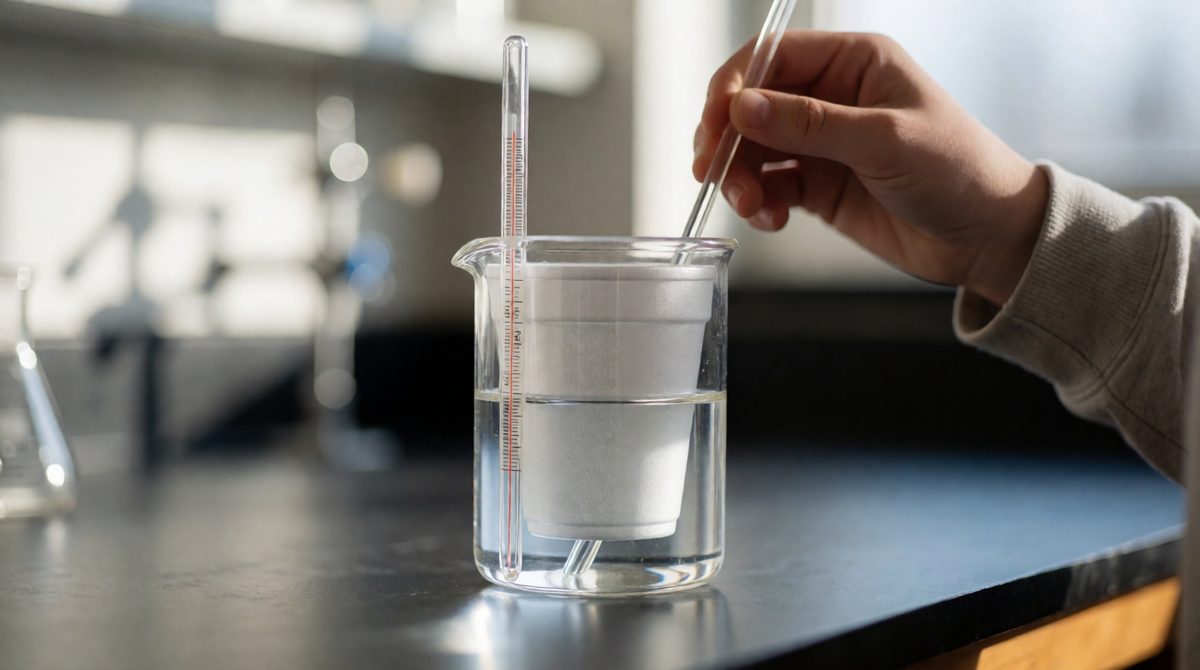
A polystyrene cup in a beaker, a thermometer and a stir - neutralisation warms the mixture, so watch for the highest reading
Here is a standard method for a neutralisation, using dilute hydrochloric acid and sodium hydroxide solution.
For acid plus a metal or carbonate, you add a measured mass of the solid (for example 1.0 g of magnesium ribbon) instead of the alkali. For displacement, you add a metal powder such as zinc to copper sulfate solution. In every version the steps are the same: measure the start temperature, mix, stir, record the highest temperature.
This links to the spec skills: measuring mass, temperature and volume accurately, and careful mixing of reagents under controlled conditions.
Polystyrene is a good insulator. A cup stops heat escaping from an exothermic reaction, or entering during an endothermic one. This makes your temperature change closer to the true value.
A lid (with a hole for the thermometer) cuts heat loss from the top and stops liquid splashing out. A lid is a simple improvement to the method.
Even with a cup, some heat is still lost. So the temperature rise you measure is usually a little smaller than it should be. Remember this when you evaluate your results.
You can only change one thing at a time, or the test is not fair. You choose which variable to investigate. Here are some options.
Start with a prediction, such as: the more zinc you add, the bigger the temperature rise, because more particles react and release more energy.
The dependent variable is always the temperature change. Everything else is a control variable and must stay the same. These are the starting temperature, the volumes, the concentrations, the mass of solid, the type of cup and how you stir.
For a metal, use the same surface area each time. Powder reacts faster than a lump, so mixing powder with ribbon would not be fair.
Draw a results table before you start. Include a column for the starting temperature, the highest temperature, the temperature change and each repeat.
Zinc powder is added to copper sulfate solution. Three repeats give starting temperatures of 21.0, 21.0 and 20.5 °C and highest temperatures of 27.5, 27.9 and 27.2 °C.
Temperature changes: 6.5, 6.9 and 6.7 °C.
Mean temperature change = (6.5 + 6.9 + 6.7) ÷ 3 = 20.1 ÷ 3 = 6.7 °C.
Work out the temperature change for each repeat first, then find the mean. Give your answer to a sensible number of significant figures, matching your thermometer readings. If one repeat is very different from the others, it is an anomaly. Check it and repeat it.
To show a pattern, plot a graph. Put the thing you changed (the independent variable) on the x-axis and the temperature change on the y-axis. If you added more and more zinc to the same copper sulfate solution, the temperature change rises and then levels off once all the copper sulfate has reacted. Draw a line of best fit. If the temperature change rises then levels off, draw two straight lines that meet where the temperature stops rising.
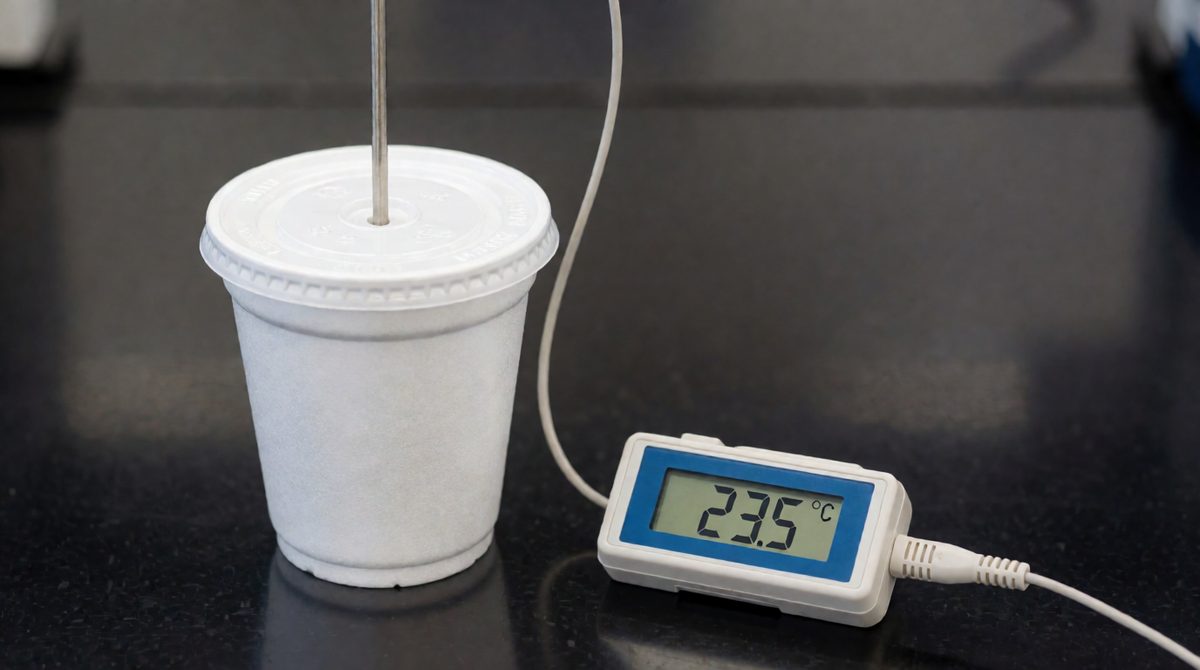
A digital temperature probe gives more precise readings than a glass thermometer - an easy upgrade to the method
The spec asks you to evaluate methods and suggest improvements. Common ideas are below.
Writing the highest temperature as the temperature change. You must subtract the starting temperature. Another mistake is changing two variables at once, such as using a different volume and a different concentration. A third is blaming 'human error'. Say exactly what happened, such as heat loss to the air.
A student adds 2.0 g of magnesium ribbon to 30 cm3 of dilute hydrochloric acid in a glass beaker. The temperature rises from 20.0 °C to 31.0 °C. The student repeats the experiment with 2.0 g of zinc powder and gets a rise of only 6.0 °C.
(a) Calculate the temperature change for magnesium. (b) Suggest two ways the student could improve the method. (c) Give two variables the student must control to compare the metals fairly. (d) Is the student's comparison fair? Explain your answer.
(a) 31.0 − 20.0 = 11.0 °C.
(b) Use a polystyrene cup with a lid to reduce heat loss. Repeat the experiment and calculate a mean.
(c) Any two of: volume of acid, concentration of acid, mass of metal, starting temperature, surface area of the metal.
(d) No. Magnesium was a ribbon and zinc was a powder, so the surface area was different. This is a control variable that was not kept the same.
For a method question, give the numbered steps in order and say what you measure and when. Always mention the starting temperature and the highest temperature.