✂ Breaking bonds
Energy must be supplied to break bonds in the reactants. This step takes energy in.
This whole lesson is for Higher tier students. Foundation tier students do not need it.
Sign up to access the complete lesson and track your progress!
Unlock This Course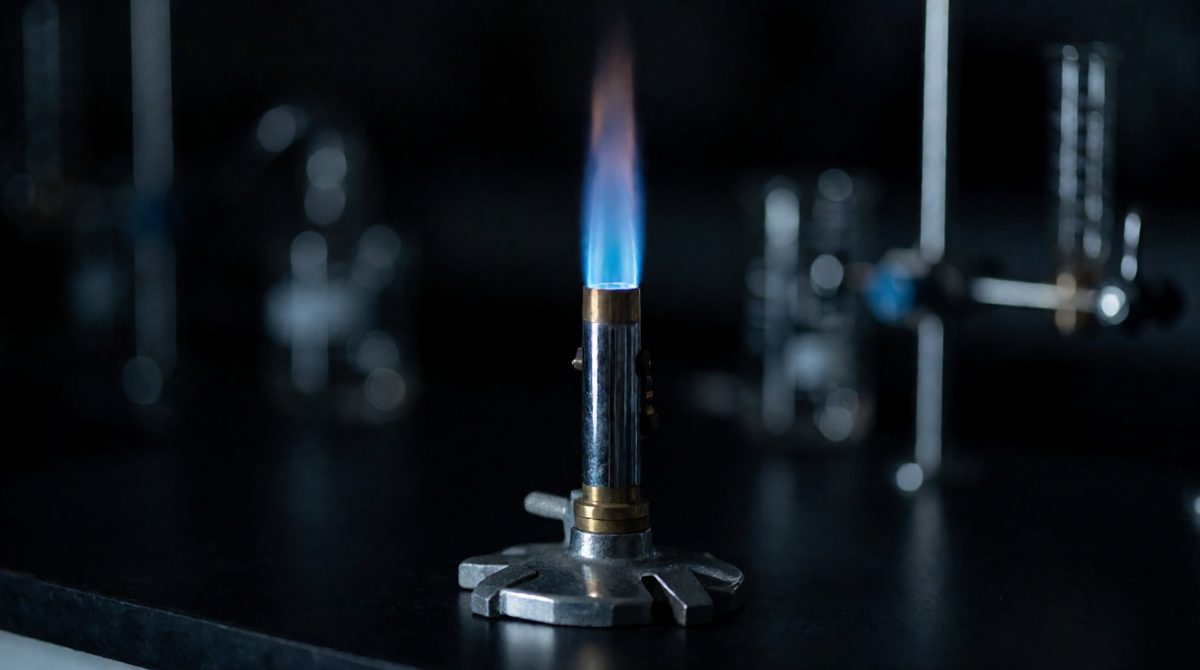
Burning gas: breaking bonds takes energy in, but making the new bonds in CO₂ and water gives out more
In every chemical reaction, the bonds in the reactants are broken and new bonds form in the products. Atoms get rearranged. Both steps involve energy, but in opposite directions.
Energy must be supplied to break bonds in the reactants. This step takes energy in.
Energy is released when bonds in the products are formed. This step gives energy out.
It helps to think of two magnets stuck together. You must put in effort to pull them apart. When they snap back together, energy is given out.
Key terms:
You will be given the bond energies in the exam. Follow these steps:
Remember to multiply a bond energy by the number of those bonds. Two molecules of HCl means two H–Cl bonds, so count them all.
Hydrogen reacts with chlorine: H–H + Cl–Cl → 2 H–Cl
Bond energies: H–H = 436, Cl–Cl = 242, H–Cl = 431 (all kJ/mol).
Energy to break bonds = 436 + 242 = 678 kJ/mol
Energy released making bonds = 2 × 431 = 862 kJ/mol
Overall energy change = 678 − 862 = −184 kJ/mol
Methane burns: CH4 + 2O2 → CO2 + 2H2O
Bond energies: C–H = 413, O=O = 498, C=O = 805, O–H = 464 (all kJ/mol).
Bonds broken: 4 C–H and 2 O=O = (4 × 413) + (2 × 498) = 1652 + 996 = 2648 kJ/mol
Bonds made: 2 C=O and 4 O–H = (2 × 805) + (4 × 464) = 1610 + 1856 = 3466 kJ/mol
Overall energy change = 2648 − 3466 = −818 kJ/mol

Fireworks are exothermic - far more energy is released making new bonds than it took to break the old ones
The sign of your answer tells you the type of reaction.
The energy released from forming new bonds is greater than the energy needed to break existing bonds. The overall energy change is negative.
The energy needed to break existing bonds is greater than the energy released from forming new bonds. The overall energy change is positive.
Both worked examples above are exothermic, because more energy was released making bonds than was taken in breaking them. Both answers were negative.
Now turn the first reaction round: 2 H–Cl → H–H + Cl–Cl. Breaking bonds takes 862 kJ/mol and making bonds releases 678 kJ/mol. The overall energy change is 862 − 678 = +184 kJ/mol. More energy goes in than comes out, so this reaction is endothermic.
1. Forgetting to multiply by the number of bonds, for example using one H–Cl bond instead of two.
2. Subtracting the wrong way round. It is always bonds broken minus bonds made.
3. Thinking breaking bonds gives out energy. It never does. Breaking bonds takes energy in.
4. Leaving out the sign or the units (kJ/mol).
Ammonia is made from nitrogen and hydrogen: N≡N + 3 H–H → 2 NH3, where each NH3 has three N–H bonds. The bond energies are N≡N = 945, H–H = 436 and N–H = 391 kJ/mol. Calculate the overall energy change and say whether the reaction is exothermic or endothermic.
Energy to break bonds = 945 + (3 × 436) = 945 + 1308 = 2253 kJ/mol
Energy released making bonds = 6 × 391 = 2346 kJ/mol
Overall energy change = 2253 − 2346 = −93 kJ/mol
The reaction is exothermic, because more energy is released making bonds than is needed to break bonds.
Draw a quick sketch of each molecule so you can see every bond. Then count the bonds before you multiply.