✅ Isotopes
Same bottom number (atomic number), different top number (mass number). For example 126C and 136C.
Sign up to access the complete lesson and track your progress!
Unlock This CourseEvery atom of an element has the same number of protons. That is what makes it that element. But the number of neutrons can change.
Atoms of the same element can have different numbers of neutrons. These atoms are called isotopes of that element.
Because isotopes have the same number of protons but different numbers of neutrons, they have the same atomic number but a different mass number.
Key terms:

Archaeologists date ancient bones like these using carbon-14, an isotope with 6 protons but 8 neutrons
Hydrogen has three isotopes. All of them have 1 proton, so all of them are hydrogen. They just have different numbers of neutrons.
11H
1 proton, 0 neutrons. This is by far the most common.
21H
1 proton, 1 neutron. Also called deuterium.
31H
1 proton, 2 neutrons. Also called tritium.
Carbon is the same. Carbon-12, carbon-13 and carbon-14 all have 6 protons. They have 6, 7 and 8 neutrons.
The name tells you the mass number. "Carbon-14" means the mass number is 14. You can then use the atomic number to find the neutrons, as you did in Protons, Neutrons and Electrons.
Same bottom number (atomic number), different top number (mass number). For example 126C and 136C.
Different bottom numbers mean different elements, even if the top numbers match. 146C and 147N are different elements, not isotopes.
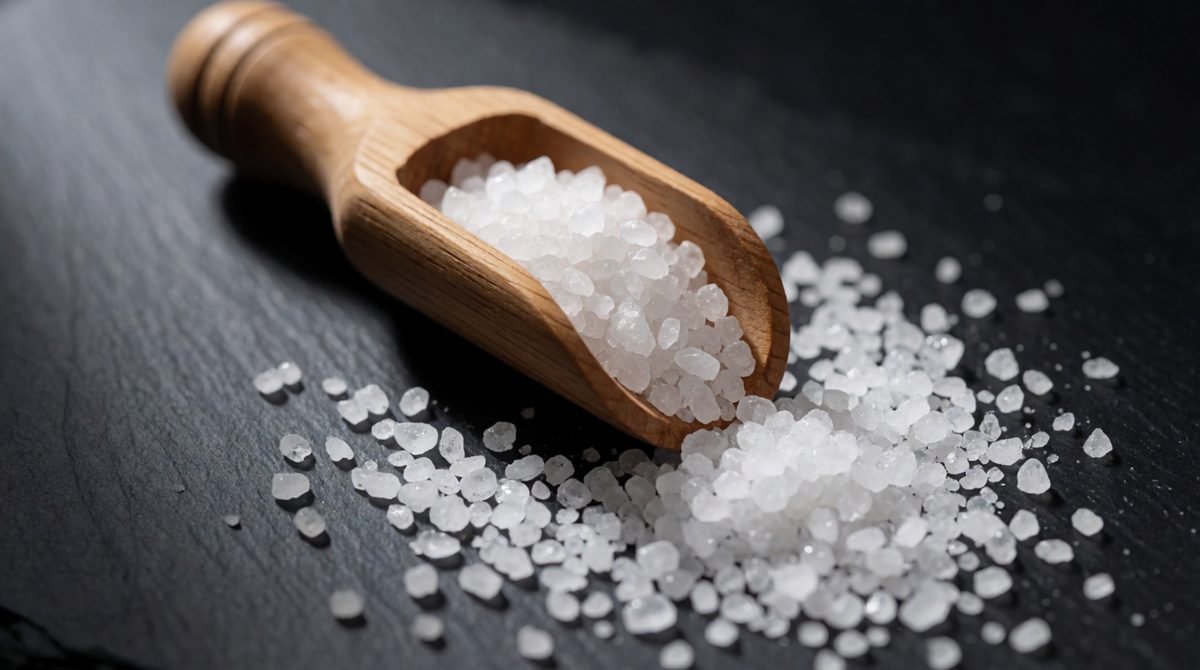
The chlorine atoms in this salt are a mix of chlorine-35 and chlorine-37, which is why chlorine's relative atomic mass is 35.5, not a whole number
A real sample of an element is a mix of its isotopes. Each isotope has a different mass, and some are much more common than others.
So chemists use the relative atomic mass. It is an average value that takes account of the abundance of each isotope. Common isotopes count for more in the average. Rare ones count for less.
This is why some relative atomic masses on the periodic table are not whole numbers. Chlorine is shown as 35.5. No single chlorine atom has a mass of 35.5. It is the average of a mix of chlorine-35 and chlorine-37 atoms.
Relative atomic mass has no units, because it compares masses with each other.
To calculate the relative atomic mass from percentage abundances:
As a formula:
Ar = (mass 1 × % 1 + mass 2 × % 2 + ...) ÷ 100
Chlorine is 75% chlorine-35 and 25% chlorine-37. Calculate its relative atomic mass.
35 × 75 = 2625
37 × 25 = 925
2625 + 925 = 3550
3550 ÷ 100 = 35.5
Check: the answer is closer to 35 than to 37, because chlorine-35 is three times as common. That makes sense.
Boron is 20% boron-10 and 80% boron-11. Calculate its relative atomic mass.
10 × 20 = 200
11 × 80 = 880
200 + 880 = 1080
1080 ÷ 100 = 10.8
Magnesium is 79% magnesium-24, 10% magnesium-25 and 11% magnesium-26. Calculate its relative atomic mass to 1 decimal place.
24 × 79 = 1896
25 × 10 = 250
26 × 11 = 286
1896 + 250 + 286 = 2432
2432 ÷ 100 = 24.32 = 24.3 (1 d.p.)
The method is the same however many isotopes there are. Just add one more line for each one.
Lithium has two isotopes, lithium-6 and lithium-7. 92.5% of lithium atoms are lithium-7. Calculate the relative atomic mass to 1 decimal place.
The abundances must add up to 100%, so lithium-6 is 100 − 92.5 = 7.5%.
6 × 7.5 = 45
7 × 92.5 = 647.5
45 + 647.5 = 692.5
692.5 ÷ 100 = 6.925 = 6.9 (1 d.p.)
Your answer must always sit between the smallest and largest mass numbers. With two isotopes, it will also be closest to the mass of the more abundant isotope. If lithium came out as 6.2, you would know something had gone wrong, because nearly all lithium atoms are lithium-7.
If two isotopes were equally common (50% each), the relative atomic mass would be exactly halfway between their mass numbers.
Taking a simple average. For chlorine, (35 + 37) ÷ 2 = 36 is wrong. You must use the abundances, because there is much more chlorine-35.
Forgetting to divide by 100. An answer of 3550 for chlorine is clearly not an atomic mass. Always check your answer is sensible.
Saying isotopes have different numbers of protons. If the protons change, it is a different element. Only the neutrons change.
Mixing up mass number and relative atomic mass. Mass number belongs to one atom and is always a whole number. Relative atomic mass is an average for the element.
Adding units. Relative atomic mass has no units, so do not write g.
Bromine has two isotopes, 7935Br and 8135Br.
(a) What is meant by the term isotopes? [1 mark]
(b) How is an atom of 8135Br different from an atom of 7935Br? [1 mark]
(c) A sample of bromine is 51% bromine-79 and 49% bromine-81. Calculate the relative atomic mass of bromine. Give your answer to 1 decimal place. [2 marks]
(a) Atoms of the same element with the same number of protons but different numbers of neutrons. (1)
(b) It has two more neutrons. (1)
(c) (79 × 51) + (81 × 49) = 4029 + 3969 = 7998 (1)
7998 ÷ 100 = 79.98 = 80.0 (1)
Always show your working in calculations. If you make a slip with the numbers, you can still get a mark for the correct method.