⛽ What goes in
Hydrogen from a tank, and oxygen from the air. They are fed in all the time, so the cell does not go flat.
Sign up to access the complete lesson and track your progress!
Unlock This CourseIn the last lesson you met cells and batteries. A normal cell has its chemicals sealed inside. When they are used up, the cell is flat. A fuel cell works differently. It is supplied with its chemicals from outside, all the time. As long as you keep feeding it, it keeps making electricity.
A fuel cell is supplied by an external source of fuel and with oxygen or air. The most common fuel is hydrogen. Inside the cell, the fuel is oxidised electrochemically. This means the hydrogen reacts with oxygen without burning. Instead of giving out heat and light like a flame, the reaction produces a potential difference (voltage). That voltage can push a current round a circuit.
Key terms:
Hydrogen in, oxygen in, electricity out - and the only product of a hydrogen fuel cell is water
In a hydrogen fuel cell, hydrogen goes in on one side and oxygen (or air) goes in on the other. The reaction happens at two electrodes, and the electricity flows through the wire joining them.
Hydrogen from a tank, and oxygen from the air. They are fed in all the time, so the cell does not go flat.
Water. This is the only chemical product, plus the electrical energy the cell produces.
The overall reaction involves the oxidation of hydrogen to produce water:
2H2 + O2 → 2H2O
This is the same overall equation as burning hydrogen. The difference is how the energy comes out. Burning gives heat. A fuel cell gives most of its energy as electricity.
You need to write the half equations for the electrode reactions in the hydrogen fuel cell.
At the negative electrode, hydrogen is oxidised. It loses electrons:
H2 → 2H+ + 2e-
At the positive electrode, oxygen is reduced. It gains electrons and reacts with hydrogen ions to make water:
O2 + 4H+ + 4e- → 2H2O
The electrons travel through the external wire, and that flow of electrons is the current. To balance the electrons, double the first equation:
2H2 → 4H+ + 4e-
Add the two half equations and the electrons and hydrogen ions cancel. You are left with 2H2 + O2 → 2H2O.
Remember, oxidation is loss of electrons and reduction is gain of electrons. Hydrogen loses electrons, so it is oxidised.

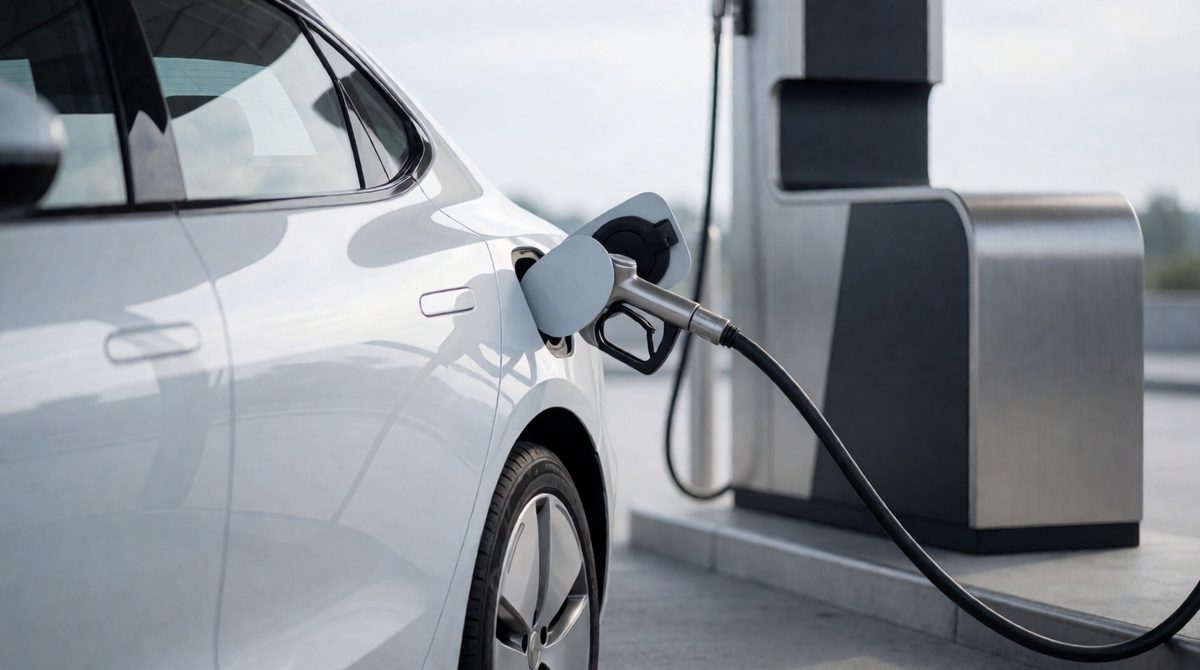
Hydrogen buses only puff out water vapour, but storing hydrogen gas safely is still tricky
Hydrogen fuel cells offer a potential alternative to rechargeable cells and batteries. You need to be able to evaluate them. This means giving points for and against, then reaching a conclusion.
The only product is water, so no polluting gases come out of the vehicle. They do not need recharging from the mains. You just refill the hydrogen, which is quick. They keep working as long as fuel is supplied.
Hydrogen is a gas that is hard to store, because it takes up a lot of space and is flammable. There are few places to refill it. Hydrogen has to be made first, and making it can use energy and fossil fuels.
You can charge them at home from the mains. They are small, easy to carry and widely used. No gas storage is needed.
They take time to recharge. They eventually wear out and must be disposed of. Making them uses up resources, and the electricity used to charge them may come from fossil fuels.
Do not say a fuel cell makes "no pollution at all". The cell itself only makes water, but the hydrogen may have been made using energy from fossil fuels. Also, you do not recharge a fuel cell. You refuel it.
A car company is deciding whether to use a hydrogen fuel cell or a rechargeable battery to power a car. Evaluate the use of a hydrogen fuel cell compared with a rechargeable battery. (4 marks)
A hydrogen fuel cell only produces water as a product, so there is no pollution from the car itself. It can be refuelled quickly with hydrogen and does not need to be plugged in and recharged for a long time. However, hydrogen is difficult to store because it is a flammable gas, and there are few places to refuel. A rechargeable battery can be charged at home and is easy to use, but it takes longer to recharge and wears out over time. Overall, the fuel cell is better for quick refuelling and clean exhaust, but the battery is more convenient at the moment because it is easier to recharge.
For "evaluate" questions, give at least one point for and one against each option, then finish with a clear conclusion.