🔧 Why a gas syringe?
It gives an accurate volume reading at any moment. An upturned measuring cylinder in water can also be used, but it is less accurate.
Sign up to access the complete lesson and track your progress!
Unlock This CourseIn this required practical you investigate how changing the concentration of a reactant changes the rate of a reaction. The spec asks you to use two different methods: one that measures the volume of a gas produced, and one that uses a change in colour or turbidity. You should also develop a hypothesis before you start.
A good hypothesis says what you expect and why. For example: "As the concentration of the acid increases, the rate of reaction will increase, because there are more acid particles in the same volume." Here the job is to test it properly.
Key terms:
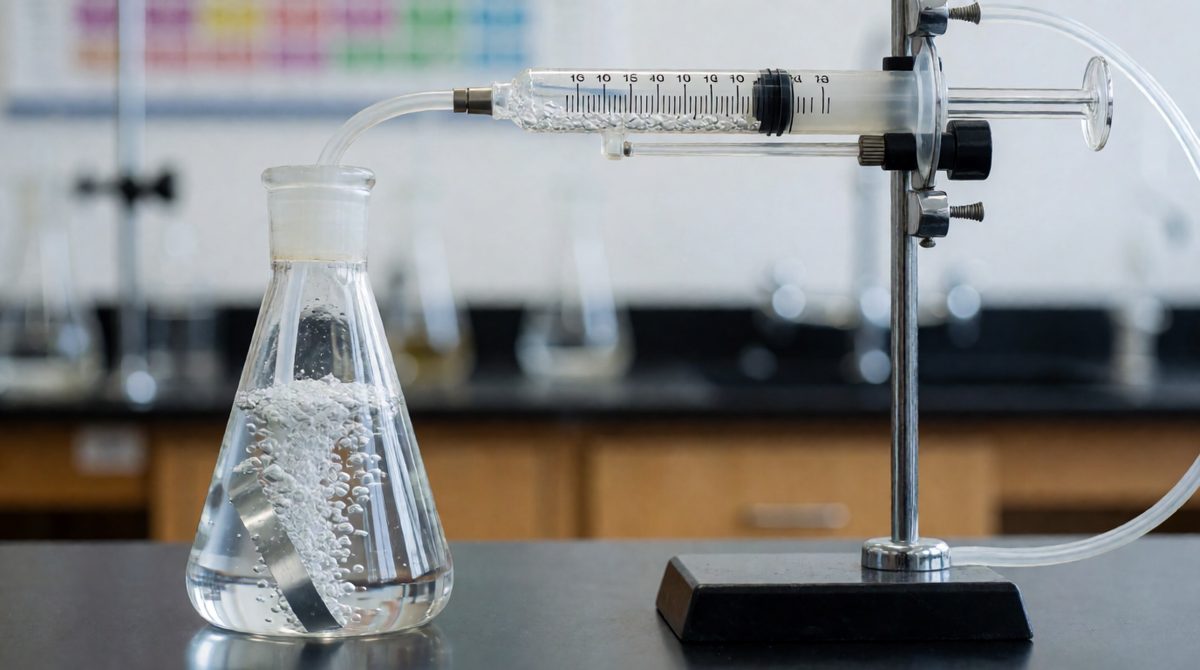
Magnesium + hydrochloric acid makes hydrogen - stronger acid fills the gas syringe faster
A good reaction to use is magnesium ribbon with dilute hydrochloric acid, which makes hydrogen gas: Mg + 2HCl → MgCl2 + H2.
1. Measure 50 cm3 of the lowest concentration of acid with a measuring cylinder and pour it into a conical flask.
2. Set up the gas syringe and connect it to the flask with a bung and delivery tube. Check that the plunger moves freely.
3. Drop in a piece of magnesium ribbon of a fixed length, put the bung in straight away and start the stopwatch.
4. Read the volume of gas in the syringe at regular intervals, for example every 10 seconds, for 2 minutes. Record the results in a table.
5. Repeat with the other concentrations of acid, using a new piece of magnesium each time.
6. Repeat each concentration at least twice more so you can work out a mean.
Plot volume of gas (cm3) against time (s) for each concentration. The steeper line shows the faster reaction. To compare rates fairly, you can work out the mean rate, as shown in Measuring and Calculating Rates. Higher tier students can also use the gradient of a tangent.
It gives an accurate volume reading at any moment. An upturned measuring cylinder in water can also be used, but it is less accurate.
The reaction starts as soon as the metal touches the acid. Put the bung in quickly, or some gas escapes before you start measuring.
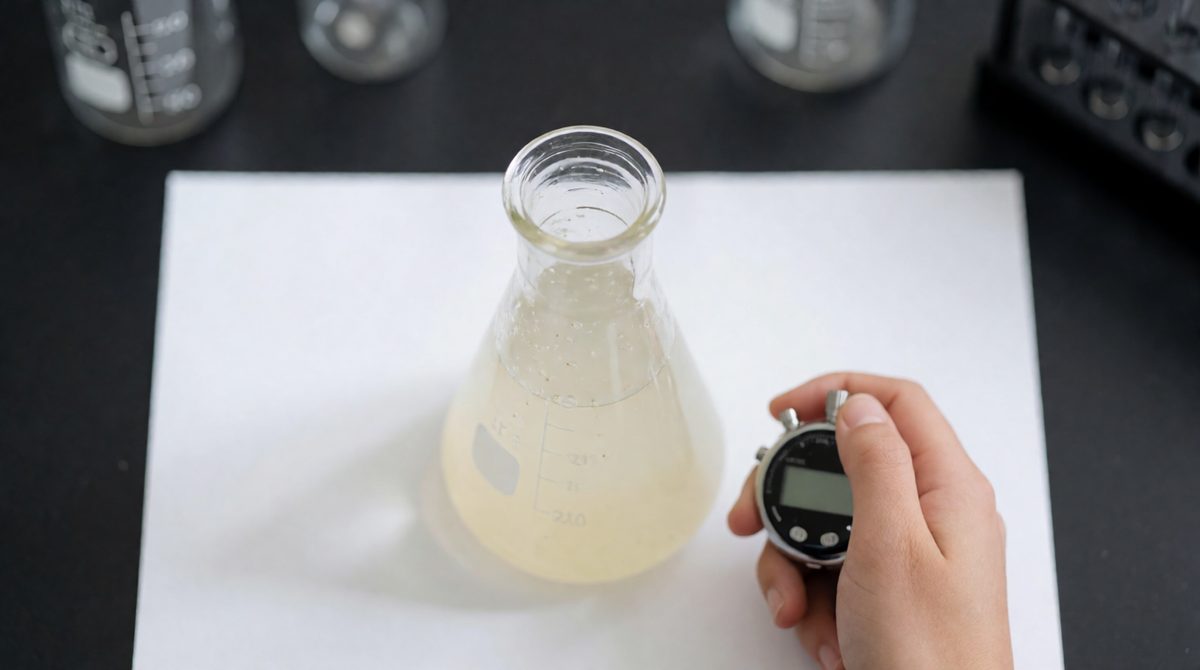
As yellow sulfur forms the mixture turns cloudy - stop the clock when you can't see the cross any more
This method uses a reaction that makes a solid and turns a clear solution cloudy. Sodium thiosulfate solution reacts with hydrochloric acid and forms a pale yellow precipitate of sulfur:
Na2S2O3(aq) + 2HCl(aq) → 2NaCl(aq) + SO2(g) + S(s) + H2O(l)
1. Draw a black cross on a piece of paper and put a conical flask on top of it.
2. Measure 10 cm3 of sodium thiosulfate solution into the flask. Add water to make the volume 50 cm3, so the solution is a known concentration.
3. Measure 10 cm3 of dilute hydrochloric acid in a small measuring cylinder.
4. Add the acid to the flask, swirl once and start the stopwatch at the same moment.
5. Look down from above through the solution. Stop the stopwatch when the cross can no longer be seen. Record the time.
6. Repeat with 20, 30, 40 and 50 cm3 of thiosulfate solution, always topping up with water to 50 cm3 before the acid goes in.
7. Repeat each one and calculate a mean time.
The higher the concentration of thiosulfate, the shorter the time for the cross to disappear. A shorter time means a faster rate. The same person should always judge when the cross vanishes, because different people judge it differently.
This method measures a change in turbidity. Other reactions give a colour change that can be timed in the same way.
Here is how the three types of variable apply to this practical.
The concentration of the reactant you change (the acid, or the thiosulfate solution).
The volume of gas made over time, or the time for the cross to disappear.
Temperature, total volume of liquid, length and mass of magnesium, volume and concentration of the other reactant, same flask and same cross.
Temperature matters because a warmer solution reacts faster. If it changes between runs, you cannot tell whether concentration or temperature caused the difference.
For the gas method, draw one line graph with a curve for each concentration. The higher concentration gives a steeper curve at the start. Compare the steepness of the curves to compare the rates (Higher tier: use the gradient of a tangent). For the cross method, plot concentration on the x-axis and time on the y-axis, or work out 1 ÷ time for each run, which is proportional to the rate.
Your conclusion should go back to the hypothesis. State whether the results support it and use the data, for example: "When the concentration doubled, the time halved, so the rate doubled."
A student records these mean times for the cross to disappear.
Thiosulfate 10 cm3: 120 s
Thiosulfate 20 cm3: 60 s
Thiosulfate 40 cm3: 30 s
Each time the volume of thiosulfate doubles, the concentration doubles (the thiosulfate and water always make 50 cm3) and the time halves. The rate is twice as fast each time. This supports the hypothesis that a higher concentration gives a faster rate.
Forgetting to keep the total volume the same in the cross method: if you add more thiosulfate without topping up with water, you change two things at once. Writing "the same amount of acid" when you mean the same volume and concentration. Saying "the temperature will be a control" without saying how you will keep it the same. Starting the stopwatch late or stopping it at different points of cloudiness.
A student reacts sodium thiosulfate solution with dilute hydrochloric acid. The solution turns cloudy and the student times how long it takes for a cross under the flask to disappear. The student uses four different concentrations of sodium thiosulfate. Each time the thiosulfate and water make 50 cm3 before the acid is added.
(a) Name the independent variable. (1 mark)
(b) Give two control variables. (2 marks)
(c) Explain why the solution turns cloudy. (1 mark)
(d) The time for the cross to disappear was 40 s at the highest concentration and 160 s at the lowest. What does this tell you about the effect of concentration? (2 marks)
(a) The concentration of sodium thiosulfate solution.
(b) Any two from: the temperature, the volume (and concentration) of hydrochloric acid, the total volume of liquid (thiosulfate, water and acid), the same flask and cross.
(c) A solid (sulfur) is formed, which makes the solution turbid.
(d) The higher the concentration, the shorter the time, so the rate of reaction is faster at a higher concentration.
In a "describe the method" question, always mention how you will measure the dependent variable and which two or three variables you will keep the same.